DOOH Advertising Platforms Compared for Small Business
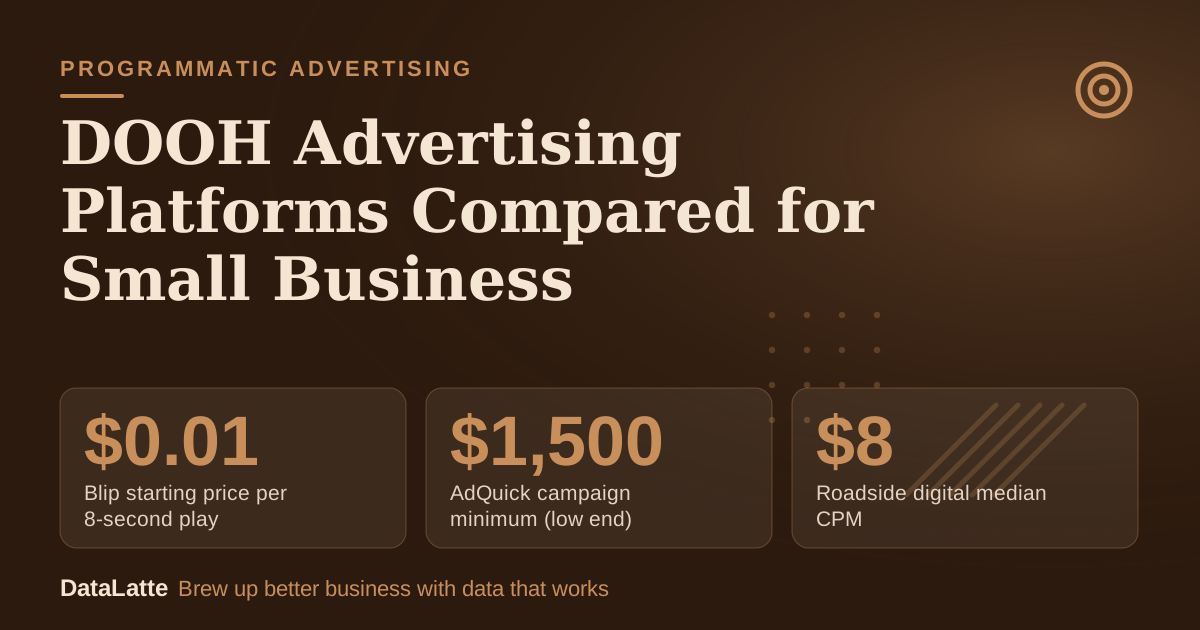
Blip starting price per 8-second play
Blip pricing page (vendor-stated)
AdQuick campaign minimum (low end)
AdQuick small-business page (vendor-stated), range $1,500 to $3,000
Roadside digital median CPM
AdQuick marketplace transactions, July 2025 to June 2026
Low end of typical programmatic minimum
AdQuick cost page (vendor-stated), range $10,000 to $50,000
See Sources at the end of the article. Cards marked Assumption are examples, not results.
What are the three ways to buy digital out-of-home screens?
How do the DOOH platforms compare side by side?
| Platform | How buying works | Minimum spend | Pricing basis | Suits, as stated in the source |
|---|---|---|---|---|
| Blip | Self-serve marketplace: pick locations, set budget and schedule, upload artwork, get approved | No required minimum, no contract (Blip's own page) | From $0.01 per 8-second play; varies by location, time of day, demand | Businesses of all sizes running short bursts or tests (Blip) |
| AdQuick | Marketplace plus programmatic buying; real-time availability and pricing; 1 million+ screens, 1,700+ publishers (AdQuick's own page) | $1,500 to $3,000 per campaign, no long-term contracts (AdQuick's own page) | CPM or flat monthly rates | Small businesses wanting straightforward DOOH buying with transparent local pricing (AdQuick) |
| Adomni | Self-service and managed-service options; DOOH, connected TV and online video | Not stated on its homepage; AdQuick's page calls its minimums low (secondary) | Not stated | DOOH-only campaigns as a first step; zip code and radius targeting (AdQuick's page, secondary) |
| Vistar Media | DSP, SSP and ad server; programmatic and traditional OOH; contact-based onboarding | Not stated on its homepage; AdQuick's page says around $1,500 (secondary) | Not stated | Audience-segment targeting using mobility and visitation data (AdQuick's page, secondary) |
| Take 10 Media | Self-serve ad portal for convenience-store and ATM screens | "No high minimums" (its own blog); figure not stated | Pay-as-you-go; figure not stated | Neighborhood-focused brands choosing screens by ZIP code (its own blog) |
| StackAdapt | Multi-channel DSP covering DOOH, native, display, connected TV, audio | "Higher monthly minimum"; figure not stated (AdQuick's page, secondary) | Not stated | Mid-market advertisers or agencies running DOOH as one channel among several (AdQuick's page, secondary) |
| Managed or direct buy | Planner or agency negotiates placements | Below $10,000 for local direct (AdQuick); $10,000 to $25,000+ for traditional managed (Take 10 Media's comparison) | Flat monthly rates or CPM | Advertisers who want execution handled for them (AdQuick, secondary) |
What do the cost numbers mean for a small budget?
Which option fits which budget and goal?
- A budget below any platform minimum, or a wish to test for a few dollars a day: Blip states no required minimum and no contract, and says a test can start with a few dollars per day in one market.
- One campaign of about $1,500 to $3,000: AdQuick states this range as its own minimum, and its page lists Adomni and Vistar Media at similar entry points (secondary). Ask Adomni and Vistar directly.
- A neighborhood goal, such as getting people near the shop through the door: screen-level or ZIP-level selection matters more than raw reach. Take 10 Media says highway boards offer short dwell times of 3 to 5 seconds and little geographic precision. That is a competitor-style argument from a vendor that sells retail screens, so weigh it accordingly.
- Several locations needing tight geographic control: AdQuick's page points to Simpli.fi and Vistar Media (secondary).
- DOOH as one channel among several, with budgets above $10,000 a month: AdQuick's page positions StackAdapt here (secondary). The CTV and DOOH omnichannel guide covers how the channels fit together.
- A wish to hand off the work: managed options exist at Adomni and Vistar, but pricing is not stated in the sources.
What does a worked coffee shop test look like?
- Impressions: $1,500 divided by $8, times 1,000, equals 187,500 delivered impressions.
- Break-even visits: $1,500 divided by $4.50 equals about 334 visits.
- Per week: 334 divided by 4 is about 84 extra visits a week, or roughly 12 a day.
- Required response: 334 divided by 187,500 is about 0.18% of impressions turning into a tracked visit.
What does a 4-week first-test checklist look like?
Week 1: set the goal and collect quotes
- Write one goal in a sentence, such as "new customers within a short drive of the shop."
- Pick one market or radius.
- Request current pricing and minimums from two or three platforms in the table, and save the answers.
- Decide the tracked action: a QR code, an offer code, or a "mention this screen" prompt.
Week 2: build and submit creative
- Keep the design simple and readable. Blip advises artwork that is easy to read and stands out.
- Take 10 Media recommends silent-first video, bold typography and a clear QR code for busy retail environments (secondary).
- Submit for approval. Blip says designs are reviewed with its sign partners. Take 10 Media says review takes under 24 to 48 hours (vendor-stated).
- Confirm the schedule and daily budget cap.
Week 3: launch and watch
- Check the dashboard for plays or impressions, spend and location mix.
- Log the tracked actions daily against the break-even number from the worked example.
- Change only one variable at a time, such as location or time of day.
Week 4: decide
- Compare tracked visits to break-even.
- Keep, adjust or stop. The sources say pay-as-you-go setups let advertisers pause and adjust, so stopping should not carry a penalty.
- Read the guide to measuring ads in local business for measurement ideas that carry over.
FAQ
What is the cheapest way to try digital billboards?
Is a $1,500 budget enough to learn something?
Will platform prices change?
Should a small business use a managed service instead?
Sources
- Blip: Digital Billboard Pricing (secondary, vendor page)
- Blip: How It Works (secondary, vendor page)
- AdQuick: How much does DOOH advertising cost? (secondary, vendor page)
- AdQuick: Best affordable programmatic DOOH platform for small businesses (secondary, vendor page)
- Take 10 Media: Programmatic DOOH Trends in 2026 (secondary, vendor blog)
- Adomni: Self-service DOOH and video advertising marketplace (secondary, vendor page)
- Vistar Media: Out of Home Advertising (secondary, vendor page)
Free for local businesses
Want this applied to your business?
I'll review your Google presence, local SEO, and ad accounts — and send you a specific action plan within 48 hours. No pitch, no pressure.
Want hands-on help?
See how DataLatte handles CTV Advertising for local businesses.

Local marketing strategist with 10+ years at global agencies — OMD, Dentsu, GroupM, and BBDO. Now helping small businesses get the same data-driven edge. Based in Europe, working with clients in the US, UK, Australia, and beyond.
Related articles
CTV + DOOH Strategy for Local Business: Full Playbook
7 min read
TV Advertising for Pizzerias and Local Restaurants
9 min read
Podcast Advertising for Coffee Shops
10 min read
Netflix Ads for Small Business: Can You Buy Them?
8 min readWant this applied to your business?
Let's review your current marketing setup together — free, no obligations.
Get Your Free Marketing Audit