DataLatte☕
Google Ads

Google Ads for Solar Companies in 2026
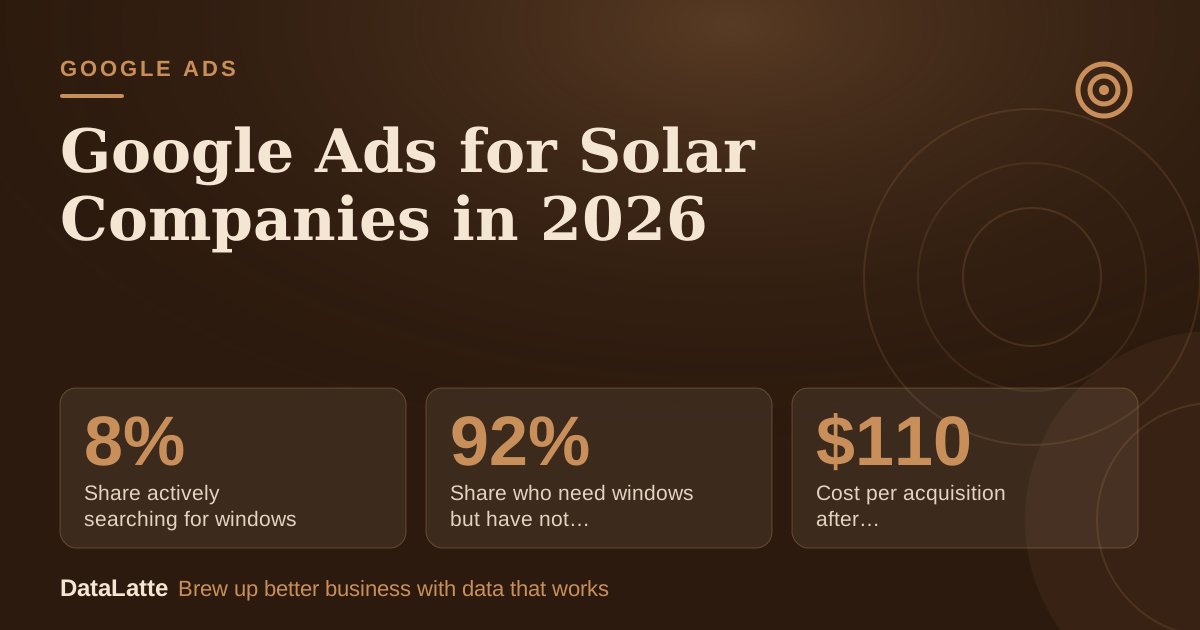
Infographic: Google Ads for Solar Companies in 2026

Part of the guide: Google Ads

May 21, 2026·Nataliia Rumiantsewa· 9 min read All posts
Judge Google Ads for a solar company by cost per held appointment, not cost per click. This guide does not quote a solar-specific cost benchmark, so the figures below are either cited from other industries or labelled as assumptions you should replace with your own data. Solar ads that mention a federal credit need current IRS guidance, and financing copy can trigger disclosure rules. The sections cover copy, audience, a worked calculation and a checklist for your next test.
8%→

Share actively searching for windows

Vendor claim for Google search in window replacement (secondary)

92%→

Share who need windows but have not started searching

Same vendor: reached through social rather than search (secondary)

Assumption
35-65→

Homeowner age in Google's example audience

Google's example for a home improvement business

$110↓

Cost per acquisition after lookalike audiences

One agency's client result, not a solar benchmark (secondary)

See Sources at the end of the article. Cards marked Assumption are examples, not results.

What do tax-credit rules change in solar ad copy?

A window-replacement vendor cites the IRS as saying that the Energy Efficient Home Improvement Credit under section 25C does not apply to property placed in service after December 31, 2025 (Netembark, secondary). That is a different section from the residential solar credit, so do not copy that date into solar copy. Check the IRS's current residential energy guidance directly before writing any credit claim.
Financing copy carries its own rules. The same vendor page says that under Regulation Z §1026.24, terms such as a payment amount, number of payments, repayment period or down payment trigger additional disclosures, including the APR. If a solar ad quotes a monthly payment or a deposit, check those disclosure obligations with a compliance adviser before launch.
The practical rule is simple. Remove any headline that promises a percentage back unless a current official source supports it and a tax adviser has checked it.

Who should solar ads target?

Google's small business guide gives a home improvement example in which the target audience is local homeowners between 35 and 65 years old (Google). That is an illustration of audience thinking, not a rule for solar.
A construction marketing vendor suggests age targeting of 30 to 55 for homeowners (Ruban KT, secondary). Test both ranges in separate ad groups and compare cost per held appointment, not clicks, before committing to one. The same logic applies to window companies, which also sell a large ticket to homeowners.
A window-replacement vendor states that Google captures about 8% of homeowners actively searching for windows, while about 92% need windows but have not started looking, and it suggests Facebook for that second group (Home Service Direct, secondary). Treat that split as one vendor's view, not a measured market share.
Solar will likely differ, so measure it. Compare the leads that come from search with the leads your sales team hears about from other sources. Geo-fencing is one non-search option. One vendor says a geo-fenced user can receive targeted messages for 30 days after entering the area (West Coast Media, secondary). Check the platform's rules and local privacy law before using it.
Fence companies face a similar high-ticket homeowner funnel, so their Google Ads approach can serve as a comparison point.

What does cost per held appointment look like?

No solar-specific cost per click is quoted here. The table uses illustrative inputs so you can see how each filter compounds. Every figure in the input column is an assumption, not a benchmark. Replace each one with your own account data.
StepInput (assumption)Result
Monthly budget$5,000$5,000
Average CPC$15333 clicks
Click to lead rate6%20 leads
Cost per lead$250
Leads that qualify (own the home, suitable roof)40%8 qualified
Qualified leads whose appointment is held75%6 held
Cost per held appointmentabout $833
Held appointments that sign20%about 1.2 sales
Cost per saleabout $4,167
Qualification and show rate together multiply the lead cost by about 3.3, because 40% times 75% is 30%, and $250 divided by 0.3 is about $833. Two filters move the final number more than a cheaper click does.
Whether $4,167 per sale works depends on your gross profit per installed system, which only your own numbers can answer. A filter that removes leads who would never be held or sold can lower cost per sale even when it reduces lead count.

What should you change this quarter?

  1. Add homeowner status and a roof or monthly bill range to the first form fields. Measure how far the lead count falls and whether held appointments rise.
  2. Remove or isolate tax-credit keywords and copy until an official source and a tax adviser confirm them.
  3. Import offline conversions for held appointments and signed jobs, so bidding learns from outcomes rather than form fills. The guide to AI-driven local SEO reports shows one way to build the reporting view.
  4. If a Google sign-up offer applies, read its terms first. Google states that new advertisers receive the ad credit only after meeting the minimum spend for the offer they select (Google Ads), so budget that spend before counting the credit as free money.
  5. Keep your local listing consistent with the ads. The guide to AI for Google Business Profile optimization covers the listing side.
  6. Test audience changes against cost per acquisition. A marketing agency reported halving a client's cost per acquisition to $110 using lookalike audiences (Brolik, secondary). That is one agency's result, not a solar benchmark, but it shows why audience tests are worth running.
Want a solar campaign judged on held appointments rather than clicks? Book a free audit.

FAQ

Can I quote the 30% solar credit in an ad?

This guide does not confirm current credit rules. Check the IRS's residential energy guidance and a tax adviser before quoting any credit or percentage.

What cost per lead should I expect for solar?

This guide does not quote a solar-specific figure. Run a test using the worked example, then replace the assumptions with your own clicks, leads and held appointments.

Does targeting homeowners aged 30 to 55 work?

One vendor suggests it, and Google's example uses 35 to 65 for local homeowners. Test both ranges in separate ad groups and compare cost per held appointment.

What about the Google sign-up credit?

Google states that new advertisers receive the ad credit only after meeting the minimum spend for the offer they select, so plan that spend before counting on the credit.

Sources

Free for local businesses

Want this applied to your business?

I'll review your Google presence, local SEO, and ad accounts — and send you a specific action plan within 48 hours. No pitch, no pressure.

google ads for solar companiestargeted advertisingsolar panelshomeowners

Want hands-on help?

See how DataLatte handles Google Ads Management for local businesses.

Learn more
Nataliia — local marketing expert
Nataliia Rumiantsewa

Local marketing strategist with 10+ years at global agencies — OMD, Dentsu, GroupM, and BBDO. Now helping small businesses get the same data-driven edge. Based in Europe, working with clients in the US, UK, Australia, and beyond.
Want this applied to your business?

Let's review your current marketing setup together — free, no obligations.

Get Your Free Marketing Audit