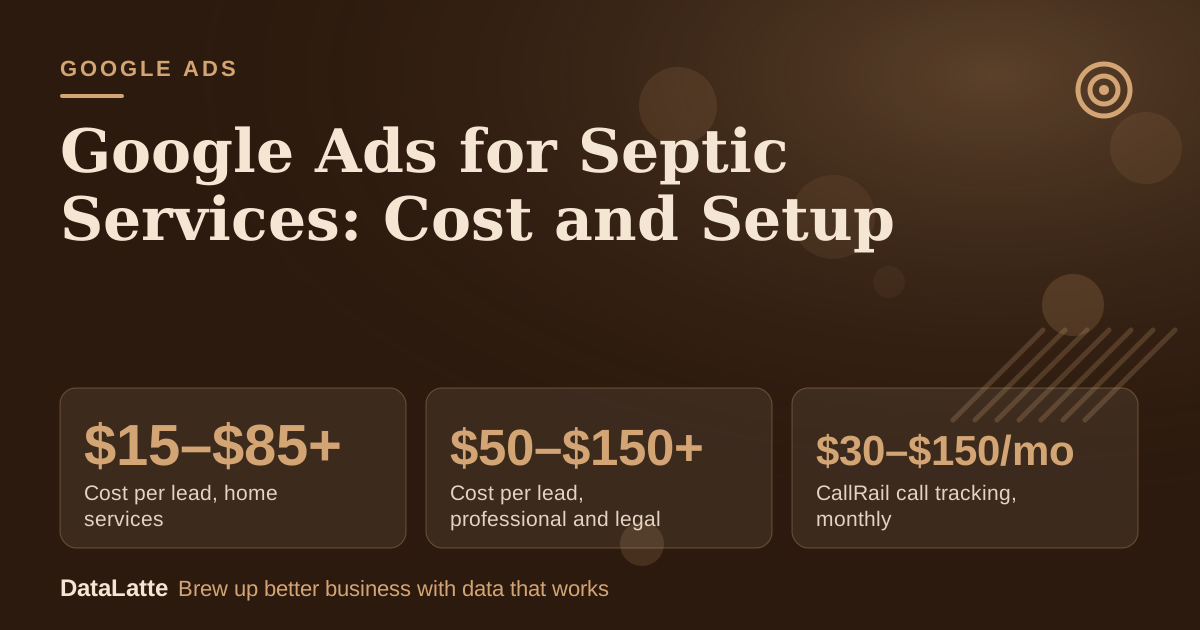
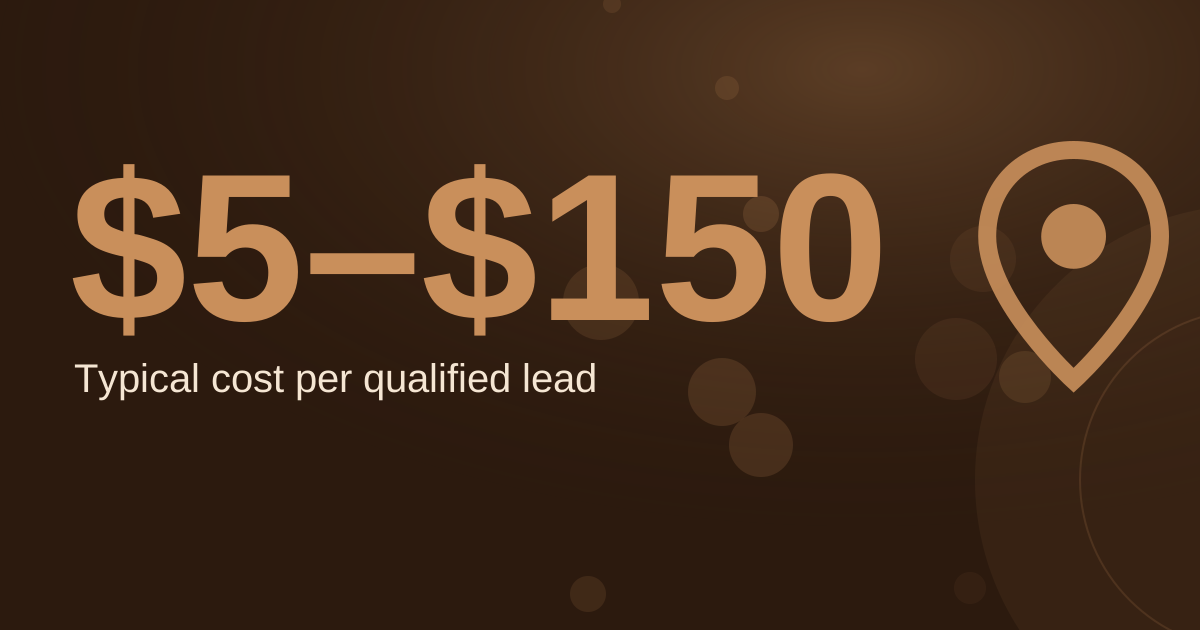
A septic company should run a small Search campaign limited to its service area, split emergency and scheduled work into separate ad groups, and count phone calls as the main conversion. No septic-specific cost figure appears below, so the closest proxy is the home-services range. One agency puts cost per lead at $15 to $85+ depending on local competition (
WizerunekWSieci). Treat that as a range to test, not a forecast.
→
Cost per lead, home services
Secondary: WizerunekWSieci
→
Cost per lead, professional and legal
Secondary: WizerunekWSieci
→
CallRail call tracking, monthly
Secondary: Ryze AI
→
Looker Studio dashboards
Secondary: Ryze AI
See Sources at the end of the article. Cards marked Assumption are examples, not results.
How Much Does Google Ads Cost for a Septic Company?
Costs depend on where you are. One agency notes that you are charged for each click, that the amount varies by location, and that big cities are more competitive and therefore more expensive (
Sunnystorm, secondary). A rural county and a dense suburb can produce very different bids for the same keyword.
For the home-services trades, the same agency range quoted above applies: $15 to $85+ per lead. Professional and legal services sit higher, at $50 to $150+ per lead. Septic work is closer to home services than to legal work, so the lower half of the home-services range is a reasonable place to start your test, while the top end shows what a crowded market can cost.
Check the keyword planner inside Google Ads for your own location before setting a budget. Run the account for at least a month, then compare your actual cost per lead with the range above.
Which Customers Are Worth Bidding For?
Septic demand has two shapes. Emergency searches come from homeowners with a backup, a slow drain field or an alarm going off, and they want someone today. Scheduled searches come from owners who need a routine pump-out or an inspection. The two behave differently, so they should not share one ad group.
Emergency terms need a call button, a clear service area line and after-hours coverage if you offer it. Scheduled terms can send people to a booking page, where the decision is less urgent and the form can collect the details you need before a visit.
Home sale inspections are a third group. Buyers and agents often need a system checked before closing. Confirm the local rules on who may carry out those inspections before you advertise the service, because an ad that promises something your licence does not allow creates more problems than it solves.
What Keywords Should a Septic Company Use?
Start with plain service words plus your town or county. Keep the list short and tied to jobs you actually do. Useful starting groups include:
- Pumping: septic tank pumping, septic cleaning, septic service near me
- Inspection: septic inspection, septic inspection for home sale
- Repair: septic backup, drain field problems, septic alarm going off
Add negative keywords for jobs and searches you do not sell, such as DIY guides, product additives and general "how to" queries. Include singular and plural versions in your negatives so one term does not slip through while another is blocked.
If you would rather hand the account to a specialist, our guide on
how to find a good Google Ads manager for a local business covers what to ask before you sign up.
How Do You Keep Ads Inside Your Service Area?
Set location targeting to the counties or towns you actually drive to. A septic company that serves three counties should not pay for clicks from a fourth, because a lead outside your area is a lead you cannot book. Revisit the targeting whenever you add a crew or change your radius.
Then review the search terms report every week. Septic searches attract curiosity queries about system types, regulations and general costs. Those rarely book a truck, so add them as negatives as you find them. Over a few weeks the list of wasted searches usually shrinks fast.
Pair location control with a complete Google Business Profile. Directwest lists Google Business Profile setup among the local services it offers (
Directwest, secondary), which reflects a common approach for local firms: make sure your listing, hours and service areas match what the ads promise.
Should You Track Phone Calls?
Yes. For most septic jobs, the first contact is a phone call, so calls should be counted as conversions from the start. Google's conversion tracking can measure calls, leads and other valuable actions, and vendor reporting commonly tracks cost per lead and return on investment (
Global Advertising Media, secondary).
Tracking tools differ in cost and effort. Google My Business Insights is free and takes about 5 minutes to set up, but offers only basic lead tracking. CallRail costs $30 to $150 per month and takes about 20 minutes to set up, and it is built for call tracking specifically (
Ryze AI, secondary). Looker Studio is free and suits custom dashboards, though setup takes around 45 minutes.
Whichever tool you choose, log each call and mark it as booked or not. Cost per call means little until you know the booking rate.
What Could $800 a Month Produce? A Worked Example
The inputs below are assumptions, not septic data. The cost per lead uses the home-services range from the source above, with the high case at $85 and the low case at the $50 floor of the professional range as a stress test.
| Line | High cost case | Low cost case |
|---|
| Monthly budget (assumption) | $800 | $800 |
| Cost per lead (assumption) | $85 | $50 |
| Leads | about 9.4 | 16 |
| Share of leads becoming booked jobs (assumption) | 35% | 35% |
| Booked jobs | about 3.3 | about 5.6 |
| Average job value (assumption) | $400 | $400 |
| Revenue from first-month jobs (assumption) | about $1,318 | about $2,240 |
At $85 per lead, $800 buys about nine leads, and the revenue roughly covers the spend in the first month. At $50, the same budget produces noticeably more booked work. Neither case counts repeat pump-outs, which is where a septic business can earn more from the same customer over time.
These numbers are a planning tool. Replace each assumption with your own booking rate and average job value after two or three months of data.
Is Local Services Ads an Option for Septic?
Google's own guidance describes Local Services Ads as designed to be less hands-on, with minimal management once you are set up, while standard Google Ads needs more active management (
Google Ads). For a busy septic owner without a marketing hire, that difference matters.
Eligibility depends on your trade and location, so check Google's current list for your state before planning around this format. Standard Search campaigns work either way and give you more control over keywords and areas. Many owners run standard Search first, then test Local Services Ads once they know their booking rate.
FAQ
How much should a septic company spend on Google Ads?
Start with a budget you can sustain for at least a month. The worked example above shows $800 a month producing roughly nine leads at $85 each, or about sixteen at $50, using assumed booking rates. Judge the spend by cost per booked job, not by clicks.
Is there a septic-specific conversion rate?
Not in the sources used here. Track your own calls and form fills for a few weeks, then compare them with the lead costs above.
Should I run emergency and routine work in the same campaign?
Separate them. Emergency searches need a call-first ad and fast response, while routine pumping and inspections can use a booking page and a reminder after the visit.
Should I use Local Services Ads or standard Google Ads?
Google describes Local Services Ads as less hands-on, but eligibility depends on your trade and state. Standard Search gives you more control over keywords, so many owners start there.
Sources
Ready to set up the account properly? See the
Google Ads service or
book a free audit to check your targeting and call tracking before you spend.
Free for local businesses
Want this applied to your business?
I'll review your Google presence, local SEO, and ad accounts — and send you a specific action plan within 48 hours. No pitch, no pressure.