Google says local results are mainly based on three things: relevance, distance and prominence. Relevance is how well your Business Profile matches the search. Distance is how far you are from the searcher. Prominence is how well known you are. You can change the first and third. You cannot change the second, which is why category, reviews and profile accuracy are where the work is.
This guide separates what Google states from what experts believe. Google's wording comes from its help pages. The ranked list comes from Whitespark's 2026 Local Search Ranking Factors survey, which is opinion, not Google's formula. Illustrative examples are labelled as assumptions.
→
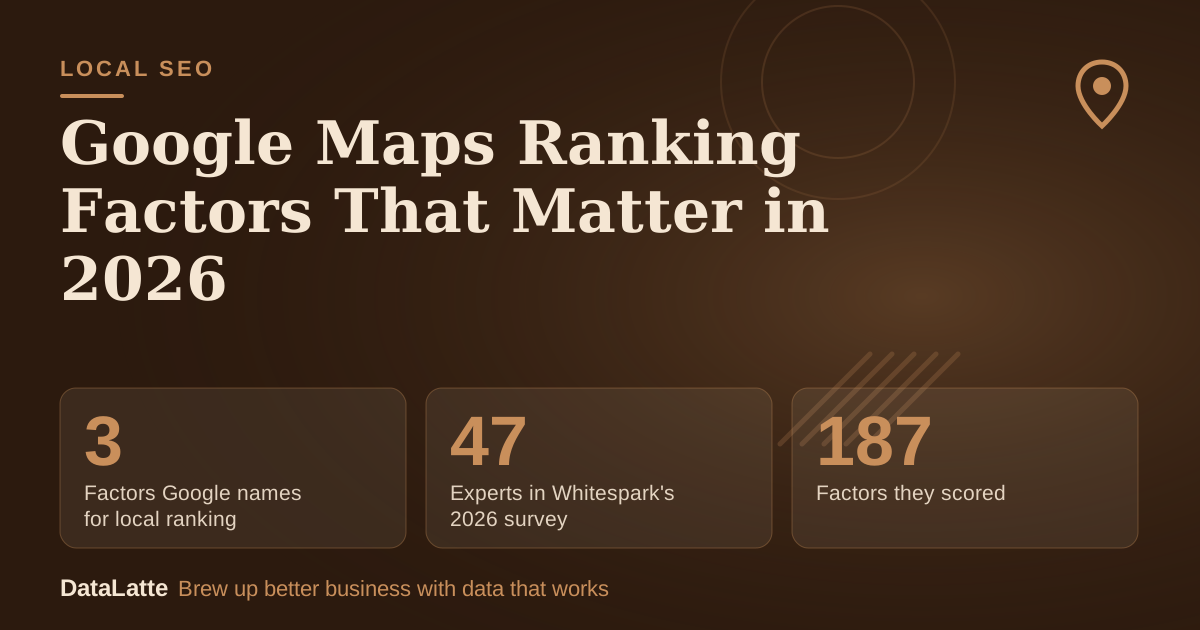
Factors Google names for local ranking
Google Business Profile Help
→
Experts in Whitespark's 2026 survey
Whitespark, published Nov 2025
→
Factors they scored
Whitespark 2026
↑
Top score, the primary GBP category
Whitespark 2026
See Sources at the end of the article. Cards marked Assumption are examples, not results.
What Does Google Say Actually Decides Local Rankings?
Google's help page on improving local ranking gives the official answer. Local results are mainly based on relevance, distance and popularity (the page later calls the third factor prominence). Prominence, it says, includes how many websites link to your business and how many reviews you have. It adds that more reviews and positive ratings can help your local ranking.
Because distance is one of the three, a cafe can plausibly show first on one block and lower two streets away. Treat the three factors as the frame, then use the expert survey below to decide what to do first.
Which Factors Do Local SEO Experts Rank Highest?
Whitespark's 2026 report surveyed 47 experts on 187 factors and was published on November 6, 2025. Its top ten for the local pack and maps, by score, were:
- Primary Google Business Profile category (227)
- Proximity of address to the point of search (225)
- Keywords in the business title (223)
- Physical address in the city of search (213)
- Business is open at the time of search (189)
- High numerical Google ratings, such as 4 to 5 (181)
- Address showing on the profile, not hidden as a service-area business (176)
- Additional categories (173)
- Quantity of native Google reviews with text (170)
- Proper placement of the map pin (165)
The report also says review and behavioural signals rose in importance, while on-page and link signals dropped slightly. Behavioural signals are the actions people take on your profile, such as calls and directions.
Which of These Can a Small Business Control?
Four of the top ten are physical: proximity, address in the city, a visible address and the pin. You decide them once, when you choose your premises. The rest are within reach:
- Primary category. Pick the one that matches what you are mainly known for. Google advises against using categories solely as keywords or to describe features.
- Additional categories. Add only ones that truly describe you, and avoid categories that match other nearby businesses.
- Hours. Being open at search time scored 189, so keep regular and holiday hours accurate.
- Ratings and review count. Ask every customer, with no incentives. Our reviews strategy guide covers the ethical way.
What About Keywords in the Business Name?
Experts scored keywords in the business title third (223), but Google's guidelines say to enter your name exactly as it appears on real-world signage, stationery and other branding. Stuffing extra words into the name risks a profile edit being rejected or reversed, so the safe move is a name that already contains what you are.
If your legal name is "Smith and Co", do not rename the profile "Best Cheap Dentist Near Me".
Do not mistake a high expert score for permission. Whitespark describes what moves rankings in testing. Google's guidelines describe what it allows. Follow the second, and use the first only inside it.
Do Reviews, Photos and Activity Still Matter?
Yes, and customers watch them even more than Google does. BrightLocal's 2026 survey of 1,002 US adults found that 74% look for reviews written in the last three months and 31% will only use a business rated 4.5 stars or higher. Fresh ratings matter to people, and Whitespark places both rating level (181) and review count (170) in its top ten.
Google's Business Profile performance report counts calls, directions, website clicks, messages and bookings. These are the same behaviours Whitespark says are gaining weight. Check them monthly. If views rise but calls don't, fix the listing, not the ranking. For the step-by-step version, see our
guide to the Google Maps local pack.
The Math: Where Should Your Five Hours Go?
This is a heuristic with assumed numbers, not Google's formula. Say you have five hours this month and split them across the six factors you control, in proportion to Whitespark's scores (total 1,163).
| Factor | Whitespark score | Share | Hours (of 5) |
|---|
| Primary category check | 227 | 19.5% | 1.0 |
| Business title (compliant) | 223 | 19.2% | 1.0 |
| Hours accuracy | 189 | 16.3% | 0.8 |
| Ratings (asking system) | 181 | 15.6% | 0.8 |
| Additional categories | 173 | 14.9% | 0.7 |
| Review quantity | 170 | 14.6% | 0.7 |
In practice the category and hours checks take minutes, so move the spare time into your review-request routine. It is the slow, compounding work.
Search your own business on your phone from three spots a few streets apart. Note where you rank, then check your primary category and hours in your profile.
FAQ
Q: What are the main Google Maps ranking factors?
A: Google names relevance, distance and prominence. Prominence includes links to your business and how many reviews you have. More reviews and positive ratings can help.
Q: What is the single most important ranking factor?
A: In Whitespark's 2026 expert survey, the primary Google Business Profile category scored highest at 227, with proximity close behind at 225. That is expert opinion, not a confirmed Google formula.
Q: Can I put keywords in my business name?
A: Google's guidelines say to use the name as it appears on your signage and branding. Experts rate title keywords highly, but adding words that are not in your real name risks problems.
Q: How long does it take to move up in Maps?
A: Google gives no timeline. Profile edits are reviewed before they go live, so check changes after they publish and track calls and directions monthly.
Q: Why do I rank differently at different locations?
A: Distance is one of Google's three factors, so results shift with the searcher's position.
Sources
Free for local businesses
Want this applied to your business?
I'll review your Google presence, local SEO, and ad accounts — and send you a specific action plan within 48 hours. No pitch, no pressure.