DataLatte☕
Marketing Strategy

How Often Should a Small Business Send Emails?
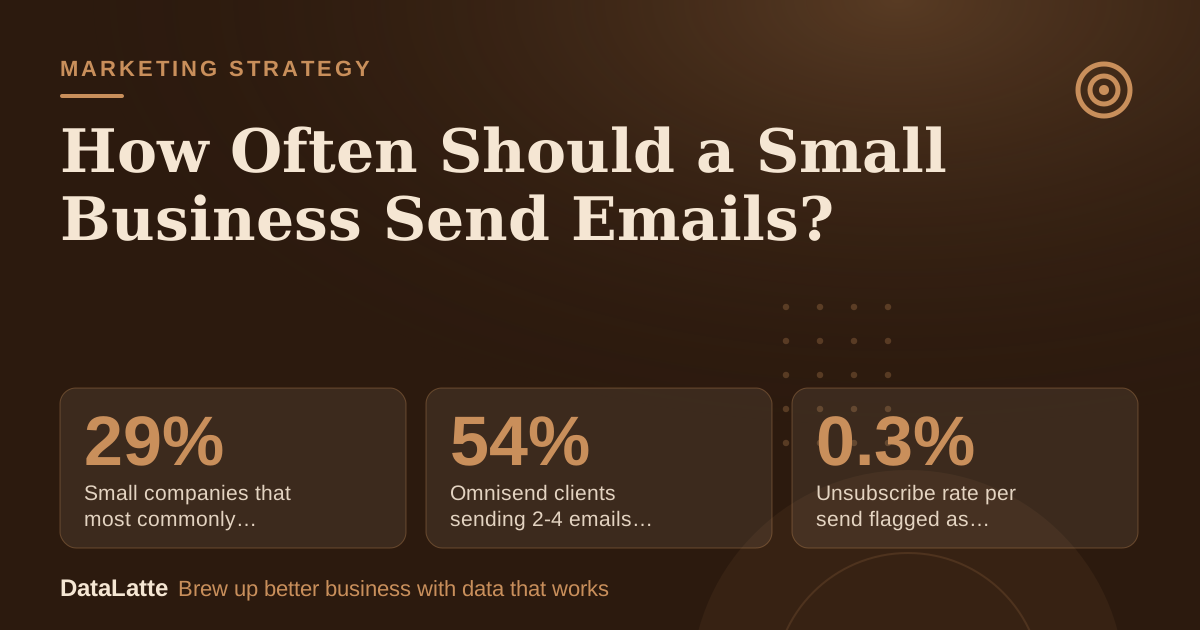
Infographic: How Often Should a Small Business Send Emails?
November 12, 2026·Nataliia Rumiantsewa· 9 min read All posts
No single number answers this question. The sources reviewed put small business email frequency anywhere from 1-3 emails per month to 1-3 per week, and nearly all of them come from email vendors rather than independent benchmarks.
A workable start for a local business is one email every week or every other week. Then run a six-week split test that watches unsubscribes, spam complaints, clicks and bookings. That starting point is a test assumption, not a documented benchmark.
29%→

Small companies that most commonly email weekly

Litmus via Selzy (secondary)

54%↑

Omnisend clients sending 2-4 emails per month

Omnisend via Snov.io (secondary)

0.3%↓

Unsubscribe rate per send flagged as too much

OptiMonk (secondary)

0.1%→

Spam complaint rate called a hard ceiling

OptiMonk (secondary)

See Sources at the end of the article. Cards marked Assumption are examples, not results.

What do the sources say about email frequency?

The published ranges differ by roughly a factor of four at the extremes. The table lists each cadence with the evidence behind it and who published it. All entries are vendor material or retellings of vendor studies, so they are marked secondary.
CadenceEvidenceSource
1-3 emails per monthSuggested starting baseline, with engagement monitored before increasing. A MailerLite study cited there says most businesses send one to three emails monthly.Selzy (secondary)
2-4 emails per month54% of Omnisend clients send this often, and 32% send once a month. Omnisend serves businesses with up to 5,000 users.Snov.io (secondary)
Weekly29% of small companies most commonly send weekly (Litmus). Newsletters usually fit a weekly or bi-weekly schedule.Selzy, AdWave (secondary)
Twice weeklyIn a MailerLite study, open rates held steady and click-through peaked at twice-weekly sends.Selzy (secondary)
1-3 per weekGeneral rule of thumb for small businesses. Local service providers are also told to stay in this range. For ecommerce stores it is called the sweet spot.AdWave, OptiMonk (secondary)
2-5 per weekSuggested for ecommerce categories such as beauty, food, apparel and pet supplies.OptiMonk (secondary)
DailyMailerLite open rates drop. Only 15% of people want promotional or educational emails daily.Selzy, Snov.io (secondary)
Two details matter for local businesses. The 2-5 per week range applies to online stores selling products, not appointment-based services. And AdWave says its own 1-3 per week figure is a starting point, not a one-size-fits-all answer.

Why do the vendor numbers conflict?

The ranges do not overlap cleanly because they measure different things. Omnisend's client data and Litmus's survey describe what businesses do. The MailerLite and GetResponse figures describe how campaigns performed. A common habit is not proof of a good habit.
The audiences also differ. OptiMonk writes about ecommerce stores. AdWave covers ecommerce at 3-7 emails per week but gives local service providers 1-3. Selzy's baseline of 1-3 per month is framed as a starting point to be raised later.
Reasons for unsubscribing conflict as well. OptiMonk cites MarketingSherpa data that 56% of unsubscribes happen because content stopped being relevant. Snov.io reports that 69% of people who unsubscribe name being tired of receiving emails as the primary reason. The two surveys are different and cannot be merged.
Appetite for volume is also contested. AdWave cites an unnamed study of over 2,000 adults in which more than 60% appreciate weekly promotional emails and 38% want to hear from brands even more often. Because the study is unnamed, it cannot be checked.
None of these are independent benchmarks. Each is a vendor's view, and a local business's own list is the only reliable test.

What cadence should a salon, coffee shop, groomer or studio start with?

The sources give no cadence for salons, coffee shops, pet groomers or fitness studios specifically. The starting points below are assumptions that sit inside the published ranges. They are meant to be tested, not treated as benchmarks.
BusinessStarting cadence (assumption)Higher arm to test (assumption)Range it draws on
Hair or beauty salon2 per monthWeeklyOmnisend client range, AdWave weekly newsletter
Coffee shopWeeklyTwice weeklyMailerLite click-through peak at twice weekly
Pet groomer2 per monthWeeklyOmnisend client range, AdWave local service range
Fitness studioWeeklyTwice weeklyAdWave 1-3 per week, MailerLite
The logic is simple. Businesses with appointment gaps of weeks start lower. Businesses with frequent repeat visits start higher. Whichever arm is higher is the one to watch most closely for unsubscribes.
Automated messages are a separate layer. OptiMonk describes a welcome flow of 3-5 emails over 7-14 days and a win-back flow of 3-5 emails for people who have not bought in 60-120 days, both written for ecommerce. AdWave says transactional emails such as confirmations must go out immediately. For salon examples, see the guide to marketing automation for hair salons.

What should be tracked during a frequency test?

Five numbers decide the test. Sources offer reference points for four of them, and the fifth, bookings, comes only from the business's own records.
  • Open rate. Snov.io cites Mailchimp benchmarks of 20.81% across all industries and suggests a goal of about 20%, while also advising to follow the business's own past campaign stats. CMG Local Solutions gives a similar figure of around 20%.
  • Click rate. Snov.io suggests aiming for an average click-through rate of 2.5%. CMG's rough estimate is that about 3% of those who open an email click a link. These use different bases, so they should not be compared directly.
  • Unsubscribe rate per send. OptiMonk flags anything above 0.3% as a sign of over-sending. Snov.io calls 0.2% perfect, says professionals treat rates above 0.5% as a signal to improve, and calls about 1% acceptable only for novices.
  • Spam complaint rate. OptiMonk calls anything above 0.1% a hard ceiling that can push email into Gmail's promotions tab.
  • Bookings or redemptions. Give each test group its own booking link or offer code. Setting this up in analytics is covered in the guide to Google Analytics 4 for small business.
Open and click rates move with content, so a higher cadence should never be judged on opens alone.
GetResponse data cited by Snov.io shows the first newsletter sent in a week averaging a 4.88% click-through rate, the second 3.53%, and the 14th and 15th about 1.92% and 2.01%. That pattern suggests diminishing returns per additional send. For a business sending one or two emails, the practical point is to compare per-send results, not weekly totals.

What does a 6-week email frequency test look like?

The test splits the list into two random groups. Group A stays at the starting cadence and Group B gets the higher one. Everything else stays fixed, including send day, send time, offer style and subject line style. Selzy cites a Databox study in which most marketers report the best engagement on Tuesday emails, so a single fixed weekday is a reasonable constant.
  • Week 1: Record current open, click and unsubscribe rates from the last campaigns. Split the list randomly into A and B. Create a separate booking link or code for each group. Send the first email.
  • Week 2: Send on the same day and time as week 1. Check unsubscribes and spam complaints per send for both groups.
  • Week 3: Keep content type identical across groups. Log bookings from each link or code.
  • Week 4: Midpoint review. If two or more red flags appear in a group (see the cut rules below), cut that group's frequency and re-measure.
  • Week 5: Check subscribers who have not opened or clicked in 30 days. OptiMonk suggests pulling lapsing subscribers back to 1 email per week.
  • Week 6: Final sends. Tally unsubscribes, complaints, clicks and bookings per group, then pick the cadence for the next quarter.
Seasonal peaks distort results, so a test is best run outside a major promotion. Holiday sends have their own planning logic, covered in the holiday email marketing guide.

What does the test look like with real numbers?

This worked example is a coffee shop. Every input below is an assumption, and the results are invented to show the arithmetic, not forecasts.
Assumptions:
  • List of 2,000 subscribers, split into 1,000 per group.
  • Group A: 1 email per week, so 6 sends in six weeks.
  • Group B: 2 emails per week, so 12 sends.
  • Each email carries a group-specific code redeemed at the register.
  • Average ticket per redemption: $6.
  • Unsubscribe rate per send: 0.2% for A and 0.35% for B.
  • Spam complaint rate: 0.05% for both groups.
  • Redemptions over six weeks: 30 for A and 38 for B.
The math:
MeasureGroup AGroup B
Unsubscribes (sends x 1,000 x rate)6 x 2 = 1212 x 3.5 = 42
Redemption revenue30 x $6 = $18038 x $6 = $228
Revenue per subscriber$0.18$0.228
Group B earns $48 more in revenue but loses 30 more subscribers. If each lost subscriber would have spent like an average Group A subscriber ($0.18 per six weeks), that costs about $5.40 per six-week period. On this arithmetic, B comes out ahead for now.
The unsubscribe rate of 0.35% per send is above OptiMonk's 0.3% flag but below Snov.io's 0.5%. Complaints are under 0.1%. Only one red flag appears, so the OptiMonk rule does not trigger. A sensible response is to extend the B test two more weeks and cut by 25% (to 3 emails every two weeks) if a second flag appears.

When should email frequency be cut or raised?

The only explicit cut rule in the sources comes from OptiMonk. Its red flags include an unsubscribe rate above 0.3% per send and a spam complaint rate above 0.1%. When two or more occur at once, it says to cut frequency by 25-30% for two weeks and re-measure.
No source gives a numeric rule for raising frequency. Selzy advises monitoring engagement before increasing. The MailerLite study cited by Selzy found click-through peaks at twice-weekly sends and open rates drop at daily sends, so two per week is a natural ceiling for the test arm.
Segments help more than a single list-wide cadence. OptiMonk suggests that engaged subscribers (opened or clicked in the last 30 days) can take 2-4 emails per week, lapsing ones (30-90 days) should drop to 1 per week, and disengaged ones (90+ days) should get a re-engagement sequence of 3-5 emails over 2-3 weeks. These numbers are written for ecommerce, so local businesses should scale them down. The mechanics of such a sequence are in the guide to customer reactivation campaigns.
When a cadence works, content becomes the next lever. The email marketing ideas guide lists campaign types that keep a list relevant.

FAQ

Is daily email ever a good idea for a small business?

The sources lean against it. In the MailerLite study cited by Selzy, open rates drop when emails are sent daily. Snov.io says only 15% of people want promotional or educational emails daily. AdWave's unnamed study also reports 15% wanting daily messages. Daily sending could be tested on a small, engaged segment, but the evidence does not support it as a default.

Do automated emails count toward weekly frequency?

The sources treat them differently. AdWave says transactional emails such as order confirmations are functional and must be sent immediately. OptiMonk describes welcome, abandoned cart, post-purchase and win-back flows separately from campaign cadence, and its 1-3 per week sweet spot refers to campaign emails. For planning, count total messages per subscriber so that automations do not pile on top of campaigns.

What open rate should a small business expect?

Snov.io cites Mailchimp benchmarks of 20.81% across all industries, and CMG Local Solutions says the average hovers around 20%, citing MailChimp research. Both are secondary retellings. Snov.io advises setting a goal near 20% while following the business's own past campaign stats. A business's own history is more useful than an industry average.

Which day is best to send?

Selzy cites a Databox study in which most marketers report the best engagement on Tuesday emails. That is a marketer survey, not a guarantee for any specific list. During a frequency test, keeping one fixed send day matters more than choosing the right one, because changing day and cadence together makes results impossible to read.
Want a second opinion on where email fits next to local ads and booking? Request a free audit.

Sources

Free for local businesses

Want this applied to your business?

I'll review your Google presence, local SEO, and ad accounts — and send you a specific action plan within 48 hours. No pitch, no pressure.

email marketingemail frequencylocal businesssmall business marketingtesting

Want hands-on help?

See how DataLatte handles Analytics & Reporting for local businesses.

Learn more
Nataliia — local marketing expert
Nataliia Rumiantsewa

Local marketing strategist with 10+ years at global agencies — OMD, Dentsu, GroupM, and BBDO. Now helping small businesses get the same data-driven edge. Based in Europe, working with clients in the US, UK, Australia, and beyond.

Want this applied to your business?

Let's review your current marketing setup together — free, no obligations.

Get Your Free Marketing Audit