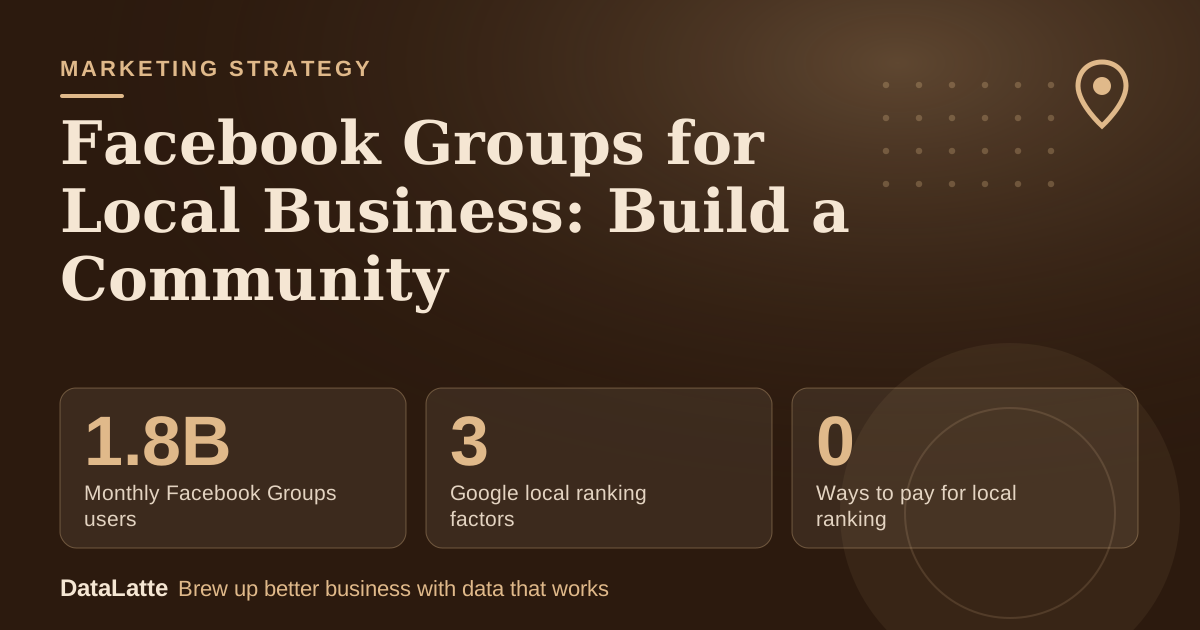
A local business can use Facebook groups in two ways: run its own community group, or take part in existing neighborhood and interest groups. Buffer reports that
over 1.8 billion people use Facebook Groups each month (secondary, cited by AdWave), so the audience exists. Running a group gives control but demands moderation. Joining groups costs less but depends on each group's rules. The sources reviewed give no engagement or sales benchmarks, so the numbers below are labelled examples.
→
Monthly Facebook Groups users
Buffer, cited by AdWave (secondary)
↑
Google local ranking factors
Relevance, distance, popularity (Google)
↓
Ways to pay for local ranking
Google Business Profile Help
Assumption→
Weekly admin time in the example
Assumption for the worked example
See Sources at the end of the article. Cards marked Assumption are examples, not results.
What can a local business actually do with Facebook groups?
A Facebook group is a space organized around a shared interest or place, not around a brand page. For a local business, that opens two separate jobs. One is hosting: creating a group for regulars, neighbors or members, and carrying the admin work. The other is participating: joining groups that already exist for a town, a neighborhood or a hobby, and contributing there.
The two jobs differ in cost and in control. A hosted group belongs to the business, so the owner sets the topic, the tone and the rules. A joined group belongs to someone else, so the business is a guest and the administrators decide what is allowed.
The AdWave guide
on building a community in Facebook groups is a vendor page, so its advice is best treated as secondary. It was published on April 15, 2026, and it gives guidance rather than measured results. No source reviewed for this article states how many group members turn into customers, how much revenue a group produces, or what a typical response rate looks like. Anyone promising specific returns from a group is working from numbers that these sources do not provide.
That gap shapes the right way to start: small, with a fixed time budget, and with a way to count what happens. The same logic applies to other local channels, such as the ones covered in the
guide to hyperlocal marketing on Nextdoor.
Should a business start its own group or join existing local groups?
The answer depends on staff time and on how much a business wants to control the conversation. The table below compares the main options. Effort and risk ratings are editorial judgments, not measured figures, because the sources do not quantify them.
| Group type | What it is | Effort (editorial judgment) | Main risks |
|---|
| Own customer group | A group the business creates for regulars, members or clients | High: daily or near-daily attention, moderation, content | Goes quiet if not tended; admin owns every dispute; can read as a thinly disguised ad channel |
| Own neighborhood-style group | A group named around the area, such as "[Your City] Homeowners" style naming | High: needs content that is useful beyond the business | Members may feel misled if the group is mostly promotion |
| Joined local community group | A town or neighborhood group run by someone else | Low to medium: read rules, comment helpfully | Promotion rules vary by group; posts can be removed; a member can be banned |
| Joined interest group | A group around a hobby, such as pets, fitness or coffee | Low to medium | Off-topic posts are unwelcome; value depends on genuine contribution |
| Partner or cross-business group | A group shared with nearby non-competing businesses | Medium: needs agreed rules and a shared admin | Unclear ownership; slow decisions; inconsistent moderation |
For a business with no spare hours, joining one or two relevant groups and answering questions is the realistic start. A business with a loyal customer base and a person who enjoys community work may get more from a branded group. That choice connects to broader retention work, such as
loyalty program software, which can hold the same customers through a different channel.
How should a business name and set up its own group?
Naming should help the right neighbors find the group. AdWave cites Performance Financial for a starting point:
local keyword framing such as "[Your City] Homeowners" or related community phrases (secondary, third-party guidance). The logic is that a name built around the place or the shared interest says who the group is for, while a name built around the business says only who owns it.
For privacy, AdWave states that for most local businesses
"private but visible" is the sweet spot. That is the vendor's recommendation, with no numeric support, and it is not a Facebook rule. Facebook's own settings screen should be read before choosing, because option names and behavior can change.
Setup choices worth settling before the first invitation:
- Who the group is for, in one sentence (for example, regulars of one coffee shop, or members of one studio).
- Two or three written rules, covering what may be posted, how disputes are handled, and what the business will do with member information.
- Who moderates, and what the backup is when that person is away.
- What will be posted on a normal week, so the group does not start with a flurry and then fall silent.
A written rule set also protects the business. When a member posts something off-topic, the response can point to a rule rather than to the owner's mood.
The sources reviewed do not document Facebook's own policies on promotion or any specific group's rules, so this section sticks to practical risk management rather than policy claims.
In groups run by others, the administrators write the rules. Some local groups allow business posts on certain days, some require approval, and some ban promotion entirely. The safe habit is to read the pinned rules and the "about" section before the first post, and to ask an admin when a rule is unclear. A post removed for breaking a rule is a minor loss. A repeated violation can cost the business access to the group, and a neighborhood group may be where many of its nearby customers gather.
In a group the business runs, the risks flip. Moderation becomes the business's job:
- Complaints posted in public need a calm, fast reply and a move to a private channel for details.
- Disputes between members need a rule to point to.
- Spam and off-topic posts need removal on a regular schedule.
- Customer information shared in comments needs care, since a member's post can reveal who visits a business.
Reviews belong in a different place. A group conversation is not a substitute for public ratings, and Google
bases prominence partly on how many reviews a business has. Tools for collecting them are compared in the
review management software guide.
What should a local business post in a group?
The sources give no tested content mix, so the list below is an editorial suggestion, not a benchmark. The principle is that most posts should be useful to members even if they never buy anything.
For a group the business hosts, useful categories include:
- Answers to questions that customers ask repeatedly (hours, allergens, how to prepare a pet for a first groom, what to bring to a first class).
- Short behind-the-scenes updates, such as a new menu item or a schedule change.
- Questions that invite replies, such as asking members to vote between two options.
- Occasional offers, kept clearly in the minority.
- Local news that fits the group's topic, such as a street closure that affects parking.
For groups run by others, the better habit is to comment helpfully on other people's questions and to post about the business only where rules allow it. A short reply that solves a neighbor's problem tends to be remembered more than an advertisement, though no source here measures that.
Content drafting can be sped up with an assistant, as described in the guide to
using ChatGPT for local business marketing, but every post should be read for accuracy before it goes out, especially anything about prices, hours or health claims.
What does a four-week plan look like?
The plan below assumes one person with a fixed weekly time budget. The sequence moves from decisions, to a small launch, to review. It borrows the week-by-week structure used in the
12-month local marketing calendar.
| Week | Focus | Checklist |
|---|
| 1 | Decide and prepare | Choose own group, joined groups, or both. Pick a name using place or interest wording. Choose a privacy setting after reading Facebook's current options. Write two or three rules. Name a moderator and a backup. |
| 2 | Soft launch | Invite a handful of friendly regulars first. Post a welcome message that states the group's purpose and rules. Join one or two relevant local groups and read their rules without posting. |
| 3 | Build routine | Post on a fixed rhythm. Reply to every comment. Answer two or three questions in joined groups. Add one question post to start conversation. |
| 4 | Review and adjust | Count members, posts, replies and any visits or bookings members mention. Remove or relax rules that caused friction. Decide whether to continue, widen invitations, or stop. |
Week 4 matters most. Without a count, a group can consume hours without anyone knowing whether it pays. A simple tracking habit, such as asking new customers how they heard about the business, is enough to start. Where web visits are involved,
Google Analytics 4 for small business can show whether group links bring traffic.
What does a worked example look like for a coffee shop?
Every input below is an assumption chosen for illustration. None comes from a source, and real results will differ.
Inputs (assumptions)
- Group size after four weeks: 150 members.
- Weekly offer shown only in the group.
- Share of members who redeem it in a week: 6 percent in the base case, 2 percent in a weak case.
- Average ticket: $8.
- Gross margin on the ticket: 65 percent.
- Admin time: 45 minutes a week, valued at $20 an hour, or $15.
Base case
- Redemptions: 150 × 0.06 = 9 visits.
- Revenue: 9 × $8 = $72.
- Contribution after product cost: $72 × 0.65 = $46.80.
- Minus admin time of $15 leaves about $31.80 a week.
Weak case
- Redemptions: 150 × 0.02 = 3 visits.
- Revenue: 3 × $8 = $24.
- Contribution: $24 × 0.65 = $15.60.
- Minus $15 leaves about $0.60 a week.
The lesson is about sensitivity, not about the specific dollars. At a low redemption rate, the group roughly pays for the owner's time and nothing more. Its value then rests on goodwill and repeat visits that this simple model does not count. The same arithmetic works for a salon or a studio by swapping the ticket value and margin, and a salon with an
online booking system can track bookings that come from a group link directly.
Do Facebook groups help a business show up on Google?
The Google page reviewed does not mention Facebook groups, so no link between group activity and local ranking is documented there. What Google does say is useful for setting expectations.
Local results are mainly based on relevance, distance, and popularity, and there is
no way to request or pay for a better local ranking.
Google describes prominence as how well-known a business is, and says prominent places are more likely to show up in search results. It adds that prominence also reflects how many websites link to a business and how many reviews it has. A group may raise awareness among neighbors, but whether that feeds prominence is not stated in the source, so treating a group as a ranking tactic would be a guess.
The dependable steps sit in the profile itself. Google says verifying a business tells Google the owner is authorized to represent it, which makes it more likely to show up, and that businesses with complete and accurate info are more likely to show up in local search results. The
Google Business Profile optimization checklist covers those basics, and they deserve attention before any group work begins.
Distance also matters. Google says that if a customer does not share their location, it uses what it knows about that location, which is one more reason a business should keep its address and service area accurate.
FAQ
Is a Facebook group better than a business page for a local shop?
The sources reviewed do not compare the two, so no performance claim can be made. A group suits two-way conversation among customers, while a page suits announcements. A business with limited time can start with joining relevant groups before committing to run one.
What privacy setting should a local business group use?
AdWave recommends "private but visible" for most local businesses, as a vendor opinion without numeric support. Facebook's current setting descriptions should be checked before choosing, since the sources do not describe them.
That depends on each group's rules, which the sources do not document. The safe approach is to read the pinned rules, contribute helpful replies first, and ask an administrator before posting any offer.
How much time does a group take?
The sources give no figure. The 45 minutes a week in the example above is an assumption. A group the business runs needs regular moderation, so time should be set before launch and reviewed after four weeks.
Will a Facebook group improve Google rankings?
No source reviewed says so. Google states that local results are mainly based on relevance, distance, and popularity, and that rankings cannot be bought. Profile completeness and reviews are the documented levers.
Sources
A group works best as one part of a wider local plan. For a second opinion on where a Facebook group fits beside search, reviews and paid media, request a
free marketing audit.