AI Writing Tools for Small Business Compared
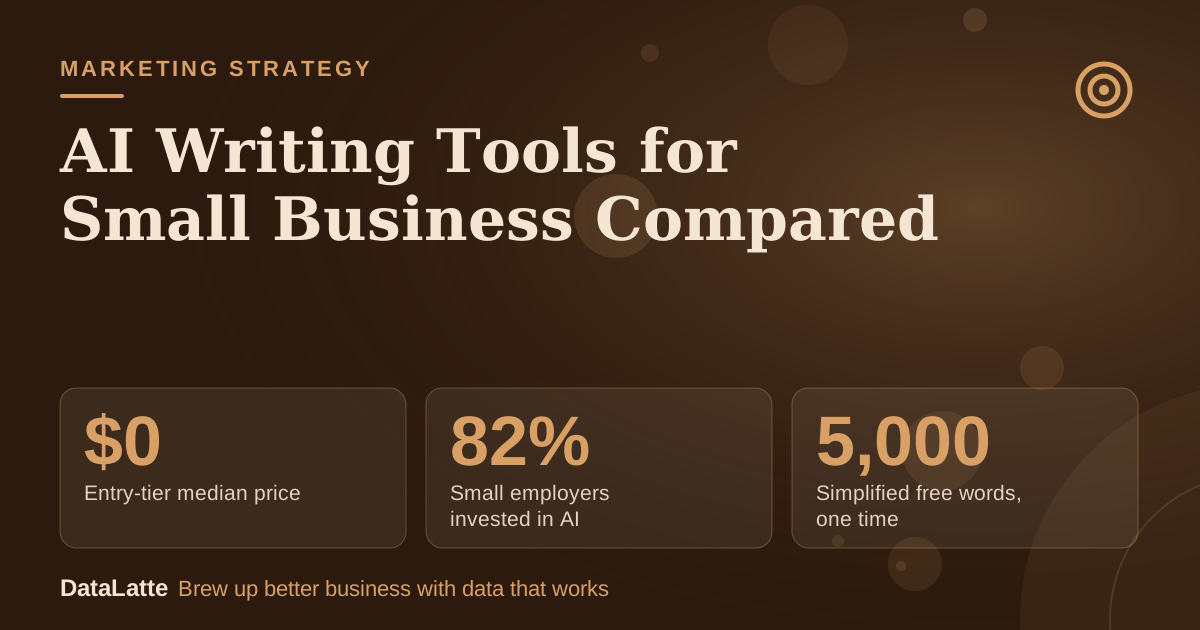
Entry-tier median price
CostBench, 12 tools, April 2026 (secondary)
Small employers invested in AI
SBE Council via AdWave, March 2026 (secondary)
Simplified free words, one time
Simplified free plan, does not reset monthly (secondary)
Top-tier median price
CostBench, 12 tools, April 2026 (secondary)
See Sources at the end of the article. Cards marked Assumption are examples, not results.
What do small businesses use AI writing tools for?
How much do AI writing tools cost, and which have free tiers?
| Tool | Listed paid pricing | Free tier | Limits and notes |
|---|---|---|---|
| Rytr | Unlimited $7.50/mo billed annually; Premium $24.16/mo billed annually (eesel, secondary) | Yes: 10,000 characters per month, 20+ tones, one language | Custom tone training needs Unlimited; 40+ templates |
| Copy.ai | Chat $29/mo ($24 annual), 5 seats (eesel, secondary); Growth $1,000/mo, billed $12,000/yr, 75 seats (Copy.ai) | Free Chat, no credit card; word limit not published as of May 2026 | Growth includes 20K workflow credits per month |
| Simplified | One/Pro $24/mo annual, 100,000 AI words per month (eesel, secondary) | 5,000 AI words, one-time | Free quota does not reset monthly |
| eesel AI Blog Writer | $4.00 per blog post; two months free on annual; add-ons from $199/mo (eesel, secondary) | 100 credits, no card | Credits do not refill; claimed 94% voice match |
| Jasper | Pro $69 per seat/mo; a second Pro listing shows $59 (Jasper) | Not stated on the pricing page | Pro: 1 seat, 2 Brand Voices, 5 knowledge assets, 3 audiences |
| Grammarly | Paid plans from $12/mo (CostBench, secondary) | Yes | Limits not stated |
| Wordtune | $13.99 to $19.99/mo (CostBench, secondary) | Yes | Limits not stated |
| Writesonic | $99 to $499/mo (CostBench, secondary) | Not stated | Limits not stated |
| Anyword | $49 entry, $59 median, $99 top (CostBench, secondary) | Not stated | Limits not stated |
Why do prices differ between sources?
Which limits matter more than the monthly price?
- Jasper Pro includes 2 Brand Voices, and the Business plan lists unlimited voices.
- Rytr's custom tone training requires the Unlimited plan.
- eesel states a claimed 94% voice match. That is a vendor claim, and no independent test appears in the sources.
What should be checked before AI copy is published?
- Hours, prices, addresses, phone numbers and booking links match the current versions.
- Offers have correct start and end dates, and any holiday cutoff is accurate. This matters most for holiday email campaigns.
- Staff names, product names and service names are spelled as customers know them.
- Superlatives and results claims ("best in town", "guaranteed results") are supportable by the business, or removed.
- No invented reviews, testimonials or customer stories appear in the text.
- Local details (neighborhood, parking, seasonal items) are real, not generic filler.
- The tone matches the last three posts or emails that performed well.
- Repeated phrases and stock openers are cut, so posts do not read like every other AI draft.
What human review policy works for a small team?
- Every piece has a named approver, usually the owner or manager, and nothing goes out on the tool's say-so.
- A fact sheet with hours, prices, current offers and service names is pasted into each prompt, so the tool is not guessing.
- Anything with a price, discount, date or health or results claim gets a second set of eyes before it is scheduled.
- Emails are sent to a test address first and checked on a phone.
- Customer personal details stay out of prompts until the vendor's data terms have been read. The sources cited here do not state those terms.
What does a two-week trial look like?
- Day 1: write the fact sheet and a short brand voice note with three real captions or emails the business likes.
- Day 1: pick two or three tools from the table, preferring free tiers, and note each tool's limit (characters, words or credits).
- Days 2 to 3: time how long five current tasks take by hand, such as 3 captions, 1 email and 1 description.
- Days 4 to 5: run the same five tasks through each tool with the same prompt.
- Day 5: note edits needed per draft and whether the voice note was followed.
- Days 8 to 10: edit the best drafts, run the checklist above, and publish or schedule them.
- Days 8 to 12: log minutes spent per piece, including review.
- Day 11: record when any free allowance ran out or a feature sat behind a paid plan.
- Day 12: check the vendor pricing page again and note per-seat, annual and monthly prices.
- Day 14: compare time saved against the plan price using the formula in the next section, then keep one tool, keep two, or stop.
Is a subscription worth it for a coffee shop? A worked example
- Pieces per month: 32 captions, 4 emails and 4 descriptions, so 40 pieces (assumption).
- Time per piece: 20 minutes by hand, 10 minutes with a draft plus review (assumption), so 10 minutes saved.
- Time saved: 40 pieces × 10 minutes = 400 minutes, about 6.7 hours.
- Value of the owner's time: $25 per hour (assumption), or about $0.42 per minute. That makes 400 minutes worth $166.67.
- Plan prices come from the table: Rytr Unlimited $7.50, Copy.ai Chat $29, Jasper Pro $69.
| Plan | Monthly cost | Break-even minutes saved | Net at 400 min saved | Net at 120 min saved |
|---|---|---|---|---|
| Rytr Unlimited (annual) | $7.50 | 18 | $159.17 | $42.50 |
| Copy.ai Chat | $29.00 | 70 | $137.67 | $21.00 |
| Jasper Pro | $69.00 | 166 | $97.67 | -$19.00 |
FAQ
Is a free AI writing tool enough for a small business?
Do the cheaper tools offer brand voice controls?
Why is Copy.ai listed at both $29 and $1,000 per month?
How often should tool prices be rechecked?
Sources
- eesel AI: The best free AI writing tools for small businesses in 2026 (secondary)
- CostBench: Best AI Writing Tools for Small Business 2026 (secondary)
- CostBench: AI Writing Tools Pricing Benchmarks 2026 (secondary)
- AdWave: AI Writing Tools for Small Business, Practical Uses and Limitations (secondary)
- Jasper: Plans and Pricing
- Copy.ai: Pricing
Free for local businesses
Want this applied to your business?
I'll review your Google presence, local SEO, and ad accounts — and send you a specific action plan within 48 hours. No pitch, no pressure.
Want hands-on help?
See how DataLatte handles Analytics & Reporting for local businesses.

Local marketing strategist with 10+ years at global agencies — OMD, Dentsu, GroupM, and BBDO. Now helping small businesses get the same data-driven edge. Based in Europe, working with clients in the US, UK, Australia, and beyond.
Related articles
How Often Should a Small Business Send Emails?
9 min read
Word-of-Mouth Marketing Strategy for Local Business
7 min read
Marketing for Wellness Businesses: A 90-Day Plan
8 min read
Toast vs Square for Restaurants: Fees and Contracts
8 min readWant this applied to your business?
Let's review your current marketing setup together — free, no obligations.
Get Your Free Marketing Audit