Billboards and TV differ mainly in how they are bought and counted. A billboard is a leased board, usually contracted for 4 weeks, and most contracts require a 4 to 12 week minimum (
Adwave, secondary). TV covers broadcast, cable and streaming, with reported monthly ranges from $500 to $50,000+ (
Adwave, secondary). The sources here do not show either format beating the other for local businesses, so this guide lays out the sourced facts and a 4-week test for each.
→
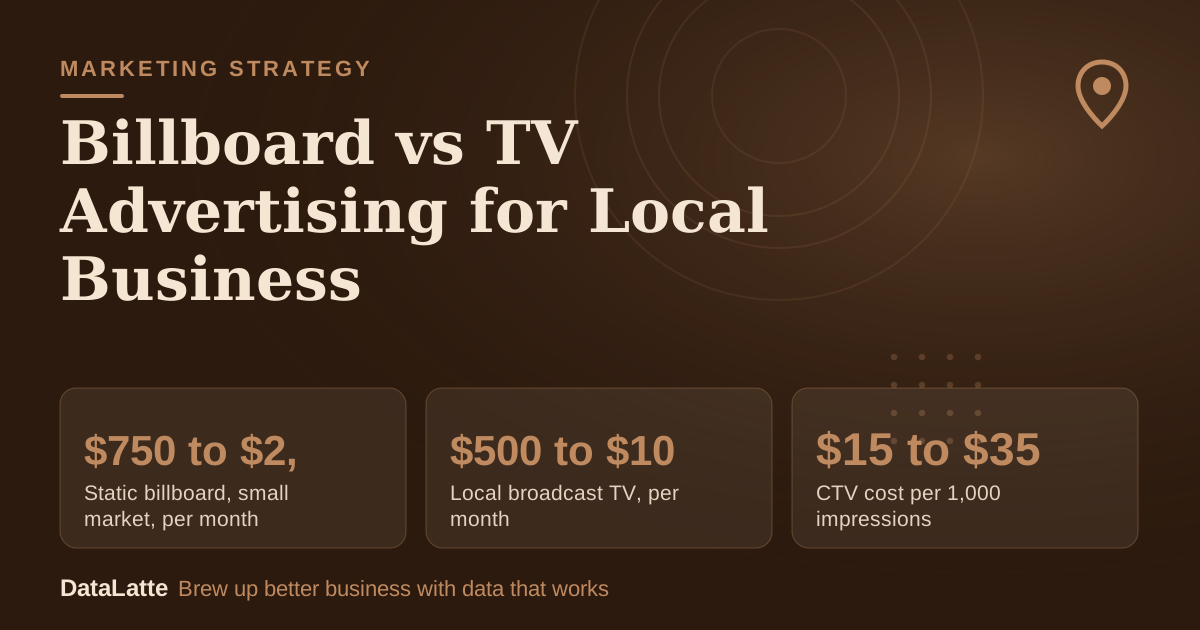
Static billboard, small market, per month
Adwave billboard page (secondary)
→
Local broadcast TV, per month
National Media Spots via Adwave, June 13, 2026 (secondary)
→
CTV cost per 1,000 impressions
Adwave billboard page (secondary)
→
Typical billboard minimum commitment
Adwave billboard page (secondary)
See Sources at the end of the article. Cards marked Assumption are examples, not results.
What does a billboard cost a local business?
Adwave (secondary) reports static billboards at $750 to $2,000 per month in small markets, $2,000 to $5,000 in medium markets and $5,000 to $15,000+ in large markets. Premium spots such as highway interchanges run $10,000 to $30,000+. Its digital billboard ranges are $500 to $1,500 (small) and $1,500 to $4,000 (medium), described as typically 30 to 50% less than static because the board is shared.
The sources conflict. AdQuick (secondary) says monthly digital billboard costs run from $1,200 in smaller markets to $15,000 or more in major cities, so the small-market floor is $500 in one source and $1,200 in another. Blip (secondary) cites a $3,953 monthly national average for traditional billboards, with a range of $250 to $100,000+, and gives no source for it. These figures are not averaged here.
Other pricing models exist. Blip sells 8-second plays from $0.01. AdQuick lists digital billboard CPMs at $5 to $10 and programmatic DOOH at $3 to $20.
Creative adds cost: $200 to $1,000 for design and $300 to $1,000 for static production and installation (Adwave, secondary). More detail is in the
DOOH platforms comparison.
What does TV advertising cost a local business?
National Media Spots, quoted by
Adwave (secondary), lists local broadcast TV at $500 to $10,000 per month, regional cable at $1,000 to $20,000 and streaming/CTV at $500 to $50,000+. All three are dated June 13, 2026. The same page lists streaming/CTV at $15 to $40+ CPM, while Adwave's billboard page gives $15 to $35. Amazon Ads lists a 30-second TV spot at $5 to $30 CPM, with no date stated.
Per-airing pricing is described only loosely: a few hundred to several thousand dollars, depending on market and schedule. Prime time, typically 8 to 11 PM, carries the highest local rates.
Production is a separate line. Moonb's 2026 guide, quoted on that page (secondary), puts a simple local spot at $1,500 to $10,000 and mid-range work at $10,000 to $50,000.
BIA puts 2026 local political spending at $9.7 billion, with $1.2 billion of a $1.3 billion increase going to broadcast and streaming TV. Whether that changes what a local advertiser pays is not documented in these sources. Ask each seller for current rates. A broader breakdown is in
local TV advertising cost and
real CTV CPM data.
What minimums and contract terms apply?
Billboards are the longer commitment. A static ad is typically contracted for about 4 weeks, with one advertiser owning the board, and most billboard contracts require 4 to 12 weeks (Adwave, secondary). Digital boards rotate ads for 6 to 8 seconds each, typically with 6 to 8 other advertisers.
DOOH terms vary by buying route:
- AdQuick (secondary): programmatic campaigns generally require $10,000 to $50,000, small business campaigns can start at $1,000 to $5,000 per month, and direct local deals can start below $10,000.
- Take 10 Media (secondary): traditional outdoor often demanded $25,000 or more, while its self-serve platform has no high minimums and can be paused anytime.
- Blip (secondary): no monthly minimum and no contract.
On the TV side, National Media Spots says CTV campaigns can launch on $500 to $1,000 a month (secondary). Adwave says its daily budgets run $30 to $10,000, prepaid, with no subscription or contract (vendor claim). Minimums for local broadcast and cable are not stated in these sources.
Vendors describe their own products, so the same format can show very different entry points depending on who is selling it.
The table uses only sourced facts. "Not stated" means the sources reviewed here give no figure.
| Format | Reported cost | Minimums or terms | Targeting as stated | Measurement as stated |
|---|
| Static billboard | $750 to $2,000 per month (small) up to $5,000 to $15,000+ (large) | Usually 4 weeks per contract; most require 4 to 12 weeks | One advertiser owns the board | Third-party estimate of 30,000 to 50,000 daily impressions for a well-placed medium-market board; no method stated |
| Digital billboard, leased | $500 to $4,000 per month (Adwave); $1,200 to $15,000+ (AdQuick) | Same 4 to 12 week norm for billboards | Shares board with 6 to 8 advertisers, 6 to 8 seconds each | Not stated |
| Pay-per-play digital billboard (Blip) | From $0.01 per 8-second play | No monthly minimum, no contract (vendor) | Pick from 3,500+ boards; test a single market | Not stated |
| Self-serve DOOH (Take 10 Media) | Not stated | No high minimums (vendor claim) | Neighborhoods, ZIP codes, convenience store and ATM screens | Dashboard of play counts and impressions |
| Programmatic DOOH via platforms | CPM $3 to $20 | Generally $10,000 to $50,000 | Not stated | Not stated |
| Local broadcast TV | $500 to $10,000 per month | Not stated | Not stated; prime time carries highest rates | Not stated |
| Regional cable | $1,000 to $20,000 per month | Not stated | Not stated | Not stated |
| Streaming/CTV | $500 to $50,000+ per month; CPM $15 to $40+ | Can launch on $500 to $1,000 a month; Adwave from $30 a day | Not stated | Not stated |
Every row comes from a vendor or agency page (secondary). Blank targeting and measurement cells for TV are gaps in the sources, not evidence that the features do not exist.
How do reach and targeting differ?
Billboard reach is location-based. The Out of Home Advertising Association of America estimates a well-placed billboard in a medium market generates 30,000 to 50,000 daily impressions (third-party estimate, quoted by Adwave). That counts exposures to passers-by, not customers.
Attention is short. Adwave says drivers have 5 to 7 seconds at highway speed, so headlines should run 5 to 7 words. Take 10 Media (secondary) puts highway dwell time at 3 to 5 seconds, and claims a video ad on a convenience store or ATM screen holds attention for 1 to 3 minutes. Both are vendor statements, and the article does not verify them.
Self-serve DOOH can narrow targeting to neighborhoods or ZIP codes (Take 10 Media, secondary). Take 10 Media also recommends short vertical video (9:16) with a clear call to action and high contrast.
The sources reviewed give no audience-size or targeting detail for broadcast or cable beyond the prime-time rate note. CTV targeting is not described either, so questions about it belong in a seller conversation.
The sourced measurement picture is thin. Take 10 Media says its dashboard tracks play counts and impressions and lets advertisers shift budget to locations that perform well (secondary). Impressions and plays show delivery. They do not show visits or sales.
For static billboards, the only figure is the industry impression estimate above. For broadcast TV, the sources mention a Nielsen rating only inside a pricing method: SQAD cost per point multiplied by the rating of the program airing approximates the spot price. No audience-to-sales method is documented.
A local business can fill the gap with its own tracking: a unique offer code, a dedicated landing page or a "how did you hear about us" question at sign-up. Website visits can be segmented in
Google Analytics 4. For streaming specifically, see
how to measure CTV ads.
Offer codes undercount people who see an ad and later walk in without using one. Treat results as a floor rather than an exact count.
Billboard test
- Week 1: Ask for the current monthly rate, minimum term and number of advertisers sharing the board. Static contracts are usually 4 weeks, but most billboard contracts require 4 to 12, so confirm a 4-week term is possible. Write a 5 to 7 word headline and one offer code. Record baseline weekly new customers.
- Week 2: Launch. Visit the location to confirm the ad is live and legible. Log code redemptions.
- Week 3: Request any plays or impressions report the seller provides. Compare redemptions and new customers with the baseline.
- Week 4: Total spend, including design and installation, and divide by redeemed codes. Check the contract end date before deciding on renewal.
TV test (broadcast, cable or streaming)
- Week 1: Request current rates for one format and one schedule. Confirm creative requirements and production cost. Set up a separate offer code or landing page. Record baseline weekly new customers.
- Week 2: Launch at the lowest budget the seller quotes. Note flight dates and dayparts.
- Week 3: Review the delivery report. Compare code use and new customers with the baseline.
- Week 4: Divide total cost, including production, by new customers attributed. Decide whether to repeat, change the schedule or stop.
What does a worked example look like for a fitness studio?
Every input below is an assumption, not a sourced result.
| Input | Value (assumption) |
|---|
| Studio market | Medium |
| Media test budget per format | $2,000 |
| Creative cost per format | $500 |
| Billboard CPM | $7.50 (inside AdQuick's $5 to $10 range) |
| CTV CPM | $25 (inside Adwave's $15 to $35 range) |
| Membership | $60 per month, 6-month average stay |
| Baseline new members | 8 per month |
Impressions: $2,000 at a $7.50 CPM gives about 266,667 billboard impressions. $2,000 at a $25 CPM gives 80,000 CTV impressions.
Revenue per new member: $60 x 6 = $360. Total cost per format: $2,500. Break-even: $2,500 / $360 = 6.9, so 7 attributable new members.
Against a baseline of 8, the studio needs about 15 sign-ups in the test month, all tracked by offer code, to break even on this basis. That equals roughly 0.026 members per 1,000 billboard impressions or 0.0875 per 1,000 CTV impressions.
The sources do not say a billboard impression and a CTV impression are equivalent, so these hurdles are not a ranking. The example shows how much response each format needs before it pays back.
What should a local business ask before booking?
Short questions settle most of the open points: What is the current rate for this market and schedule? What is the minimum term, and can it be paused? Who else shares the board or the ad break? What report arrives at the end, and does it show plays, impressions or something else? What does creative cost on top?
Price ranges in this article come from vendor and agency pages with different dates, so a written quote beats any range. A
free audit can help check a quote against a local marketing plan before money is committed.
FAQ
What is the minimum contract for a billboard?
A static billboard ad is typically contracted for about 4 weeks, and most billboard contracts require a 4 to 12 week minimum (Adwave, secondary). Blip says its digital billboards have no monthly minimum and no contract (vendor claim).
Can a small business run TV ads on a small budget?
National Media Spots notes that CTV campaigns can launch on $500 to $1,000 a month, and Adwave says its campaigns open from $30 a day (both secondary). Local broadcast is listed from $500 per month. Minimums for broadcast are not stated in these sources.
How long should a billboard headline be?
Adwave recommends 5 to 7 words at most, because drivers have 5 to 7 seconds to read a billboard at highway speed (secondary).
How are digital billboard ads shown?
Digital ads rotate for 6 to 8 seconds each, typically sharing the board with 6 to 8 other advertisers (Adwave, secondary). Blip sells 8-second displays and does not sell 30-second ads as one block (secondary).
Sources