DataLatte☕
Marketing Strategy

ChatGPT Ads for Small Business: Cost and Setup
Infographic: ChatGPT Ads for Small Business: Cost and Setup
November 12, 2026·Nataliia Rumiantsewa· 9 min read All posts
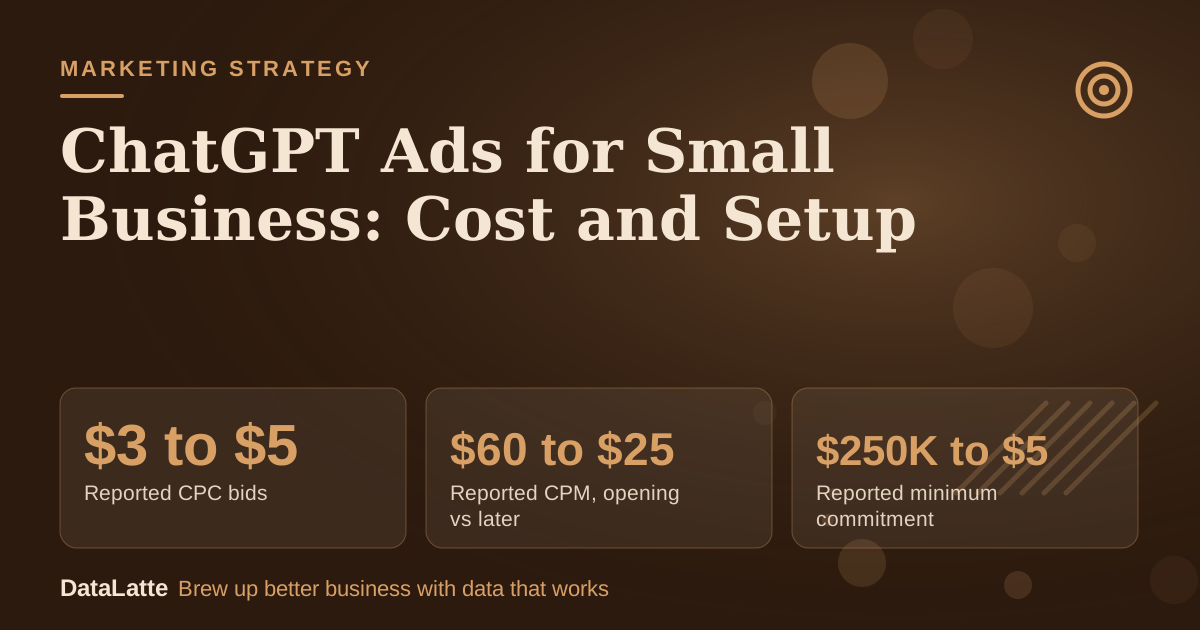
ChatGPT ads are labeled sponsored placements that appear below ChatGPT's answers. A local US business can now buy them through a beta self-serve Ads Manager that OpenAI began rolling out in May 2026, where advertisers set budgets, bids and pacing. Reported prices run from $3 to $5 per click and $25 to $60 per thousand impressions, but those figures are secondary and unconfirmed. A small, capped 4-week test is the sensible way to start.
$3 to $5→

Reported CPC bids

Secondary reports, unconfirmed (Quartz, Relevant Audience)

$60 to $25↓

Reported CPM, opening vs later

Secondary reports, some transactions (Quartz)

$250K to $50K↓

Reported minimum commitment

Pilot minimum, Feb to Apr 2026 (secondary)

600+↑

Advertisers in managed pilot

As of April 2026 (Relevant Audience, secondary)

See Sources at the end of the article. Cards marked Assumption are examples, not results.

What are ChatGPT ads and where do they appear?

OpenAI previewed the direction publicly in January 2026 as a small test with firm guardrails (secondary). The managed pilot launched February 9, 2026 (secondary).
An ad shows up after ChatGPT responds, in a clearly labeled sponsored section below the answer. The answer itself is unchanged, and OpenAI states that ads do not influence how responses are generated (secondary retelling of OpenAI's statements).
Early reports limit the test to logged-in adult US users on the Free and Go plans, while Plus, Pro and Enterprise plans stay ad-free (Workshop Digital, secondary). Users under 18 are excluded, and ads are kept out of sensitive categories such as health, mental health and politics.
For a local business, this means the audience is people asking ChatGPT questions on free tiers, not everyone searching a city. Anyone already using ChatGPT for local business marketing tasks will recognize the surface, but buying an ad there is a different job from writing with it.

How can a small local business buy ChatGPT ads?

There are two routes. The first is OpenAI's beta self-serve Ads Manager. According to OpenAI, businesses can register as advertisers, add payment information, set budgets, bids and pacing, upload ads, launch and manage campaigns, and view performance. OpenAI says it is gradually opening the beta to more businesses, and describes it as built for companies of all sizes, from SMBs to global brands.
The second route is a partner. OpenAI names Dentsu, Omnicom, Publicis and WPP as agency partners, and Adobe, Criteo, Kargo, Pacvue and StackAdapt as technology partners. Partners help with budgeting, bidding and creative, while OpenAI's ads system controls all delivery decisions.
Access is described differently across sources. Quartz (news report) says OpenAI opened the platform to all US businesses. OpenAI's own wording is that access is rolling out gradually. A new account may therefore show a waitlist or limited access. The Ads Manager sign-up screen is the only reliable answer.
Category rules also apply. Quartz reports that eligibility is currently narrow, with consumer goods, local services, travel, entertainment, and digital or educational products among those permitted.

What do ChatGPT ads cost?

OpenAI's announcement confirms the pricing models, not the rates. In the first phase of the pilot, advertisers bought on a CPM basis. OpenAI is adding CPC bidding, says advertisers are only charged on a click outcome, and says it will keep supporting both. The announcement does not list a price or a minimum spend.
Dollar figures come from third parties (secondary, unconfirmed). The sources conflict, so they are shown side by side rather than averaged:
ItemReported figureSource and timing
Launch CPMAbout $60Relevant Audience, Workshop Digital (Feb 2026)
Later CPMAs low as $25, or about $25 in some transactionsRelevant Audience (April 2026), Quartz
CPC bids$3 to $5Quartz (pilot advertisers), Relevant Audience ("currently")
Pilot minimum at launch$250,000 (Workshop Digital says $200,000 to $250,000)Relevant Audience, Workshop Digital
Pilot minimum later$50,000Quartz, Relevant Audience (April 2026)
Self-serve minimum$50,000 barrier reported eliminatedQuartz
The newest dated price point in these sources is from spring 2026. No source documents what rates look like later in the year, and none says whether they will rise or fall. Ask for current rates in the Ads Manager before budgeting.

How do ChatGPT ads compare with Google and Meta ads?

The sources describe ChatGPT ads in detail but give no facts on Google or Meta ads, except one comparison with social CPMs. The table marks those cells "not stated" instead of guessing. Fill them from a live account.
FactorChatGPT adsGoogle search adsMeta ads
Where ads appearLabeled sponsored section below the answerNot statedNot stated
Buying modelsCPM and CPC (OpenAI)Not statedNot stated
Reported price pointsCPM about $25 to $60, CPC bids $3 to $5 (secondary, unconfirmed)Not statedReported ChatGPT CPM is roughly three times typical social averages (secondary)
Entry minimumConflicting: $50,000 barrier reported removed (Quartz); OpenAI's announcement states noneNot statedNot stated
TargetingContextual, matched on conversation topic and intent signals; no demographics or interest profiles shown to advertisers (secondary)Not statedNot stated
Local geo targetingNot statedNot statedNot stated
MeasurementAggregated insights; pixel reported live; conversions API status conflictsNot statedNot stated
Local services eligibleYes, among permitted categories (Quartz)Not statedNot stated
The blank cells carry a practical point. A local business that cannot confirm radius or city targeting in ChatGPT's Ads Manager has no sourced basis to expect neighborhood-level delivery. Search ads on Google remain the baseline to test against, and an updated Google Business Profile still feeds that baseline.

How can results be measured?

OpenAI says advertisers receive aggregated performance insights without access to individual conversations. Quartz adds that advertisers get rolled-up figures, not raw conversation data behind a placement.
Conversion tracking is where sources disagree:
  • OpenAI says it recently launched Conversions API and pixel-based measurement, so advertisers can track purchases, leads and sign-ups after engaging with an ad.
  • Quartz says a conversions pixel is live and a conversions API is in development. It also says cost-per-action bidding and third-party measurement are forthcoming, with no date given.
  • An earlier secondary report (Optimum7, written around the January 2026 test) says there was no standard conversion tracking, no pixels allowed, and only counts of shows and interactions.
The likeliest explanation is timing: the early test was limited and measurement was added later. The Ads Manager should confirm which tools are active on a given account.
Whatever is active, a local business should not depend on it alone. Tag every ad link with UTM parameters, make sure bookings or calls land in Google Analytics 4, and ask new customers how they found the business. Clicks reported by the platform and bookings recorded by the business will rarely match exactly.

What does a 4-week pilot test plan look like?

The plan caps risk. Spend is fixed before launch, one offer is tested, and a stop rule is set in advance. Day and budget rules below are working assumptions, not sourced benchmarks.
Week 0 (before launch)
  • Register as an advertiser, add payment information, and read the current minimum spend and targeting options in the Ads Manager.
  • Check that the category is eligible. Anything near health or mental health needs a direct check, since those categories are kept out.
  • Build one landing page with a booking button or phone number and a UTM-tagged link.
  • Check whether the pixel or conversions API is available and test it with one booking.
Week 1
  • Launch one campaign with one offer, such as a first-visit price. Use CPC bidding if offered, so cost is tied to clicks.
  • Set a total pilot cap (the example below uses $600) and pace it evenly.
  • Check delivery daily, with no edits for the first three days.
Week 2
  • Compare clicks against bookings in GA4 and the booking system.
  • Change one variable only, usually the headline or offer.
Week 3
  • Keep the better version. Ask every new customer how they found the business.
  • Record cost per click and cost per booking in a simple sheet.
Week 4
  • Spend the remaining budget, then compare cost per booking against a Google search ads result for the same offer.
  • Apply the stop rule: continue, adjust, or end.
Anyone planning wider spending can set the pilot beside a local ad spend forecast to see where it fits.

What would a salon pilot cost? A worked example

All inputs below are assumptions chosen for arithmetic, except where a reported range is named. They are not forecasts.
Assumptions: a hair salon spends $600 over four weeks. A CPC of $4 sits inside the reported $3 to $5 range. 5% of clicks become bookings. A first visit is worth $90.
  • Clicks: $600 divided by $4 equals 150 clicks.
  • Bookings: 150 times 5% equals 7.5 bookings.
  • Cost per booking: $600 divided by 7.5 equals $80.
  • First-visit revenue: 7.5 times $90 equals $675.
On those inputs the pilot roughly breaks even on first visits. Repeat visits would decide whether it pays. Cost per booking is simply CPC divided by booking rate, and small changes move it a lot:
CPC (assumption)Booking rate (assumption)Cost per booking
$35%$60
$45%$80
$55%$100
$43%About $133
A CPM purchase shows why click billing is easier to plan. Assume a 1% click rate. At a $25 CPM, $600 buys 24,000 impressions and 240 clicks, or $2.50 per click. At a $60 CPM, $600 buys 10,000 impressions and 100 clicks, or $6 per click. The click rate is the unknown, and it is not documented in the sources.
The same sheet works for a coffee shop (use a first-order value) or a fitness studio (use a trial-class signup). Only the inputs change.

When should a local business skip ChatGPT ads for now?

Skipping is reasonable in several situations, and it costs nothing.
  • The business cannot confirm city or radius targeting. The sources do not document it, and paying for impressions far from the storefront wastes budget.
  • The pilot cap is below what a handful of $3 to $5 clicks require. A budget that buys only a few dozen clicks cannot show a reliable pattern.
  • No booking page, phone tracking or GA4 setup exists. Without them, results are unreadable, and platform-side measurement is still described inconsistently.
  • The business sits near sensitive categories. Health, mental health and politics are kept out of ChatGPT ads.
  • Basics are unfinished: Google Business Profile, reviews, a working website. Fixing those usually comes before trying a new channel. Visibility in other AI surfaces, such as Bing and Copilot, may be a lower-risk first step.
  • The team needs user-level data. OpenAI states conversations stay private, and advertisers see only aggregates.
Whether human judgment or automation should handle the setup is a separate question, covered in this honest AI vs human marketing comparison.

FAQ

Can a small business buy ChatGPT ads without an agency?

OpenAI says its beta self-serve Ads Manager lets businesses register, add payment, set budgets and bids, upload ads and view performance. It is being opened gradually, so a new account may not have immediate access. Agency and technology partners are an alternative route.

How much do ChatGPT ads cost?

OpenAI's announcement confirms CPM and CPC buying but lists no prices. Third-party reports cite CPMs from about $60 down to about $25 and CPC bids of $3 to $5. Those figures are secondary and unconfirmed, and the dated points are from spring 2026. Confirm current rates in the Ads Manager.

Is there a minimum spend?

Sources conflict. Secondary reports put the pilot minimum at $250,000 and later $50,000, and Quartz reports that the $50,000 barrier was eliminated for self-serve buying. OpenAI's announcement does not state a minimum, so the Ads Manager is the place to confirm.

Can ChatGPT ads target people by age or interests?

The sources describe matching as contextual, based on conversation topic and intent signals, rather than advertiser access to user profiles. Advertisers reportedly see no demographics or interest profiles. Local geo targeting is not documented in the sources.

Does ChatGPT show ads to everyone?

No. Early reports limit ads to logged-in adult US users on the Free and Go plans. Plus, Pro and Enterprise plans were reported as ad-free, and users under 18 are excluded.
Not sure whether ChatGPT ads belong in the mix? A free audit compares them with Google Ads results for the same local offer, using the business's own numbers.

Sources

Free for local businesses

Want this applied to your business?

I'll review your Google presence, local SEO, and ad accounts — and send you a specific action plan within 48 hours. No pitch, no pressure.

chatgpt adslocal advertisingad costssmall businessppc

Want hands-on help?

See how DataLatte handles Analytics & Reporting for local businesses.

Learn more
Nataliia — local marketing expert
Nataliia Rumiantsewa

Local marketing strategist with 10+ years at global agencies — OMD, Dentsu, GroupM, and BBDO. Now helping small businesses get the same data-driven edge. Based in Europe, working with clients in the US, UK, Australia, and beyond.

Want this applied to your business?

Let's review your current marketing setup together — free, no obligations.

Get Your Free Marketing Audit