Call Tracking for Small Business Compared (2026)
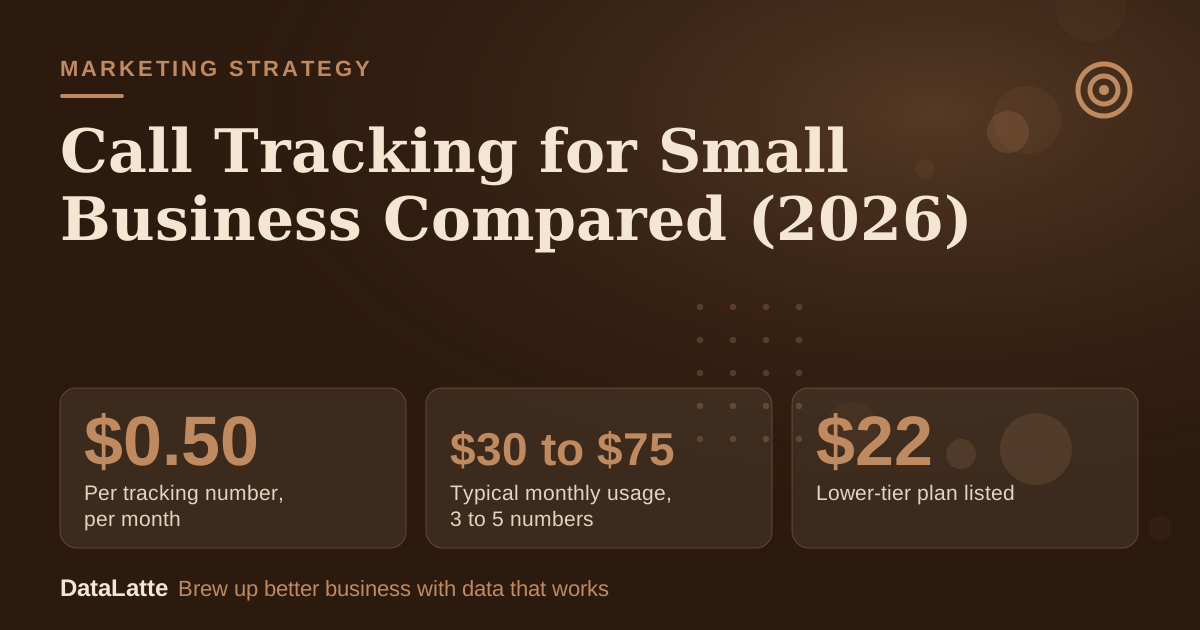
Per tracking number, per month
One provider's published price, via Adwave (secondary)
Typical monthly usage, 3 to 5 numbers
Same provider's claim, via Adwave (secondary)
Lower-tier plan listed
Analytic Call Tracking, via Adwave (secondary)
Google link delay
Search Console link to Google Ads, Google support
See Sources at the end of the article. Cards marked Assumption are examples, not results.
What is call tracking and how does it work for a small business?
How much does call tracking cost for a small business?
| Tool | Entry price | Included calls or minutes | Key limits | Source type |
|---|---|---|---|---|
| WhatConverts | Not stated | Not stated | Pricing page lists attribution cookies; plan limits not stated | Primary |
| Unnamed provider (reported by Adwave) | Numbers from $0.50 a month each, plus per-minute charges | Not stated; billed per minute | Typical usage of $30 to $75 a month for 3 to 5 numbers, on top of the plan | Secondary (vendor's published price as retold) |
| Analytic Call Tracking | $22 a month for a lower-tier plan | Not stated | Higher tiers not stated | Secondary |
| One full-featured tool in WhatConverts' 2026 roundup | From $30 a month | Not stated | Tool not named in the report | Secondary |
| Google forwarding numbers (Google Ads) | Not stated | Not stated | Available only in countries on Google's list; a call counts only above a minimum length the advertiser sets | Primary |
| Adwave platform | No subscription; daily budget $30 to $10,000 covers media, ads and management | Not applicable | Call tracking software is billed separately by its own provider | Secondary (vendor claim) |
How does Google Ads report phone calls?
What setup limits does Google document?
- Only one number can be tracked on a single page with the default JavaScript tag.
- In Google Tag Manager, the phone number entered in the website call conversion tag must match the exact digits shown on the website.
- The standard Tag Manager call conversion tag is not compatible with international number formats and can display unintended plus signs on forwarding numbers.
- Google does not recommend installing the call conversion tag through Tag Manager when the site uses DNI or third-party call tracking.
- The Google tag cannot verify a domain when it is installed through a tag management system.
- After Google Search Console is linked to Google Ads, the link takes 24 hours to take effect, and call assets must be resubmitted for review.
When does a small business not need call tracking?
- Bookings happen mostly through an online scheduler, so calls are a small fraction of inquiries. An online booking system already records where those bookings start.
- Only one paid channel runs. If every call follows a single ad, the source is already known.
- Call volume is very low. Per-minute and per-number charges are small, but a monthly plan still has to be justified by decisions it improves.
- Nobody reviews the reports. Without a monthly review of calls by source, the data does not change spending.
What does a two-week setup look like?
Week 1: decide and choose
- Days 1 and 2: pull the last 30 days of calls from the phone carrier or the front-desk log, and note how many were new customers.
- Day 3: list every place the phone number appears (website, Google Business Profile, ads, flyers, directories).
- Day 4: request written quotes from two or three vendors covering monthly fee, included minutes, per-minute rate, cost per extra number and contract length.
- Day 5: ask each vendor whether it supports DNI and how it works with Google Ads call conversions.
- Days 6 and 7: pick one vendor and choose the number of tracking numbers needed, one per source.
Week 2: install and test
- Day 8: link Google Search Console to Google Ads if needed, and note that the link takes 24 hours to take effect and call assets need resubmitting for review.
- Day 9: install the vendor's website snippet, or the Google call conversion tag, avoiding Tag Manager where Google advises against it.
- Day 10: set the minimum call length for conversions in Google Ads.
- Day 11: place the new numbers on the Google Ads call asset and other listings, keeping the exact digits consistent.
- Day 12: place test calls from a mobile phone to every number and confirm each call lands in the right source.
- Day 13: add a cookie and call-recording notice to the website and phone greeting, after checking local requirements with a lawyer.
- Day 14: schedule a monthly review of calls by source, and write down what result would change the ad budget.
What does call tracking cost in a salon example?
- Three tracking numbers: Google Ads, website, Google Business Profile.
- Plan fee: $30 a month (assumption, set equal to the lowest full-featured price listed in the Adwave roundup report, secondary).
- Number fee: $0.50 a month each, from one provider's published rate (secondary), treated as separate from the plan.
- Usage: $30 to $75 a month, that provider's stated range for 3 to 5 numbers (secondary).
- Google Ads spend: $600 a month (assumption).
- Calls from ads over the minimum length: 60 a month (assumption).
- Share of those calls that become bookings: 40% (assumption).
- Average ticket: $90 (assumption).
- Number fees: 3 × $0.50 = $1.50.
- Monthly tracking cost: $30 + $1.50 + $30 = $61.50 at the low end, and $30 + $1.50 + $75 = $106.50 at the high end.
- Bookings from ads: 60 × 40% = 24.
- Revenue from those bookings: 24 × $90 = $2,160.
- Ad cost per booking: $600 ÷ 24 = $25.
- Tracking cost per booking: $61.50 ÷ 24 ≈ $2.56 to $106.50 ÷ 24 ≈ $4.44.
FAQ
Does call tracking work with Google Ads call conversions?
How much does call tracking cost per month?
Can a business track more than one phone number on a page?
Is Google's AI call analysis available to every small business?
Sources
- WhatConverts: Lead and Call Tracking Software Pricing (primary, cookie disclosures)
- Adwave: Call tracking for small business ads (secondary, published 2026-10-23; vendor and third-party prices retold)
- Google Ads Help: Set up tracking calls to a phone number on a website (primary)
Free for local businesses
Want this applied to your business?
I'll review your Google presence, local SEO, and ad accounts — and send you a specific action plan within 48 hours. No pitch, no pressure.
Want hands-on help?
See how DataLatte handles Analytics & Reporting for local businesses.

Local marketing strategist with 10+ years at global agencies — OMD, Dentsu, GroupM, and BBDO. Now helping small businesses get the same data-driven edge. Based in Europe, working with clients in the US, UK, Australia, and beyond.
Related articles

SMS Marketing Platforms for Small Business Compared
9 min read
Net Promoter Score for Small Business: Worth It?
8 min read
Marketing for Food Trucks: Locations, Profile, Ads
7 min read
Marketing for Car Washes: Get More Traffic
7 min readWant this applied to your business?
Let's review your current marketing setup together — free, no obligations.
Get Your Free Marketing Audit