A brand lift study compares people who saw an ad with people who did not, usually through a short survey, to measure changes in awareness, recall or intent. Small local advertisers rarely need a full platform-run study. A lighter version works: a branded search comparison, a short customer survey, or a split between ZIP codes, all run over about six weeks.
→
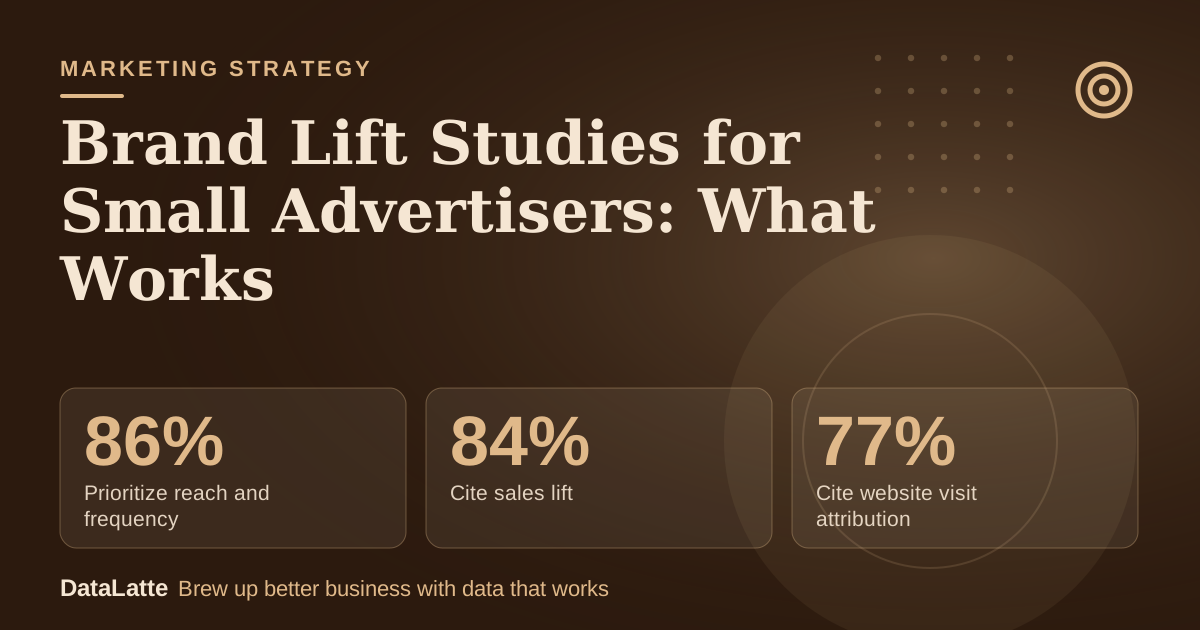
Prioritize reach and frequency
CTV reporting metric, StackAdapt (secondary), 2025
↑
Cite sales lift
CTV reporting metric, StackAdapt (secondary), 2025
↓
Cite website visit attribution
CTV reporting metric, StackAdapt (secondary), 2025
Assumption→
Example ad recall window
Example survey question, StackAdapt (secondary), 2021
See Sources at the end of the article. Cards marked Assumption are examples, not results.
What is a brand lift study?
A brand lift study is a measurement method built around a survey. According to a vendor-published article from StackAdapt (secondary), the survey usually splits people into an "exposed" group that has seen the ad and a "control" group that has not.
StackAdapt (secondary)
The gap between the two groups is the lift. If 38 of 100 exposed people recall a coffee shop and 22 of 100 unexposed people do, the difference is the part that advertising plausibly explains.
The same vendor describes survey ads, also called discovery ads or brand lift ads, as an interactive HTML5 unit that delivers the questions. The vendor also says a study measures impact across all of an advertiser's programmatic channels. That scope suits brands running many channels at once. A single-location salon or groomer usually runs one or two.
The idea is also old. One advertising-measurement page (secondary) traces the field to simple "Do you remember this ad?" surveys in the 1950s.
AdWave (secondary)
What does a brand lift study actually measure?
The StackAdapt article lists brand awareness, ad recall, brand favourability and brand affinity as the metrics a study shows for incrementality.
StackAdapt (secondary)
It also says studies can assess upper-funnel campaigns' effect on brand perception, and mid- to lower-funnel campaigns' effect on consideration or purchase intent.
The example question it gives asks whether a user recalls seeing an ad for the brand in the last 14 days. That wording is a useful template for any local survey, because a short, fixed window keeps answers comparable.
Brand lift does not measure sales directly. A related figure from the same vendor's CTV attribution article (secondary): 84% of advertisers cite sales lift and 77% cite website visit attribution as important CTV reporting metrics. Recall and intent sit upstream of those.
StackAdapt (secondary)
For a local owner, the practical reading is simple. Lift tells whether people noticed and considered the business. Bookings, visits and calls tell whether that turned into revenue. Both belong in the same plan, as laid out in the
local marketing funnel.
Minimum budget and eligibility rules for Google's and Meta's brand lift tools are not documented in the material behind this article. Any number quoted from memory or a forum thread should be treated with caution. The reliable route is to read the current help pages and ask the platform rep or agency for today's minimum spend, eligible campaign types and survey sample requirements before planning around a study.
What is documented is Meta's A/B testing. Meta's help page says it compares two versions of an ad strategy by changing variables such as images, text, audience or placement, and each version goes to a segment of the audience so nobody sees both.
MetaResults can be measured on a cost per result basis or a cost per conversion lift basis. Meta also advises equal budgets for both versions, notes that duplicating a campaign duplicates its budget, and recommends against switching ad sets on and off manually, since informal tests can overlap audiences and give unreliable results.
That is a conversion test, not a survey-based brand study. It still applies the same logic of exposed against not exposed, at small-business scale.
Which cheaper alternatives work for a local business?
Three low-cost methods approximate the exposed-versus-control design. None has a sourced price in this article, so cost entries below say what drives the cost rather than quoting a figure.
| Method | What it measures | Cost / eligibility (as sourced) | Who it suits |
|---|
| Platform brand lift study (Google, Meta, programmatic vendors) | Awareness, ad recall, favourability, affinity (per StackAdapt, secondary) | Minimums not documented here; ask the platform for current terms | Advertisers with larger, multi-channel budgets |
| Meta A/B test | Cost per result or cost per conversion lift (per Meta help page) | Same budget for both versions advised; no minimum documented here | Shops already running Meta ads |
| Branded search lift | Change in searches for the business name before, during and after a campaign | No sourced fee; uses free analytics and search reports the business already has | Any shop with a few weeks of baseline data |
| Simple recall survey | Share of customers recalling an ad in a fixed window, such as 14 days | No sourced fee; cost is staff time or a form tool | Counters, front desks, booking confirmations |
| Geo test | Difference in results between ZIP codes with ads and comparable ZIP codes without | No sourced fee; ad spend is limited to test areas | Single or two-location businesses with defined trade areas |
Branded search pairs well with
Google Analytics 4 for small business and the
Google Business Profile checklist, since profile views and name searches both show interest in the business.
How does a 6-week lift test run?
The plan below combines a branded search comparison, a recall survey and a geo split. It uses a four-week campaign window bracketed by baseline and wrap-up weeks.
Week 1: baseline and setup
- Record weekly branded searches, profile views and bookings for the prior four weeks.
- Pick test ZIP codes and comparable control ZIP codes.
- Write a recall question using a 14-day window.
Week 2: launch
- Start ads in the test ZIP codes only.
- Keep budget, creative and offers steady, and note any promotions.
Week 3: first read
- Check branded searches against the baseline.
- Start collecting survey answers from new customers in both areas.
Week 4: hold steady
- Make no creative or budget changes, since mid-test changes blur the comparison.
- Keep logging surveys.
Week 5: final campaign week
- Close the survey with at least 100 answers per area where possible.
- Log weather, holidays and local events.
Week 6: read and decide
- Compute search lift, recall gap and cost per incremental search.
- Decide whether to continue, expand or change the message.
For CTV campaigns specifically,
how to measure CTV ads for a local business covers complementary tracking.
What does a worked example look like?
The example below is a coffee shop. Every input is an assumption, not a benchmark.
Assumptions
- Campaign spend: $1,200 over four weeks (assumption).
- Baseline: 60 branded searches per week, averaged over the four weeks before launch (assumption).
- During the campaign: 78 branded searches per week on average (assumption).
- Survey, test ZIP codes: 100 new customers asked about the last 14 days, 38 recall an ad (assumption).
- Survey, control ZIP codes: 100 new customers, 22 recall an ad (assumption).
Calculation
- Weekly search lift: 78 − 60 = 18 searches, or 30% above baseline.
- Incremental searches over four weeks: 18 × 4 = 72.
- Cost per incremental branded search: $1,200 ÷ 72 = $16.67.
- Recall gap: 38% − 22% = 16 percentage points.
Reading it
The search lift and the recall gap point the same direction, which strengthens the case that the ads moved attention. The 22% recall in the control area is a reminder that people see other things, such as signage, word of mouth and social posts, so the gap matters more than the raw 38%.
A final step turns attention into visits. Pair the lift with a trackable offer, and see
how to build a loyalty program for ways to tie visits back to customers.
What are the limits of these lightweight tests?
Samples of 100 per area are small. A swing of a few points may be noise, so a result should be treated as directional.
Seasonality can inflate branded searches. Holidays, school schedules and weather change coffee, grooming and fitness demand regardless of ads. Choosing control ZIP codes with similar demographics helps, and so does repeating the test.
Meta's help page makes a related point about informal testing: manual on-off switching can give overlapping audiences and unreliable results.
Meta The same caution applies to geo splits, so test and control areas should not share a heavy overlap of commuters or events.
Platform studies add scale and a controlled survey design, but their minimums are not documented here. A local advertiser spending a few hundred dollars a month may find a self-run test more practical, then move to a platform study if spend grows.
Budget planning for the year, including how much to commit to testing, fits alongside the
local ad spend forecast.
FAQ
Do brand lift studies prove ads drove sales?
No. They measure shifts in recall, awareness or intent between exposed and control groups. Sales effects need separate tracking, such as bookings, redemptions or foot traffic against a baseline.
A minimum is not documented in the material behind this article. Ask the platform rep or check the current help pages before planning, since requirements can change.
Is a customer survey enough for a small shop?
It can be a useful directional check if the question is fixed, the window is short, such as 14 days, and a comparison group exists. Small samples limit precision, so repeat it before making big decisions.
A geo test splits locations, with ads in some ZIP codes and not others. Meta's A/B test splits audiences within the platform so nobody sees both versions, and it measures cost per result or cost per conversion lift.
Sources
Want a second set of eyes on a lift test design or current ad account? Request a
free audit.
Free for local businesses
Want this applied to your business?
I'll review your Google presence, local SEO, and ad accounts — and send you a specific action plan within 48 hours. No pitch, no pressure.