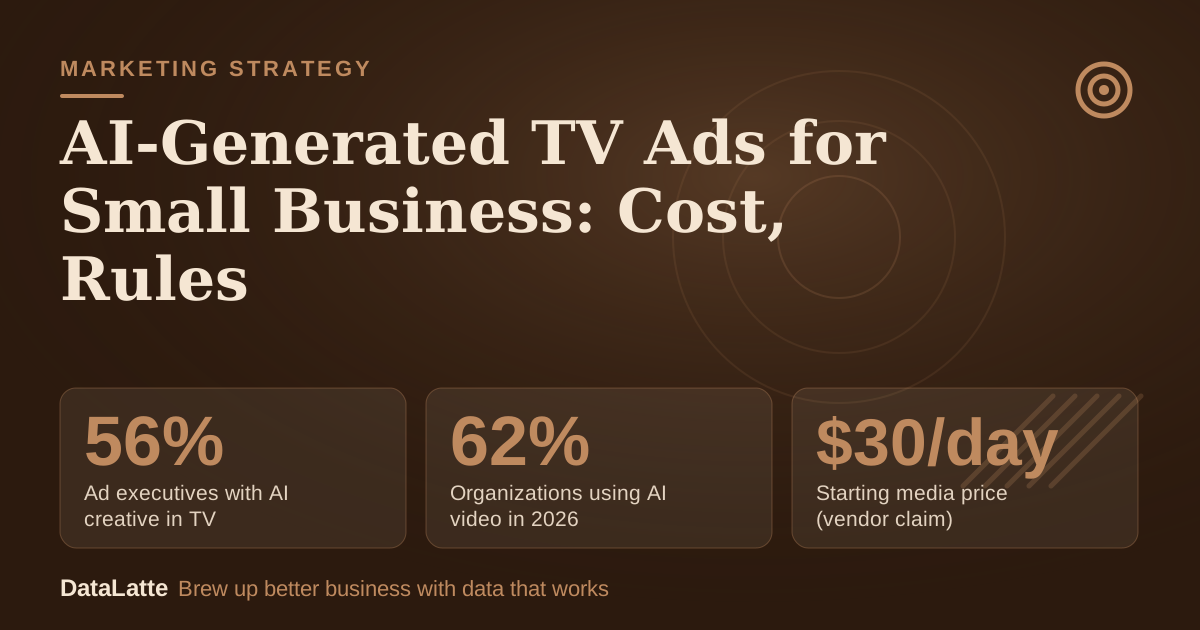
A small business can now make a 30-second streaming TV commercial with generative AI instead of hiring a production crew. One vendor says it generates the spot in about 2 minutes, charges often $0 for creation, and starts media at $30/day. Those figures are vendor claims and unconfirmed. Studio production, by the same vendor's account, runs $10,000 to $50,000 or more. The legal rules are patchy, so a pre-air checklist matters.
→
Ad executives with AI creative in TV
Mountain survey summary, secondary
↑
Organizations using AI video in 2026
Up from 51% in 2025, per Mountain chart with unnamed source
↓
Starting media price (vendor claim)
Adwave, as of 2026-08-08, unconfirmed
→
Traditional commercial production (vendor page)
Adwave citing industry sources, as of 2026-08-08
See Sources at the end of the article. Cards marked Assumption are examples, not results.
Two kinds of tools show up in the sources. The first is a platform that generates the commercial and sells the media in one flow. Adwave says it
runs an AI-generated commercial on streaming TV, Meta, and Google the same day, with media starting at $30/day (secondary, vendor claim). The result, per the vendor, is a 30-second spot for local and regional streaming campaigns.
The second is the wider push by large platforms. A Digiday report from September 2025 says
TV broadcasters and walled garden platforms are competing to lower the cost of ad creative, and names Amazon, Google, Comcast, ITV and Channel 4 as each hoping to capture a share of the long tail of ad spend. The article also says AI removes a longstanding barrier to entry for small business advertisers (secondary, trade press).
What the sources do not document: which specific broadcaster tools are open to a single-location coffee shop or salon today, and what they cost. A local advertiser should ask each seller for current rates and creative terms. Background on where local streaming inventory sits is in
Tubi and Pluto TV ads for local business.
How much does an AI TV ad cost compared with a studio?
Reported figures differ widely by source, and nearly all come from one vendor with a reason to make the studio route look expensive. The table keeps each number tied to where it came from.
| Route | Reported production cost | Reported time | Revisions | Source |
|---|
| Traditional studio or agency | $10,000-$50,000+; entry level $5,000-$10,000; professional $20,000-$50,000; premium $100,000+ | 6-12 weeks minimum | $500-$5,000 per round | Adwave and Adwave (secondary, vendor) |
| Traditional, third-party range | $1,000 to $1,000,000 depending on complexity | Not stated | Not stated | Media Culture, cited on the Adwave page (secondary) |
| AI tool from a platform | Often $0 to create; pay only to run the ad (vendor claim); media from $30/day | Under 10 minutes total; about 2 minutes to generate; 1-2 minutes per edit (vendor claims) | Free per vendor claim | Adwave (secondary, unconfirmed) |
| DIY with general AI tools | Not stated | Not stated | Not stated | No source covers this route |
Line items for the studio route, per the vendor page: concept and script $1,000-$5,000, crew $2,000-$10,000 per day, talent $500-$5,000+ per actor, equipment $1,000-$5,000, locations $500-$5,000, post-production $2,000-$10,000.
"Free" applies to creation only. Media still costs money, and the vendor's own comparison for a test campaign is
$15,000-$25,000 traditional versus media from $30/day. For the media side, see
local TV advertising cost for small business.
How good is an AI-generated commercial, and who is using them?
Adoption is rising, though the figures come from a secondary summary. A Mountain page reports that the share of organizations using AI video in digital marketing
rose from 51% in 2025 to 62% in 2026, an 11-point gain, though the chart's source is not named. It also reports that 56% of surveyed advertising executives had deployed AI creative in television, against 73% in display and 42% in audio. A separate 85% figure for social covers only AI-using advertisers, so it is not directly comparable.
Quality is the weaker side of the evidence. The same page says small and mid-size digital-video buyers were not satisfied with their current level of GenAI use for creative ad production. Nothing in the sources independently tests whether a vendor's "broadcast-ready" output holds up on a large screen.
A StackAdapt article cites
Coca-Cola and Toys 'R' Us campaigns that drew backlash for lacking a human touch (secondary, citing 2024 Forbes coverage). The lesson for a neighborhood business is practical: an AI spot of a generic café may look like every other AI spot. Real storefront footage, real menu items and a recognizable owner voice are the human parts worth keeping. The tradeoffs are covered in
AI vs human marketing for local business.
What do the rules say about AI-generated ads?
This section is not legal advice. The summaries below come from a law-firm article, which is a secondary source, and the FTC's own
advertising and marketing guidance is the place to check current rules before airing anything.
According to the
ArentFox Schiff 2026 review, New York enacted a first-in-the-nation law in 2025 requiring conspicuous disclosure when an ad features a "synthetic performer," and the law takes effect June 9. The summary as reviewed gives no year for that date, so confirm it. The sources describe no other state laws on synthetic performers, which is not proof that none exist.
On the federal side, the same article says the FTC's Operation AI Comply, launched in 2024, targets inflated or unsubstantiated claims about AI capabilities, with more than a dozen actions since. One settlement, with Growth Cave, was for $48.6 million. These cases concern claims about what AI products can do, not how an ad was produced. The sources do not describe a federal law requiring every AI-made ad to carry a label, and that absence is not confirmation that none exists.
Ordinary substantiation rules still apply to the words in an ad. The article describes an NAD challenge to a "2x faster" healing claim, and an FTC action over unsubstantiated claims, fake testimonials and manipulated reviews. An AI script that invents a superlative creates the same exposure as a human one.
What should be checked before an AI ad airs?
Six checks cover the main exposure: claims, real products, real people, disclosure, brand safety and creative specs. Spread across four weeks, they leave time to fix problems before media spend begins.
| Week | Task | Pass condition |
|---|
| 1 | Write the claims list: every price, offer, "best," "fastest" or "award-winning" line | Each claim has proof on file, or is cut |
| 1 | Collect real photos and video of the storefront, products and staff | Generated visuals match what customers actually get |
| 2 | Generate drafts and review frame by frame | No invented menu items, services, equipment or locations |
| 2 | List every person on screen, real or synthetic | Real people have written consent; synthetic performers are flagged |
| 3 | Decide disclosure wording and placement | Checked against the FTC site and the New York synthetic performer rule if the ad could run there |
| 3 | Brand-safety pass: audio, text on screen, odd visual artifacts | Nothing off-brand, misleading or distracting |
| 3 | Check creative specs against the platform | Matches the CTV creative specs guide and the seller's own requirements |
| 4 | Launch small, with tracking set before spend | Measurement follows how to measure CTV ads for local business |
If any item fails, the ad does not run until it is fixed. Cheap creation makes fast re-edits easy, so the delay costs little.
What does a coffee shop test look like in numbers?
All inputs below are assumptions for illustration, not results or benchmarks.
Assumptions: a single-location coffee shop runs a 4-week streaming test, 28 days at the vendor's "from" rate of $30/day. Real photography of the shop and menu costs $250. A one-hour compliance or legal review costs $300. A new regular customer is worth $90 in gross margin over 12 months.
- Media: 28 days x $30 = $840
- Photography: $250
- Review: $300
- Total: $1,390
Breakeven is $1,390 divided by $90, about 15.4, so 16 new regulars attributable to the campaign. Against the vendor's $15,000-$25,000 traditional test, $1,390 is roughly 9% and 6% of that range.
Three caveats apply. "From $30/day" is a starting price, and reach at that level is not documented in the sources. Attribution for a coffee shop is hard, since walk-ins rarely mention the ad. And the vendor's creation cost is "often $0," which may not hold for every account. A
worth-it check for small CTV budgets helps decide whether to run the test at all.
FAQ
Is it legal to run an AI-generated TV ad?
The sources reviewed do not describe a blanket federal ban or a blanket federal labeling law for AI-generated ads. They do describe a New York synthetic performer disclosure law and FTC enforcement over unsubstantiated AI-related claims. This is not legal advice. Check the FTC website and ask a lawyer about the states where the ad will run.
Do AI ads need an AI label?
Not under any universal rule documented in the sources. New York requires conspicuous disclosure when an ad features a synthetic performer, per a law-firm summary (secondary). Platforms may have their own policies, which the sources do not cover. Ask the seller what disclosure it requires.
Will AI make TV ad prices cheaper?
Cheaper creative is documented as a goal: Digiday reports broadcasters and platforms competing to lower creative costs. Future media prices are not documented in the sources, so no price drop should be assumed. Ask each seller for current rates and minimums.
Are the $30/day and 2-minute claims reliable?
Both come from one vendor's marketing pages as of August 2026 and are unconfirmed. Treat them as a starting point for a quote request, and verify reach, minimums and creative approval steps in writing.
Sources
- The Rise of AI-Generated Commercials: What It Means for 2026, Mountain (secondary)
- AI TV Commercials for Small Business, Adwave (secondary, vendor)
- How AI is Revolutionizing TV Commercial Production, Adwave (secondary, vendor)
- AI meets creativity: How generative AI is reshaping ad creative workflows, StackAdapt (secondary, vendor blog)
- Media Buying Briefing: Gen AI creative emerges as new battleground between TV and platforms, Digiday (secondary, trade press)
- Advertising Law Compliance in 2026: Five Developments Every Advertiser Should Know, ArentFox Schiff (secondary, law firm summary)
- Advertising and Marketing, FTC business guidance
Planning a first streaming test and unsure where to start?
Request a free audit for a review of creative, budget and tracking before spend begins.
Free for local businesses
Want this applied to your business?
I'll review your Google presence, local SEO, and ad accounts — and send you a specific action plan within 48 hours. No pitch, no pressure.