AI agent ad buying through MCP means an assistant such as Claude or ChatGPT connects to an ad account and reads reports, or changes campaigns, from plain-English requests. MCP (Model Context Protocol) is an open standard Anthropic released in November 2024 for connecting AI assistants to outside tools and data, per
Superscale AI (vendor-published, secondary). For a local business, reading reports is low risk. Changing live spend needs caps and a human sign-off.
→
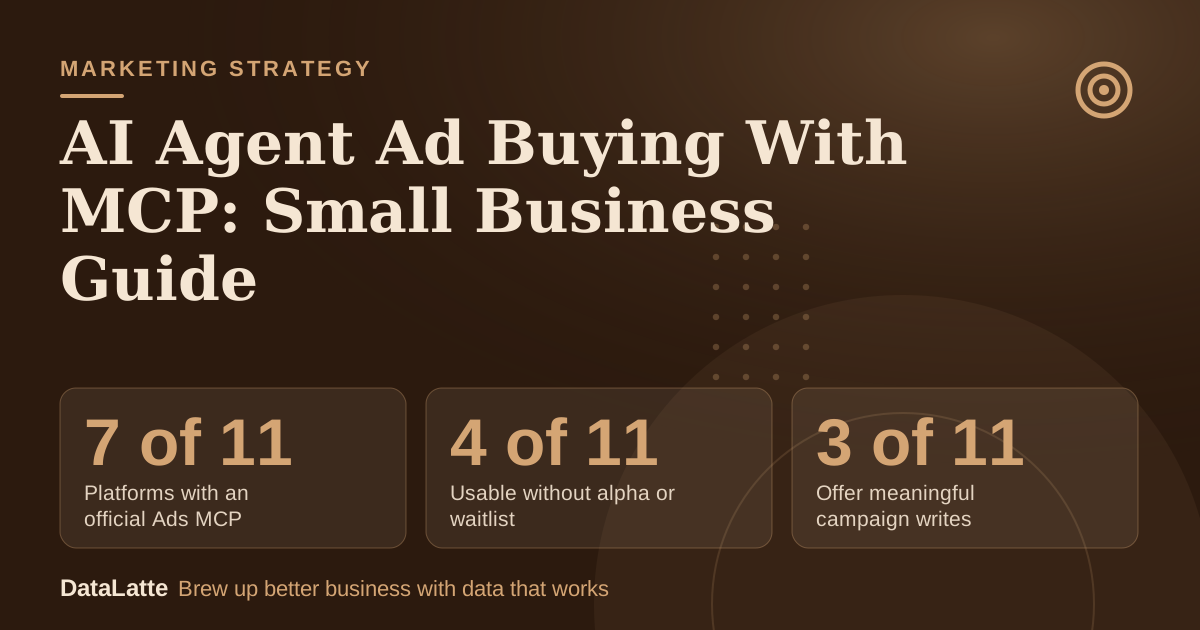
Platforms with an official Ads MCP
Markifact review, July 2026 (vendor-published, secondary)
↑
Usable without alpha or waitlist
Markifact review, July 2026 (vendor-published, secondary)
↓
Offer meaningful campaign writes
Markifact review, July 2026 (vendor-published, secondary)
→
Superscale plan for ad account connection
Superscale AI pricing page (vendor-published, secondary)
See Sources at the end of the article. Cards marked Assumption are examples, not results.
What does MCP mean in plain words?
MCP works like a standard plug between an AI assistant and another tool. Without it, an assistant only knows what is typed into the chat. With it, the assistant can ask the ad account for data, such as last week's spend, and read the answer. Some connectors also let it send instructions back.
The key idea for a business owner is that a connector has a scope. A read-only connector can look but not touch. A write-enabled connector can create, edit or pause campaigns, which affects real money. The same assistant behaves very differently depending on which scope was granted.
ContentGrip (trade publication, secondary) reports that ad-platform MCP access moved from experimental developer infrastructure to a common interface pattern in less than a year. By August, it says, Google, Meta, TikTok and X had all published, tested or launched some form of MCP-based access to advertising workflows.
That speed is the reason for caution. Features are new, many are in beta, and the documentation of what each connector can do is uneven.
Sources differ in how far along each platform is, so the table separates what is reported from what is unconfirmed. Statuses come from the sources' own dates; check each platform's current documentation before relying on them.
| Platform | What the sources say | Status per sources | Who it suits |
|---|
| Google Ads | Open-source MCP server for the Ads API released October 7, 2025 (PPC Land, secondary). Read-only, three tools: list accounts, run searches, get metadata (Markifact, vendor-published, secondary). | Available, read-only | Owners wanting reports in plain English |
| Meta | Ads AI Connectors open beta announced April 29, 2026; write access from day one per PPC Land. A June ContentGrip piece still called Meta's server a test and concept. | Open beta; sources disagree on maturity | Owners already running Facebook or Instagram ads, after read-only testing |
| Amazon | Open beta from February 2, 2026; can create, update and delete campaigns and reach billing data. Limited to partners with active API credentials (Markifact). | Open beta, partner-only | Rarely a local shop |
| Microsoft | Open pilot announced June 17, 2026; read-only access to campaigns, keywords and metrics (Markifact). | Open pilot, read-only | Bing Ads users wanting reporting |
| TikTok | Ads MCP Server announced at TikTok World in May; Agentic Hub launched June 30 (ContentGrip, Markifact). | Announced and launched; scope not detailed in sources | Developers and agencies |
| X | X Business says advertisers can create, manage and optimize campaigns through a developer account using MCP clients (ContentGrip). | Reported by ContentGrip | Technical advertisers |
| Pinterest, Snap | Pinterest announced MCP work on June 17 with alpha partners. Snap said on June 18 it was opening its ads platform to third-party agents (Markifact). | Alpha or announced | Not yet practical |
| OpenAI | No source documents an OpenAI-published ad-buying MCP. ChatGPT can connect to custom MCP servers (see below). | Not documented | Not applicable |
What can an assistant read, and what can it change?
Reading covers account discovery, performance reporting and structured lookups.
ContentGrip says Google's release is built for exactly that, and that an agent on it cannot modify bids, pause campaigns or create assets. Markifact adds that Google's server cannot create a campaign or update a budget.
Changing is where connectors split. Amazon's beta reportedly handles creating and deleting campaigns, managing account settings and accessing billing data. Meta's connectors support write access from day one, according to PPC Land. Markifact's review counts only three of 11 platforms with meaningful campaign writes.
ChatGPT adds its own permission layer. Per
Adwave (vendor-published, secondary), summarizing OpenAI documentation checked on November 2, 2026, custom MCP servers get full write access only on Business and Enterprise workspaces. On Pro, they have read and fetch permissions only. On Business, only admins and owners can create and publish custom servers.
For a salon or coffee shop on a personal ChatGPT plan, that means reporting questions are the realistic starting point. Prompt ideas for non-ad tasks are in
ChatGPT prompts for local business marketing.
What are the risks of letting an assistant touch live spend?
The main risk is write access combined with real money. A misread instruction, such as "double the budget on the cheap campaign," can be executed as typed. The sources reviewed do not document an undo function for connector actions, so any change should be treated as live and reversible only by making another change.
Beta status is the second risk. Meta's connectors are labeled open beta, and ContentGrip noted that public detail did not support claims of unrestricted production write access. The two reports on Meta do not fully line up, which is itself a reason to test with reporting before editing.
Permissions are the third. An assistant connected through an owner login inherits everything that login can do. Amazon's beta reportedly reaches billing and financial data, so a connection is not just a reporting window.
Third-party connectors add a fourth risk: another company sits between the assistant and the ad account. Superscale notes that Ryze's own roundup ranks Ryze first, so vendor lists of "best MCP tools" should be read as marketing. The same caution applies to the Markifact review, since Markifact sells a Google Ads MCP.
What do third-party connectors cost?
Prices below come from vendor pages and are vendor-published (secondary). They may change.
Superscale AI says its free plan includes 1,000 credits with no card. Connecting ad accounts requires the Pro plan at $199 per month or higher; the $99 Advanced plan covers ad creation but not the account connection. A Google Ads report run costs 10 credits and a plain chat message 1 credit. On those figures, 1,000 free credits would cover up to 100 report runs if nothing else used them (arithmetic from the stated rates).
Adwave takes a different route. Per its page, connecting ChatGPT is free, campaigns start at $30 a day from a prepaid wallet with no contract, and campaigns run in the US and Canada only. Launching a campaign sets the day's budget aside, and the next morning the user is charged for what ran, never more than the amount set aside. A daily budget repeats until paused or ended. Adwave is not in ChatGPT's plugin directory, so it must be added manually.
Universal Ads' September 2026 MCP release is a local connector for technically-minded partners and developers, covering natural-language performance queries. It says creating and launching campaigns through connectors is still only being tested. Its
TV agent buying pilot with FOX Advertising is a vendor claim of weeks reduced to minutes, aimed at larger advertisers.
What does a safe-use policy look like?
Three rules cover most of the exposure, and each can be written on one page.
Read-only first. Connect the assistant with report access only and keep it there until its answers match the platform's own dashboard. If a connector cannot be limited to reading, do not connect it yet.
Budget caps. Cap the money at risk outside the assistant. A prepaid wallet limits exposure by design, as Adwave describes. On platforms with account-level spend controls, check current documentation and set them. The sources do not specify such controls for Meta or Google connectors.
Human approval. Any step that modifies an account should wait for a person.
ContentGrip reports that Markifact's hosted Google Ads MCP holds every modifying operation for human approval, and that its founder says the marketer retains the final decision. That is a vendor claim, but it is a sound pattern to demand from any tool.
Add two practices: keep a change log with date, what was asked and what changed, and name one owner for the connection. The broader question of where automation helps and where people still win is covered in
AI vs human marketing for local businesses.
What does a 2-week safe pilot look like?
The schedule keeps spend flat for two weeks while testing whether reporting help is accurate.
Week 1: read-only
- Day 1: List every ad account and who has admin rights. Remove old logins. Decide who owns the connection.
- Day 2: Write the one-page policy: read-only, a daily spend ceiling, approval for every change.
- Day 3: Connect a read-only option, such as Google's reporting server or a free-tier connector. Do not enable write scopes.
- Day 4: Ask five questions: spend by campaign, cost per lead, best day of week, worst ad, and anything unusual. Compare each answer with the platform dashboard.
- Day 5: Log mismatches. Any answer that is wrong twice means stop and fix the setup.
- Weekend: No assistant access to changes. Check that spend matches the plan.
Week 2: drafts, then one approved change
- Day 8: Ask for recommendations as text only. No action.
- Day 9: Review them against Google Analytics 4 data to confirm leads and bookings tell the same story.
- Day 10: Approve at most one small change, such as pausing one weak ad. Make it manually or through an approval-gated tool.
- Day 11: Check the result and spend the next morning.
- Day 12: Review the log and total minutes saved.
- Day 14: Decide: keep read-only, add gated writes, or stop.
Is it worth it? A worked example for a coffee shop
All inputs below are assumptions for illustration, not sourced figures.
Assumptions: a coffee shop owner spends 3 hours a week reading ad reports and values time at $30 an hour. A read-only assistant cuts this to 1 hour. Ads run at $20 a day.
Time saved: 2 hours a week for 4 weeks is 8 hours, or $240 a month in owner time.
Risk case: a write-enabled assistant misreads "set to $20" as "set to $200" and the error runs 2 days before anyone notices. Planned spend for those days is $40. Actual spend is $400. Excess is $360.
That single error costs more than a month of time savings ($360 against $240). With human approval on every change, the likely cost is about 10 minutes of review per change. With read-only access alone, the excess exposure is $0 because the assistant cannot edit anything.
The conclusion in this example: take the reporting savings first and add write access only behind approval. For a platform comparison, see the
Performance Max setup guide and
ChatGPT ads for small business.
FAQ
Does Google Ads have an official MCP server?
Sources say Google released an open-source MCP server implementation for its Ads API on October 7, 2025. Markifact describes it as read-only, with tools for listing accessible accounts, running searches and retrieving resource metadata. It cannot create campaigns, pause ads, change bids or update budgets, per Markifact and ContentGrip.
Does OpenAI offer an official ad-buying MCP?
No source reviewed documents one. ChatGPT can connect to custom MCP servers, and per Adwave's summary of OpenAI documentation, full write access applies only on Business and Enterprise workspaces. Pro plans get read and fetch only.
Can an AI assistant spend my budget without asking?
It depends on the connector. Write-capable connectors can change live campaigns, and Meta's reportedly support writes from day one. Some tools, like Markifact's Google Ads MCP per ContentGrip, hold modifying operations for human approval. Ask any vendor in writing how approvals work.
Will ad prices change because of AI agents?
Not documented in the sources. Ask each platform or vendor for current rates, and see the
local ad spend forecast for budget planning context.
Sources
- Meta opens its ad system to Claude and ChatGPT with new AI connectors, PPC Land (secondary)
- What the ad-platform MCP rollout taught marketers, ContentGrip (secondary)
- Meta tests MCP server concept for AI-assisted ad workflows, ContentGrip (secondary)
- The State of Advertising MCPs in 2026, Markifact (vendor-published, secondary)
- How to advertise from ChatGPT with no ad accounts, Adwave (vendor-published, secondary)
- Connecting Universal Ads to Your AI Tools, Universal Ads (vendor-published, secondary)
- Introducing AI Agent Ad Buying, Universal Ads (vendor-published, secondary)
- Google Ads MCP: connect Claude to your ad account, Superscale AI (vendor-published, secondary)
Not sure which ad account to test first?
Request a free audit and get a review of what is running now before any assistant is connected.