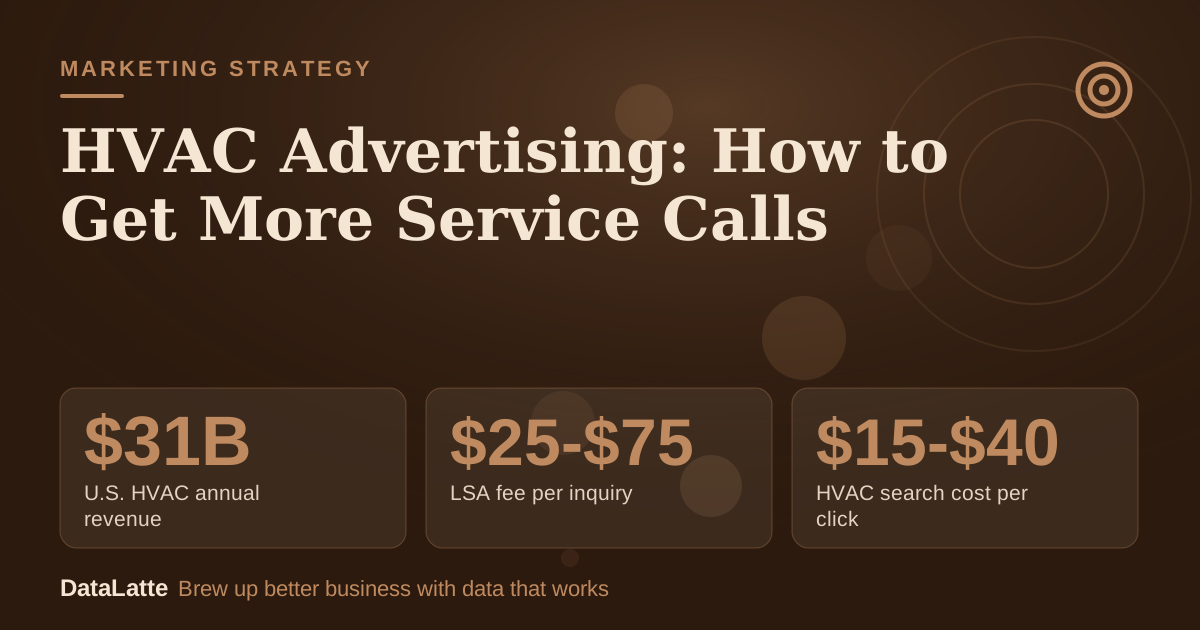
More HVAC service calls come from paying for the moments a homeowner is already searching, then measuring every call. One published range puts Google Local Services Ads at about $25 to $75 per inquiry for most HVAC markets (secondary), and HVAC search clicks at roughly $15 to $40 each. A planning range of $1,500 to $5,000 per month covers both. Tracking calls by source shows which dollars produce booked jobs.
→
U.S. HVAC annual revenue
IBISWorld, cited by AdWave (secondary)
↑
LSA fee per inquiry
Most HVAC markets, AdWave (secondary)
↓
HVAC search cost per click
WordStream 2024 via AdWave (secondary)
→
Monthly LSA plus search planning range
Media budget, not booked jobs, AdWave (secondary)
See Sources at the end of the article. Cards marked Assumption are examples, not results.
What does HVAC advertising cost per call?
Costs depend on the channel, and the sources give ranges rather than guarantees. According to
AdWave's HVAC advertising guide (secondary), Google Local Services Ads fees run about $25 to $75 per inquiry, charged when a homeowner calls or messages. The same page cites WordStream's 2024 search benchmarks, which put average cost per click for HVAC terms around $15 to $40.
Those two numbers measure different things. An LSA fee is paid per inquiry, while a search click is paid whether or not the visitor picks up the phone. A $25 click that does not call costs the same as one that does.
The page also gives $1,500 to $5,000 per month as a planning range for combined LSA and search spend, described as media budget rather than booked jobs. That distinction matters. Media spend buys inquiries, and the close rate on those inquiries decides whether the budget pays back.
For scale, the page cites IBISWorld at roughly $31 billion in annual U.S. HVAC revenue (secondary). Many competitors are bidding for the same searches.
How do Google Local Services Ads work for HVAC?
Local Services Ads charge per inquiry rather than per click, which is why the per-call math is simpler than search. The profile also leans on trust signals. Per
Google's Local Services help page, Google is replacing separate advertiser badges with a single Google Verified badge. Existing advertisers who completed verification earn it automatically, and new advertisers must complete the Local Services screening and verification process.
The badge shows on the LSA profile and may appear on other Google surfaces. Google states that LSA ranking is not affected by the badge change.
One older feature is gone. Google says it is discontinuing the Money Back Guarantee tied to the Google Guarantee badge. Eligible consumers could request reimbursement for services booked through LSA before December 7, 2025, and requests had to be filed within 30 days of the initial service completion date. Anyone still referring to the guarantee in ads or on the website should check that the wording is current.
Reviews also feed the decision. A 2024 BrightLocal survey, as cited by AdWave (secondary), found that 76% of consumers say they "regularly" read online reviews when choosing a local business. A
review management comparison helps with the follow-up process, and a
Google Business Profile checklist covers the listing itself.
Which channels have sourced support for HVAC?
Only some channels have HVAC-specific figures. The table separates those from numbers that come from other categories.
| Channel | What the sources say | Caveat |
|---|
| Google Local Services Ads | About $25 to $75 per inquiry in most HVAC markets (AdWave, secondary) | Per inquiry, not per booked job |
| Google search | HVAC cost per click around $15 to $40, WordStream 2024 via AdWave (secondary) | Paid per click, calls not guaranteed |
| Facebook and Instagram leads | Home and Home Improvement median $2.18 per click and $42.95 per lead, WordStream 2026 via AdWave (secondary) | Not HVAC-specific; sample of at least four U.S. campaigns, April 1, 2025 to June 30, 2026 |
| Short-form video on Meta | Gets 2.5 times more engagement than static images, Sprout Social 2024 via AdWave (secondary) | Engagement, not calls |
| Multi-channel mix with TV | A $30 daily budget covers TV, Google including Search, Facebook and Instagram, and web and mobile placements, $900 over 30 days (AdWave, secondary) | Published in a towing guide, not HVAC |
| Call tracking | Plans from about $22 to $30 a month (secondary) | Billed separately from ad spend |
The Facebook row has a thin sample behind it, so it works as a rough yardstick for lead cost rather than a forecast. The multi-channel row shows what a vendor says a TV-inclusive mix costs to start, and it is a vendor claim. No source in this set shows that TV produces HVAC service calls. For cost context on that channel, see
local TV advertising cost.
How should HVAC calls be tracked?
Phone calls are the main conversion for a service business, so call tracking is the measurement layer.
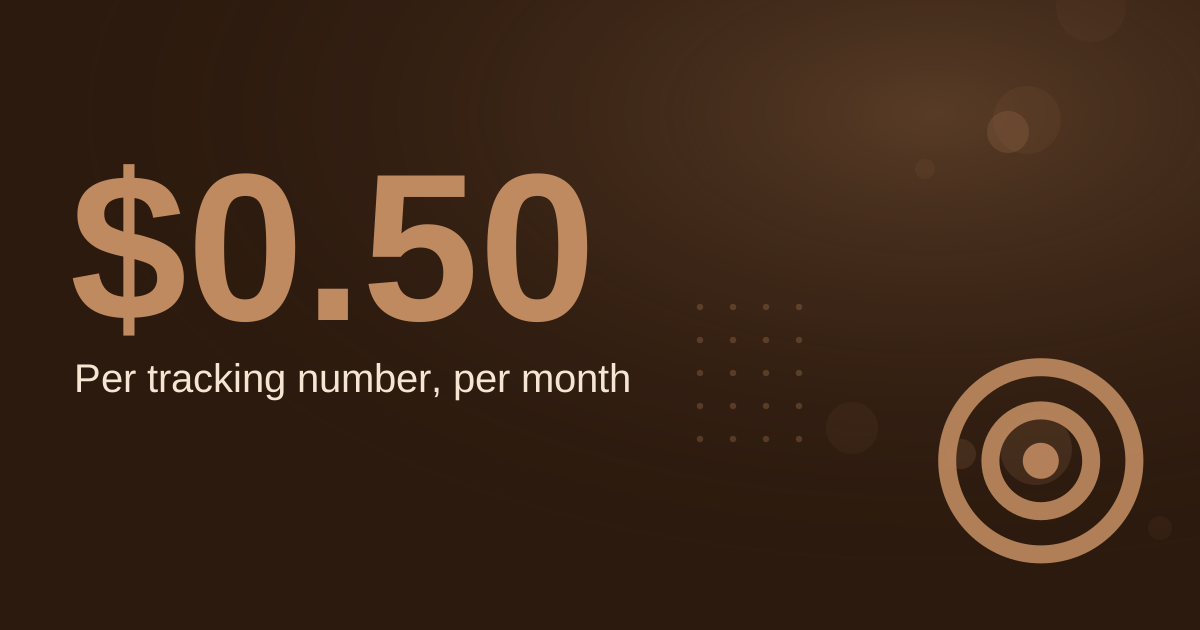
AdWave's call tracking guide (secondary) reports several price points. One unnamed provider lists tracking numbers from $0.50 a month each plus per-minute charges, and says a typical small business with three to five numbers spends $30 to $75 a month in usage on top of the plan.
Two other claims, both as reported by that page, are Analytic Call Tracking's lower-tier plan at $22 a month and one full-featured tool starting at $30 a month in WhatConverts' 2026 roundup. These are third-party claims, so current pricing should be checked on each vendor's site.
Google Ads also offers AI analysis of call recordings to judge lead quality, but only where recording is available, in the U.S. and Canada. Recording rules vary by state, so confirm what applies locally before switching it on.
A practical setup uses one number per source: LSA, search, the website, and the Google Business Profile. A side-by-side
call tracking comparison covers the options.
What about seasonality and TV for HVAC?
The cited sources do not document seasonal swings in HVAC lead cost or demand. Any plan that raises or lowers budget by season is therefore a judgment call, and the evidence for it should come from the business's own call logs. Ask the platform or agency for current rates before committing, since the ranges above are published benchmarks and not quotes.
A sensible way to test seasonality is to log calls by week for a full year and compare against spend. Past customers are a second lever that does not depend on ad prices; a
reactivation campaign targets people who already know the company.
On TV, the only support in these sources is the vendor claim in the table: a mix starting at $30 a day that includes TV, and extra creative priced at $6 per 15-second spot and $12 per 30-second spot (secondary, from a towing guide). A $30 daily budget over 30 active days totals $900, and a business can pause early and pay only for what runs. That makes TV a small test, not a proven HVAC channel. Treat it as secondary to LSA and search until call tracking shows results.
What does a worked example look like?
The numbers below are assumptions for a single-truck HVAC company, built to show the math. They are not benchmarks.
Assumptions: $3,000 monthly media budget, 30% of inquiries close into a job, and an average job value of $400. Cost per inquiry is tested at the low, middle, and high points of the published LSA range.
| Cost per inquiry (assumption) | Inquiries | Jobs at 30% | Media cost per job | Revenue at $400 |
|---|
| $25 | 120 | 36 | $83.33 | $14,400 |
| $50 | 60 | 18 | $166.67 | $7,200 |
| $75 | 40 | 12 | $250.00 | $4,800 |
At the $50 midpoint, revenue of $7,200 less $3,000 in media leaves $4,200 before labor, parts, and overhead. The result is revenue, not profit.
Close rate moves the answer as much as price does. At $50 per inquiry and an assumed 15% close rate, media cost per job doubles to $333.33. Answering fast and quoting clearly can matter as much as bid strategy.
For search, assume a $25 click (inside the $15 to $40 range) and an assumed 8% of clicks turning into calls. Cost per call is $312.50, so $3,000 buys about 9.6 calls, or roughly 2.9 jobs at a 30% close rate. That is about $1,042 per job. Search can still earn its place, but only if the call rate on the landing page is much better than that assumption. A
conversion rate benchmarks article gives context, and the same math applies to any cost range once real call data replaces these assumptions.
What does a 4-week plan look like?
The plan below builds tracking first, then adds spend in steps, so each decision rests on real calls.
Week 1: baseline and setup
- Count calls and booked jobs from the last 30 days, even roughly, and note where each customer says they came from.
- Buy tracking numbers for LSA, search, the website, and the business profile.
- Start the Local Services verification process, since new advertisers must complete screening to earn the Google Verified badge.
- Ask recent customers for reviews.
Week 2: launch LSA
- Set a weekly cap that stays inside the monthly budget, and note the starting cost per inquiry.
- Answer or return every call quickly; log missed calls.
- Dispute or flag inquiries that were not real leads, following Google's current process.
Week 3: add search
- Run a small set of high-intent terms and send clicks to a page with a tap-to-call button.
- Review call recordings where available and tag each call as booked, quote only, or not a lead.
- Compare cost per call between LSA and search.
Week 4: decide
- Calculate cost per booked job for each source, using the same formula as the worked example.
- Move budget toward the source with the lower cost per job.
- Optionally test one small extra channel, such as a $30 daily multi-channel mix, and judge it only by tracked calls.
The
12-month marketing calendar shows how to extend this into a yearly rhythm.
FAQ
How much should an HVAC company budget for advertising?
One published planning range is $1,500 to $5,000 per month for combined Local Services Ads and search spend (secondary). It describes media budget, not booked jobs, so the right amount depends on close rate and job value. The worked example above shows how to test a figure.
Are Local Services Ads cheaper than Google search for HVAC?
Per inquiry, LSA fees are published at about $25 to $75, while search clicks are around $15 to $40 each (both secondary). Search clicks do not always become calls, so cost per booked job is the fair comparison. The cited sources do not give an HVAC-specific head-to-head result.
Is the Google Guarantee still available?
Google says it is discontinuing the Money Back Guarantee tied to the Google Guarantee badge, with reimbursement requests covering LSA bookings made before December 7, 2025. A single Google Verified badge replaces the separate advertiser badges, and Google states that LSA ranking is not affected by the change.
Do HVAC businesses need call tracking?
Calls are the main conversion for service businesses, and the platforms' own reports do not show which calls became jobs. Published plan prices run from about $22 to $30 a month (secondary), plus per-minute usage on some plans. Tracking is the cheapest part of the budget.
Should an HVAC company advertise on TV?
The sources contain no HVAC-specific evidence on TV results. A vendor describes a $30 daily mix that includes TV, from a towing guide (secondary). Start with a short, tracked test, and ask for current rates in the local market.
Ready to see where the first dollar should go? A
free audit reviews the current setup and call tracking, and the
Google Ads service page covers how campaigns are built.
Sources