A local citation is any online mention of a business's name, address, and phone number, known as NAP. Published guidance agrees on the order of work: Google Business Profile, Apple Maps, and Facebook first, then Yelp, then smaller niche directories. Sources disagree on how many citations are enough and how much weight they carry in rankings, so accuracy comes before volume. A two-week audit is the practical starting point.
↑
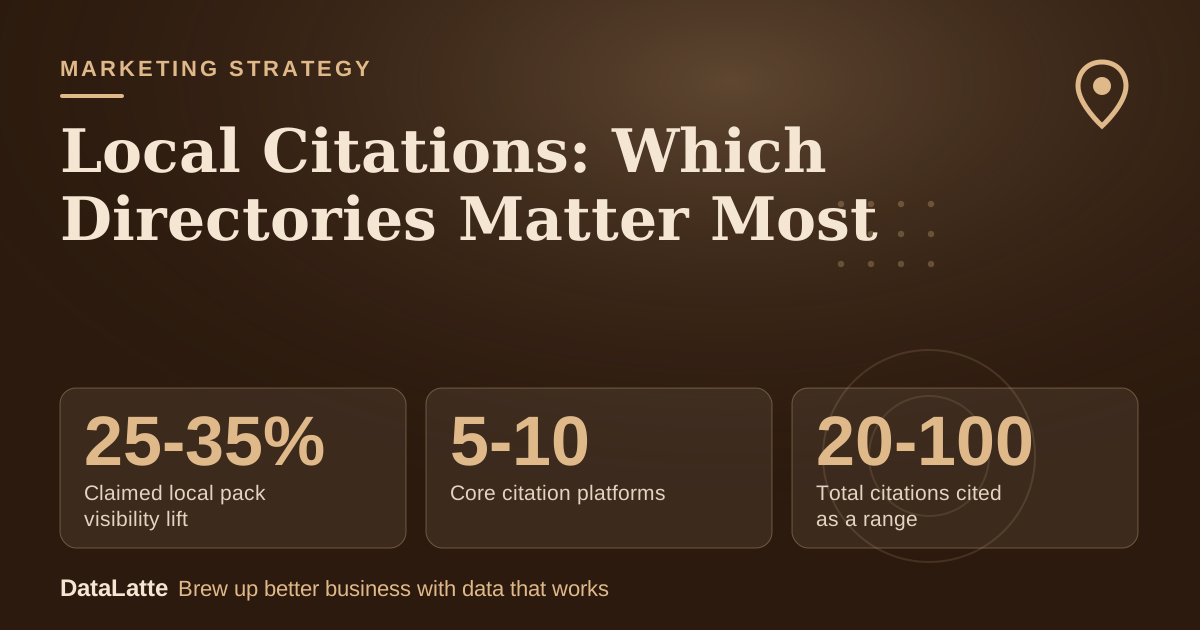
Claimed local pack visibility lift
Adwave vendor claim for 50+ directories (secondary)
→
Core citation platforms
SocialPilot core tier guidance (secondary)
→
Total citations cited as a range
SocialPilot, no agreed number (secondary)
↑
More likely to visit a complete profile
Google Business Profile documentation, as quoted by SocialPilot (secondary)
See Sources at the end of the article. Cards marked Assumption are examples, not results.
What is a local citation, and why does NAP consistency matter?
A citation is an online mention of a business's name, address, and phone number.
Adwave (secondary),
SocialPilot (secondary), and
Firestarter SEO (secondary) all use the same definition. A
Hawksem (secondary) article adds that citations include any online mention of the business, with the NAP attached.
Consistency matters because Google compares sources. According to Firestarter SEO, Google cross-references the Google Business Profile information against every other source it finds. A mismatch between the profile and a directory gives Google conflicting data about the same business.
SocialPilot makes the same point from the other direction: accuracy and placement matter more than raw count, and adding citations on top of inconsistent NAP data multiplies the mess. A suite number on one listing and not on another is the kind of mismatch an audit looks for.
Citations feed the local pack, which two sources describe as the top three map results for a search such as "dental clinic near me." Google's local results are based on relevance, distance, and prominence, according to Hawksem and Firestarter SEO.
Which directories matter most for a small business?
The sources rank directories in rough tiers rather than one official list. Adwave advises fixing listings in priority order: Google, Apple Maps, and Facebook first, then Yelp, then smaller niche directories. Hawksem calls Google Business Profile the most important listing for SEO.
| Directory type | Examples named in the sources | Priority as the sources describe it |
|---|
| Google Business Profile | Google | Described as the most important listing (Hawksem); fixed first (Adwave) |
| Big-name platforms | Apple Maps, Facebook | Fixed first alongside Google (Adwave); Apple Maps uses its own data plus Yelp feeds (Firestarter SEO) |
| Review and directory sites | Yelp | Fixed after the big three (Adwave); listed as a secondary directory (SocialPilot) |
| Search engine listing | Bing Places for Business | Takes about ten minutes to set up and is worth doing (Firestarter SEO, vendor statement) |
| Data aggregators | Data Axle, Localeze, Foursquare | Distribute business information to hundreds of downstream directories (Firestarter SEO) |
| Secondary directories | YellowPages, Foursquare, Better Business Bureau | Roughly 20 to 30 directories (SocialPilot) |
| Niche directories | Industry-specific sites | Last in the fix order (Adwave) |
SocialPilot says the first 5 to 10 platforms form the core tier. The sources do not name specific niche directories for coffee shops, salons, groomers, or studios, so that list has to come from the business's own search results.
Yelp sits in different places in two sources. Since Apple Maps pulls from Yelp feeds per Firestarter SEO, an error on Yelp can matter beyond Yelp itself.
How many citations does a small business need?
There is no agreed number. SocialPilot reports that credible sources land anywhere from 20 to 50 total citations at the low end to 50 to 100 at the high end. The same page describes its own tiers as informed guidance synthesized from across the field, not an official standard.
Adwave's figure sits inside that spread. Its own data, it says, shows businesses with NAP consistency across 50+ quality directories often see a 25-35% lift in local pack visibility over time. That is a vendor's internal data, and the page gives no method or sample.
Both views can be held at once without declaring a winner. A business with 25 accurate listings and a business with 60 accurate listings are both inside ranges that sources cite. A business with 60 listings, 20 of them wrong, is not following any of the guidance.
One practical reading: start from the core tier of 5 to 10 platforms, audit the secondary tier of roughly 20 to 30, and treat anything beyond that as optional until the existing listings match. The number to settle first is the share of listings that are correct.
Do citations actually move local rankings?
Sources disagree on weight, and the evidence is thin on all sides.
Adwave states that citations have become a top-5 local SEO ranking factor in 2026, with no third-party source cited. Firestarter SEO is more cautious: it says BrightLocal's annual Local Search Ranking Factors survey consistently identifies citation signals as one of the top factors for local pack rankings, and that the Whitespark 2026 report reinforces that consistency is what makes citations effective. Neither page gives a numeric weight.
SocialPilot leans toward quality over quantity. Keyword.com (secondary) reports one case study from Rule Marketing Group in which Google My Business began driving 50% of site traffic and 67% of conversions after citation work. That is a single reported case, and it does not isolate citations from other changes.
Context for why anyone cares: Keyword.com, citing other studies, says 54% of users search for a local business once a month and 12% every day. It also cites an average of 33 clicks per month for a Google Business Profile.
Anyone comparing vendor claims should ask what was measured and over what period. Whether citations rank as a top-5 factor or merely one of several is not settled by these pages, and the audit below is worth doing under either reading.
What does Google require that affects NAP?
The NAP copied to every directory should be one Google itself would accept.
Google's guidelines set several rules that decide what that version looks like.
Business name: it must not include marketing taglines, store codes, trademark signs, fully capitalized words, business hours, phone numbers or URLs, service information, or location information. Special characters or legal terms need real-world proof such as signage, business cards, or invoices. Unnecessary information in a name can lead to suspension of the profile.
Address: P.O. boxes or mailboxes at remote locations are not acceptable. A virtual office, where a business rents a mailing address but does not operate there, is not eligible. A co-working office qualifies only with clear signage, customers received during business hours, and business staff present. If a suite or mailbox number applies, the physical address goes on Address Line 1 and the number on Address Line 2.
Phone and profiles: premium phone numbers are not acceptable regardless of the rate charged to the caller. Google also says there should be only one profile per business, and advises against more than one page per location.
For the profile side of the work, the
Google Business Profile optimization checklist covers the fields in more detail.
How can a small business audit local citations in two weeks?
Adwave says a full citation audit is not optional and should come before building new listings. Its recommended manual searches are the business name, the business name plus city, the business phone number, and the old address if the business has moved. A listing-management service such as Moz Local can report active, inconsistent, duplicate, and missing citations.
The schedule below is a suggested routine built from those steps, not a sourced timeline.
| When | Task |
|---|
| Week 1, Mon | Write the canonical NAP in one sheet: name as shown on signage, street address with suite on Line 2, one main phone number |
| Week 1, Tue | Run the four searches: name, name plus city, phone number, old address if moved |
| Week 1, Wed | Log every listing found with a status: active, inconsistent, duplicate, or missing |
| Week 1, Thu | Check the Google profile against the guidelines: one profile, name rules, address type, phone number |
| Week 1, Fri | Check Apple Maps, Facebook, Yelp, and Bing Places; note aggregator records (Data Axle, Localeze, Foursquare) |
| Week 2, Mon | Fix Google, Apple Maps, and Facebook |
| Week 2, Tue | Fix Yelp |
| Week 2, Wed | Set up or correct Bing Places |
| Week 2, Thu | Resolve duplicates, then correct remaining secondary directories |
| Week 2, Fri | Rerun the four searches, update the sheet, and note any listings still wrong |
If a paid listing-management scan is used, it can replace part of the manual logging. The manual searches still catch old addresses and stray pages that a scan may not surface.
What does an audit look like for a salon?
The inputs below are all assumptions, built for a hair salon that moved locations last year. No ranking result is assumed.
| Input (assumption) | Value |
|---|
| Directories checked | 30 |
| Correct and consistent | 18 |
| Inconsistent | 7 |
| Duplicate | 2 |
| Missing | 3 |
| Time per fix | 15 minutes |
| Inconsistent listings found by old-address search | 4 of the 7 |
Before the fixes, 18 of 30 listings match: 60%. The to-do list is 7 + 2 + 3 = 12 items. At 15 minutes each, that is 180 minutes, or 3 hours, spread across week 2.
The order follows Adwave's advice. Google, Apple Maps, and Facebook come first, then Yelp, then the smaller directories. Because the salon moved, the old-address search matters: in this assumption it surfaces 4 of the 7 inconsistent records, which a name-only search would have missed.
If all 12 items are accepted by the directories, 30 of 30 listings match: 100%. The count of listings is what the audit changes. What it does to rankings is not predicted here.
A salon with online booking can also check that the booking link on each listing points to the right page. The
online booking system guide for salons covers how to compare options.
Where does citation work fit in the wider marketing plan?
Citation clean-up is a one-off project followed by light maintenance. A recheck of the four searches can sit in the
12-month local marketing calendar, for example whenever the address, hours, or phone number change.
Reviews connect to the same listings. Yelp and Google both carry them, and
review management software can show which platforms collect reviews and where a profile has gone unanswered. Website visits that arrive from listings can be tracked with
Google Analytics 4.
Citations are one input to local visibility, not a replacement for paid ads or email. A business that wants a second opinion on its listings and ad accounts can request a
free audit.
FAQ
What does NAP stand for in local SEO?
NAP stands for Name, Address, and Phone Number. Hawksem uses this definition, and Adwave and Firestarter SEO say the same. A citation is any online mention of those details, so NAP consistency means every listing shows the same version.
How many local citations does a small business need?
No source gives an agreed number. SocialPilot reports credible sources ranging from 20 to 50 at the low end to 50 to 100 at the high end, and says the first 5 to 10 platforms form the core tier. It also says accuracy matters more than count.
Which directories should be fixed first?
Adwave advises starting with Google, Apple Maps, and Facebook, then Yelp, then smaller niche directories. Hawksem calls Google Business Profile the most important listing. Firestarter SEO adds that Bing Places takes about ten minutes to set up and is worth doing.
Can a P.O. box or virtual office be used as the business address?
Not for a Google Business Profile. Google's guidelines say P.O. boxes or mailboxes at remote locations are not acceptable, and a virtual office where the business does not operate is not eligible. A co-working office qualifies only under conditions such as clear signage and staff present during business hours.
Sources