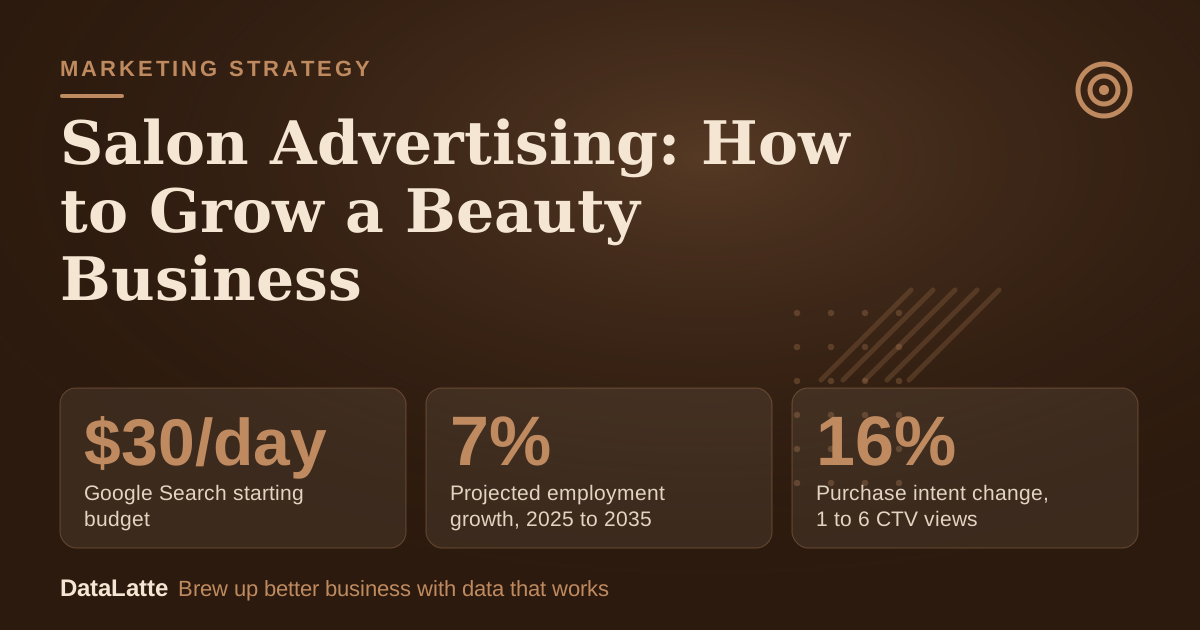
Salon advertising works best when a free Google Business Profile is paired with one paid channel that reaches people searching for a service nearby. Adwave's published pricing starts Google Search for salon campaigns at
$30/day (secondary), and the same entry price covers Facebook and Instagram, YouTube and Demand Gen, streaming TV, and mobile web and app ads. A sensible order is profile first, search second, visual and streaming channels third.
→
Google Search starting budget
Adwave published pricing (secondary)
↑
Projected employment growth, 2025 to 2035
BLS, barbers, hairstylists and cosmetologists
↓
Purchase intent change, 1 to 6 CTV views
MNTN study reported by Epom via Adwave (secondary)
→
Weekly cap that captured 95% of lift
Meta brand-lift analysis via Adwave (secondary)
See Sources at the end of the article. Cards marked Assumption are examples, not results.
How much should a salon spend on advertising?
Sources give budget ranges rather than one correct number. One rule cited by Adwave sets marketing at 5 to 15% of revenue, which for a salon taking in $15,000 a month
works out to $750 to $2,250 a month (secondary).
Boulevard, as summarized on the same page, lists monthly ranges of $150 to $750 for a smaller operation and $500 to $1,500 for a larger one. Those ranges cover social media, email, print and paid ads together, so they are not an ad-only figure (secondary).
Small budgets are common. A LocaliQ survey of more than 300 small business owners from February 2026, as cited by Zoca, found 52% had a monthly marketing budget under $1,000 (secondary).
The practical reading: a salon does not need a large budget to start, because the published entry price for several channels is $30/day. Whether $30/day is enough in a given city is not documented in these sources, so ask any vendor for current rates and minimums before committing.
Which advertising channels can a salon use, and what do they cost?
Adwave's salon page lists the channels below with the use each suits best. Anything not printed on the page is marked "not stated" rather than guessed.
| Channel | What it does | Reported cost | Limits stated |
|---|
| Google Business Profile | Local listing in search and maps | Costs nothing to set up or maintain (secondary) | Google says there is no way to pay for a better local ranking |
| Google Search | Reaches people searching for a service nearby, such as "balayage near me"; suited to filling open slots this week | From $30/day | Minimum term not stated |
| Facebook and Instagram | Shows before-and-after photos and short videos to nearby people by age and interest | From $30/day | Minimum term not stated |
| YouTube and Google Demand Gen | Video and image ads across Google's network; broad local reach | From $30/day | Frequency guidance not stated |
| Streaming TV | 15- or 30-second spot on the living room screen in the area; suited to local familiarity, launches, new locations | From $30/day | Minimum term not stated |
| Mobile web and apps | Image ads on sites and apps people use daily; repeat exposure at low cost | From $30/day | Minimum term not stated |
| Reddit | Ads in local and interest communities; younger, research-minded clients | About $35/day | Not stated |
| TikTok | Opt-in inside Adwave | From $91/day | Must be turned on in Customize, with a TikTok account connected |
Adwave is a vendor, so these are one provider's published prices, not market averages. For the cost side of larger formats,
local TV advertising costs for small businesses are covered separately.
Does the Google Business Profile still matter if ads are running?
Yes, and it is the cheapest piece. The Local Gem, as cited by Adwave, says the profile
costs nothing to set up or maintain and that salons that complete it and keep posting and collecting reviews usually see better local visibility within 4 to 8 weeks (secondary).
Google's own help page explains the mechanics. Local results are mainly based on
relevance, distance, and popularity. Prominence means how well-known a business is, and it is also based on how many websites link to the business and how many reviews it has.
Two further points from Google: verifying the business makes it more likely to show up in search results, and businesses with complete and accurate info are more likely to show up in local search results. Google also states there is no way to request or pay for a better local ranking.
That last point separates the two budgets. Ad spend buys placement in ads. Profile work builds the organic listing over weeks. The
Google Business Profile optimization checklist covers the profile fields in detail, and a
review management tool can make collecting reviews routine.
What does the beauty workforce data say about competition?
The Bureau of Labor Statistics (BLS) gives context on who a salon competes with and hires. Hairdressers, hairstylists, and cosmetologists held about
595,000 jobs in 2025, and barbers held about 75,800.
BLS lists self-employed workers at 48% for hairdressers, hairstylists, and cosmetologists, with personal care services at 45%. For barbers the self-employed figure is 80%. These shares suggest many independent operators, which in turn suggests a crowded local search results page, although BLS does not state that conclusion.
Employment of barbers, hairstylists, and cosmetologists is projected to grow 7 percent from 2025 to 2035, a change of 48,400 jobs. About 80,300 openings are projected each year, on average. Median pay in 2025 was $35,880 per year, or $17.25 per hour.
For advertising, the useful takeaway is narrow: the supply of stylists is large and growing, so a salon's ad should lead with something specific (a service, a stylist, a photo of the result) rather than generic claims. BLS also notes all states require licensing, which is a factual detail some salons mention in copy.
How often should the same person see a salon ad?
Frequency is where small budgets leak. Adwave's
ad frequency guide reports that Meta's brand-lift analysis found a cap of 2 impressions per person per week captured 95% of the potential purchase-intent lift (secondary). A cap of 1 per week captured up to 80% of the potential lift in ad recall.
For streaming TV, an MNTN study reported by Epom found recall rose from about 64% after one view to 92% after six views in a single session, while purchase intent fell 16% over the same range (secondary).
Epom's suggested starting caps per week, as listed on the page:
| Format | Suggested starting cap |
|---|
| CTV and streaming TV | 4 to 6 per viewer |
| Facebook and Instagram Feed | 3 to 5 |
| Facebook and Instagram Stories and Reels | 2 to 4 |
| Programmatic online video | About 10 |
| Display, prospecting | 15 to 25 |
| Display, retargeting | 10 to 15 (about 3 a day at most) |
The same page notes that fatigue commonly sets in around 6 to 7 exposures on a single Facebook Feed creative, and that caps set on separate platforms do not combine: 3 per day on Google plus 3 per day on Facebook can still mean 6 impressions a day for one person. More detail is in the
ad frequency guide for small businesses.
What does a 4-week salon advertising plan look like?
The plan below sequences free work first, then one paid channel, then a second. Google's 4 to 8 week visibility window for profile work means week 4 results will only partly reflect it.
| Week | Actions | Check at week end |
|---|
| 1 | Verify the Google Business Profile and fill in every field accurately. Ask recent clients for reviews. Confirm the booking link works on a phone. | Profile verified; review count noted as a baseline |
| 2 | Launch Google Search at $30/day aimed at service-plus-location searches. Add a call or booking tracking method. | Bookings and calls received versus open slots |
| 3 | Add a visual channel, such as Facebook and Instagram at $30/day, using before-and-after photos. Start with a Feed cap in the suggested 3 to 5 range. | Frequency per person; any creative showing fatigue |
| 4 | Compare cost per booking across channels. Keep the better one, pause the weaker. Decide whether streaming TV suits a launch or new location. | Cost per booking; utilisation change |
Two supporting pieces help: an
online booking system for salons so ad clicks can turn into appointments without a phone call, and
call tracking so phone bookings are credited to the right channel.
What does a worked example look like for a four-chair salon?
All inputs below are assumptions for illustration, not benchmarks.
| Input | Value |
|---|
| Chairs | 4 (assumption) |
| Bookable appointment slots per chair per week | 20 (assumption) |
| Current chair utilisation | 70% (assumption) |
| Average ticket | $90 (assumption) |
| Test budget | About $1,000 for 4 weeks (assumption) |
Capacity. 4 chairs × 20 slots = 80 slots a week. At 70%, 56 are booked and 24 sit open. Open slots represent 24 × $90 = $2,160 a week, or $8,640 over a 4-week month, at the assumed ticket.
Budget check. Booked revenue is 56 × $90 × 4 = $20,160 a month. Applying the 5 to 15% rule cited earlier gives $1,008 to $3,024, so a $1,000 test sits at the low end.
Spend. Google Search at $30/day for 28 days is $840. Five days of Facebook and Instagram at $30/day is $150. Total: $990.
Break-even on first visits. $990 ÷ $90 = 11 first-visit bookings. If the campaigns produce 20 new bookings (assumption), cost per booking is $49.50 and first-visit revenue is $1,800. Utilisation moves from 224 of 320 monthly slots (70%) to 244 of 320, or 76.25%.
The $90 is gross ticket, before product cost and stylist pay, so it overstates profit. Returning clients would add value beyond the first visit, which the example leaves out. Tools like
marketing automation for hair salons are aimed at that rebooking step.
FAQ
Is $30/day enough to advertise a salon?
Adwave's published pricing lists $30/day as the starting point for Google Search, Facebook and Instagram, YouTube and Demand Gen, streaming TV, and mobile web and app ads (secondary). Whether that volume is enough depends on the local market, which the sources do not document. Ask for current rates and any minimum term.
Can a salon pay Google for a better local ranking?
No. Google states there is no way to request or pay for a better local ranking. Ranking is mainly based on relevance, distance, and popularity, and completing the profile, verifying it, and earning reviews are the levers Google names.
How long before a Google Business Profile shows results?
The Local Gem, as cited by Adwave, says salons that complete the profile and keep posting and collecting reviews usually see better local visibility within 4 to 8 weeks (secondary). That is a usual range, not a guarantee.
How many times should a client see a Facebook or Instagram ad?
Meta's brand-lift analysis, as reported by Adwave, found 2 impressions per person per week captured 95% of potential purchase-intent lift (secondary). Epom suggests starting caps of 3 to 5 per week for Feed and 2 to 4 for Stories and Reels.
A free review of the current Google Business Profile and ad setup is available at
DataLatte's free audit, and Google campaign management is covered under
Google Ads services.
Sources