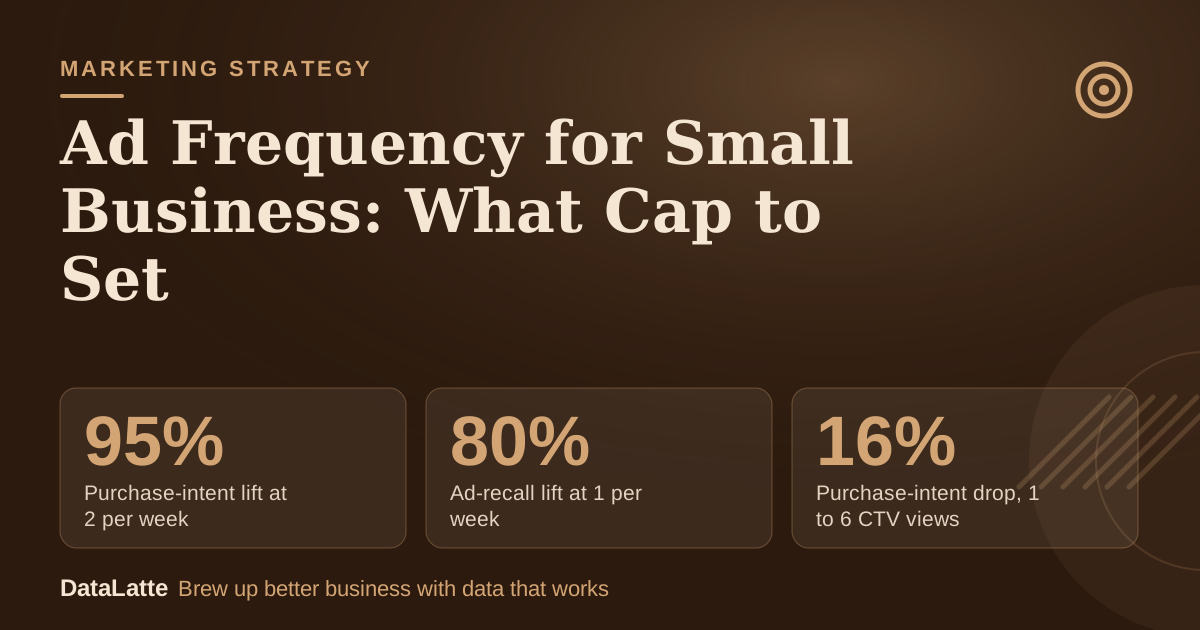
There is no single correct ad frequency. Meta research, as retold by secondary sources, found that about 1 impression per person per week captured up to 80% of the ad-recall lift, and 2 per week captured 95% of the purchase-intent lift. Vendor guidance for streaming TV starts higher, at 4 to 6 per week. Google publishes no universal number. A small advertiser should set a cap where the platform allows one, start low, and review it weekly.
→
Purchase-intent lift at 2 per week
Meta analysis, via AdWave (secondary)
↑
Ad-recall lift at 1 per week
Meta research, via Webtonic (secondary)
↓
Purchase-intent drop, 1 to 6 CTV views
MNTN study via Epom, reported by AdWave (secondary)
Assumption→
Impressions from two 3-a-day caps
Improvado example, via AdWave (secondary)
See Sources at the end of the article. Cards marked Assumption are examples, not results.
What is ad frequency, and what does a frequency cap do?
Frequency is how many times the same person sees the same ad. A frequency cap is a limit on that number. One ad-tech explainer defines
frequency capping (secondary) as limiting how many times an individual user, household, or audience segment is exposed to the same advertisement within a defined period.
An impression counts every time an ad is displayed on a screen, whether or not the person noticed it, according to a definition from Improvado
quoted by AdWave (secondary). A high count therefore does not prove anyone paid attention.
The same explainer lists five levels where caps can sit: ad, campaign, line-item, audience, and platform. Common windows are hourly, daily, weekly, monthly, and lifetime. Enforcement relies on identifiers such as cookies, device IDs, authenticated IDs, and household IDs.
Its example is a cap of three impressions per user per day. After the third, that user becomes temporarily ineligible for the campaign. Improvado also describes a recency cap, which spaces ads out, with one impression per hour as a programmatic example.
An average frequency of 2 can hide a few people seeing the ad 10 times. A cap limits that tail.
Controls differ by platform, and the cited material documents Google far better than the others. The table below separates what a platform lets an advertiser configure from what third parties suggest.
| Platform | How frequency is controlled | What the sources suggest |
|---|
| Google Display | Cap is set in the "Frequency management" section of campaign settings, only after the campaign is created. Google can optimize frequency (recommended) or the advertiser sets a cap. Only viewable impressions count. | Google gives no universal number. Practitioners commonly anchor 2 to 3 per week for Display and Demand Gen (not a platform-set figure). |
| Google Video | Cap is set at campaign level only, based on impressions, views, or both, per day, week, or month, in whole numbers. Applies to in-stream and bumper ads in the auction. | Practitioners commonly anchor 3 to 5 per week for recall-focused video (not a platform-set figure). |
| Meta (Feed, Stories, Reels) | The cited material does not describe Meta's frequency settings step by step. Confirm what is available inside the Meta account. | Meta research: 1 per week for up to 80% of recall lift, 2 per week for 95% of purchase-intent lift. Epom starting caps: Feed 3 to 5 per week, Stories and Reels 2 to 4 per week. |
| CTV and streaming | Caps can be applied at household level where the vendor supports it. The cited material documents no specific CTV platform menu, so ask the vendor. | Epom suggests 4 to 6 per viewer per week. One agency suggests 5 per 7 days for conversion campaigns. |
Google's details come from its
Help page on frequency capping. One more detail from that page: if the same videos run in other Video campaigns, those impressions and views also count toward the cap of that campaign. Epom and Attn figures appear in
AdWave and
Attn's CTV guide (both secondary).
What do the reported frequency numbers actually say?
The reported numbers do not agree, and the gap is large. Meta's studies, retold by
Webtonic (secondary), say purchase-intent lift kept climbing until close to 1.5 exposures per week before slowing. Meta's brand-building guidance recommends two or more per week for brand-building campaigns.
On CTV, an MNTN study reported by Epom found recall rose from about 64% after one view to 92% after six views in a single session. Purchase intent fell 16% over that same range. More views bought recall and cost intent.
Other figures sit much higher, and several are weaker evidence:
- A CTV benchmark citing Innovid's 2025 measurement put average campaign frequency at 7.09 exposures. That describes what campaigns delivered, not what they should deliver.
- Attn says the average viewer sees a CTV ad 8 to 12 times before acting, and gives 3 to 5 exposures as the diminishing-returns point for impulse purchases such as food. It bases this on its own analysis of 500+ campaigns, which cannot be checked here.
- Attn also claims 68% of CTV campaigns run without proper caps, without naming a source.
- Practitioner analyses of Meta data commonly report click-through decline above roughly 3.5 frequency in a 7-day window, and clearer conversion and cost damage above 5. These are third-party claims, not Meta figures.
AdWave advises skepticism toward the popular rule that people must see an ad three times. Epom also reports that fatigue commonly sets in around 6 to 7 exposures on a single Facebook Feed creative.
Each platform counts only its own impressions. Improvado's example, quoted by AdWave, is a cap of 3 per day on Google plus 3 per day on Facebook, which can still mean 6 impressions a day for the same person. Neither platform sees the other's total.
AppsFlyer's
glossary entry (secondary) explains why. Platforms track exposure using their own identifiers such as cookies, device IDs, or tracking pixels, and check the cap before serving an ad. Measurement partners use probabilistic modeling as a fallback when unique IDs are unavailable. A cap in one system cannot account for ads served in another.
Google's own system shows a narrow version of this. Video campaigns sharing the same videos count each other's impressions toward the cap, but only inside Google.
For a small advertiser, the practical step is to treat the weekly target as a shared budget. If the target is about 2 per week for a local audience, the Meta and Google caps together should land near that, not each at 2. Reach and frequency from two dashboards should never be added up as if they described separate people. For CTV, the guide on
how to measure CTV ads for a local business covers what reporting is realistic.
How does a small budget change the frequency math?
Budget, price, and audience size decide frequency before any cap does. Frequency is roughly impressions divided by people reached, and impressions are budget divided by CPM times 1,000.
A worked example for a hair salon promoting a four-week new-client offer. All inputs are assumptions:
- Meta budget: $900 over 4 weeks (assumption)
- Meta CPM: $12 (assumption)
- Result: $900 ÷ $12 × 1,000 = 75,000 impressions, or 18,750 per week
The table shows weekly frequency if those impressions were spread evenly across different local audience sizes (assumption). Real delivery is uneven, so some people would see more and some none.
| Local audience size (assumption) | Impressions per person per week |
|---|
| 30,000 | about 0.6 |
| 10,000 | about 1.9 |
| 5,000 | about 3.8 |
The 10,000-person audience lands near the 2 per week where Meta's analysis reported 95% of purchase-intent lift. The 30,000-person audience falls below Meta's 1-per-week recall point, so many people may never see the ad twice, or at all.
Now add Google Display at $300 over 4 weeks with a $6 CPM (both assumptions). That gives 50,000 impressions, or 12,500 per week, about 1.25 per person across the same 10,000 people. Someone on both platforms could see roughly 3.1 impressions a week. That is above Meta's 2-per-week point, and the sources do not say whether the extra impressions pay off.
The IPA's 2026 report, as cited by Webtonic, found fewer than half of surveyed CMOs maximize reach before layering on frequency. For a small budget, the numbers point to the same order: fix the audience size first, then check frequency.
Does higher frequency hurt small campaigns?
It can, and the cited evidence points to three costs. First, intent can fall, as in the MNTN CTV result. Second, creative tires, with Epom's 6 to 7 exposures on one Facebook Feed creative. Third, attitudes can sour.
A 2026 Gartner survey, as cited by
AIDigital (secondary), found 81% of U.S. consumers try to ignore or tune out ads and 52% actively take steps to block them. The same page reports that 24% of Gen Z consumers say retargeted ads negatively affect their perception of the brand. Optimove's 2026 Marketing Fatigue Report, also cited there, found 83% of consumers said they unsubscribe because of repeated offers they expect to see on other channels.
Retargeting deserves extra care for a local shop, since its audience is small and gets hit fastest. Epom's suggested retargeting display cap is 10 to 15 per week, with about 3 a day at most. Attn suggests 12 per 30 days for CTV retargeting. For a small list of recent website visitors, both figures are well above Meta's research points, so starting lower is reasonable.
One more caution applies to the claims of dramatic gains. Attn states that brands optimizing frequency see 35-45% better cost efficiency and 20-30% higher conversion rates. That is an agency claim with no method shown here, so it should not be used to forecast results.
AppsFlyer, citing Meta's research, says lower frequency suits established brands with high market share and long purchase cycles. Higher frequency suits new brands with low market share and short purchase cycles. The source does not address local businesses, but a newly opened shop may sit nearer the higher end.
What does a week-by-week frequency checklist look like?
A weekly review turns frequency from a setting into a habit. The sequence below uses a four-week campaign.
- Week 0 (before launch): estimate the audience size, divide weekly impressions by it, and write down a combined weekly target across platforms. Set caps on Google Display (after the campaign exists), Google Video (campaign level), and wherever the Meta account or CTV vendor allows them.
- Week 1: read frequency and reach per platform. Check that the sum of platform frequencies on the same people is near the target. Note click-through rate and cost per result as a baseline.
- Week 2: compare against the baseline. Attn suggests reducing frequency when cost per acquisition rises 25% or more and swapping creative when click-through rate drops 30% or more. Treat those as one agency's triggers (secondary), not platform rules.
- Week 3: if frequency is far below the target, narrow the audience or lengthen the cap window. If it is far above, lower the cap or add a fresh creative.
- Week 4: record what frequency each platform actually delivered next to results, so the next campaign starts from the salon's own data instead of a rule of thumb.
Results should be tracked in an analytics setup such as the one in the
Google Analytics 4 guide for small business. Cost questions for streaming are covered in
how much CTV advertising costs and whether it fits a small budget in
is CTV advertising worth it. Where repeat exposure sits in a customer journey is mapped in the
local marketing funnel guide.
For a second opinion on caps, reach, and overlap across Google and Meta, request a
free audit.
FAQ
Do people need to see an ad three times?
The sources do not support it as a rule. AdWave cites the popular rule that people must see an ad three times and advises skepticism. Meta's research, as retold by secondary sources, points to lift concentrated at 1 to 2 exposures per week, though that applies to Meta's studies, not every channel or business.
Does Google Ads recommend a frequency number?
No. Google documents frequency capping as an advertiser-set control, and for Display it recommends letting Google Ads optimize how often ads show, with a manual cap as the alternative. Figures such as 2 to 3 per week for Display come from practitioners, not from Google.
Not reliably. Each platform measures its own impressions, so a person can receive both. Improvado's example, via AdWave, is two 3-per-day caps that can still total 6 daily impressions for one person. Set a combined target and split it.
What if the budget is too small to reach a whole audience twice?
The math in the worked example suggests two options: narrow the audience so the same impressions reach fewer people more often, or accept lower frequency over a larger audience. The sources do not say which performs better for a given business, so compare results over a few weeks.
Sources