To get free local press coverage, send one short, personal email to the reporter who covers your topic. Tell a story that affects people in their community, offer one named person for interview, and link to a photo. Relevance decides coverage far more than budget does. Authentic Marketer's
guide to free press coverage sets out the process in eight numbered steps, and the same logic suits a café, salon or trades firm: find the right person, pitch a real story, follow up once.
This guide covers choosing a reporter, finding a story worth telling, writing the pitch, following up and planning eight weeks of outreach.
→
Cost to submit a press release on openPR
openPR submission page (secondary)
→
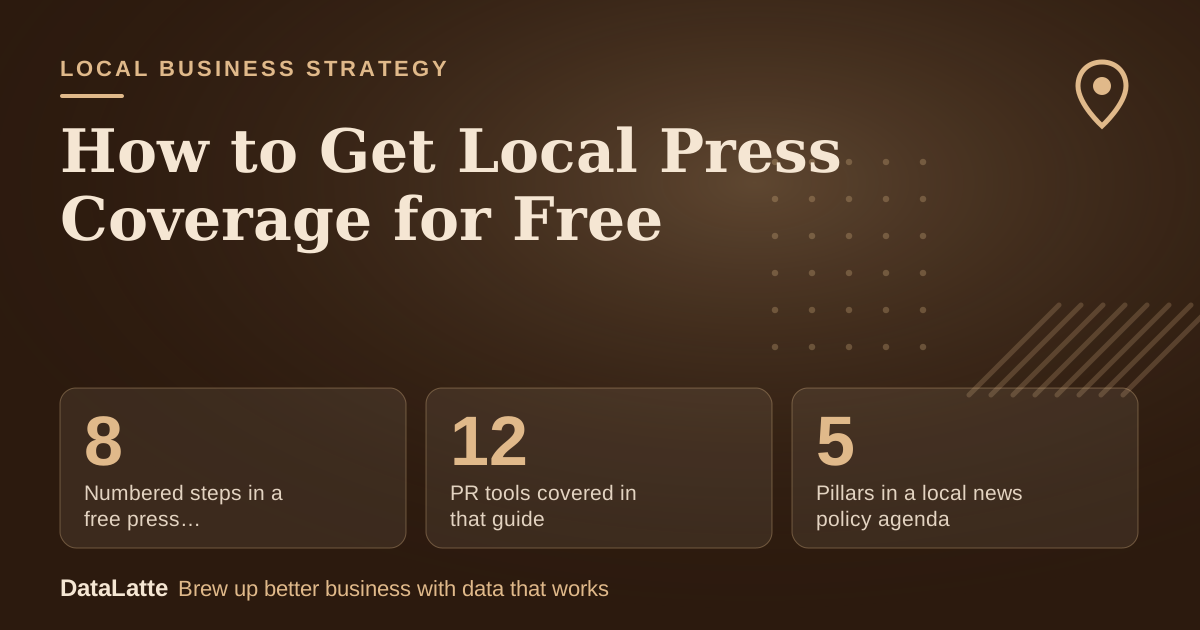
Numbered steps in a free press coverage guide
Authentic Marketer guide (secondary)
→
PR tools covered in that guide
Authentic Marketer guide (secondary)
→
Pillars in a local news policy agenda
Free Press agenda (primary)
See Sources at the end of the article. Cards marked Assumption are examples, not results.
Who Should You Pitch for Local Press?
Start with the outlets your customers already read: the local newspaper's website, community news sites, neighbourhood newsletters, local radio and active community social pages. The right contact is usually the reporter who wrote the most recent stories closest to yours, not the editor-in-chief or a general news inbox.
Check the byline on those stories or the outlet's contact page for a direct email address. Confirm that the reporter still covers that beat, since beats change. A reporter who covered a rival's opening last month may be interested in what makes yours different.
Avoid sending the same message to every address on a generic list. A pitch that fits one beat is easier to act on than a blast, and a careful approach protects your reputation with the newsroom for next time.
What Makes a Local Story Worth Pitching?
Stories about people and places travel further than product news. A café that trains and hires people through a local scheme, a groomer offering free nail trims for a rescue's dogs on a set day, a gym opening a class for older residents, or a barber collecting winter coats for a shelter each connects a business to something the community already cares about.
An opening or a sale rarely qualifies alone. Link it to a local fact, such as a closed shop reopening on a street that lost three businesses, but only if that fact is true. Pitch what has happened or has a fixed date. Vague promises give an editor nothing to print.
Coverage also tends to follow usefulness. A story that tells residents something they can act on, such as a new service, a changed schedule or a limited-time community event, is easier for an editor to justify running.
Aim for five to ten names rather than hundreds. Use a simple sheet with columns for outlet, reporter, most recent relevant story, date pitched and outcome. Recording the outcome matters, because it shows which reporters respond and which beats are worth revisiting later.
Read the reporter's recent work before writing. Note the angle they usually take, the length of their pieces and whether their stories include photos. A pitch that matches that pattern is easier to say yes to.
Keep the list current. Reporters move and beats shift, so check the outlet's contact page before each pitch and remove any address that bounces or no longer matches the subject.
What Should a Pitch Say?
Keep the email short enough to read on a phone without scrolling. A workable structure has five parts:
- A subject line that states the news and the place.
- Two sentences on what is happening, when, and who it affects.
- One named person available to talk, with a phone number.
- A link to photos, if you have them.
- One sentence on why this reporter, referring to a story they wrote.
Words such as "award-winning", "best in town" and "grand opening" read as advertising. Describe what happened and who it affects instead. Check the reporter's name and the outlet's name before sending, because a wrong name is an easy way to end the conversation.
How Should You Follow Up?
Follow up once, a few days after the first email, and only if you have a new detail or a reason the story is timely. Repeated sends with no new information feel like pressure rather than news, and they can make the reporter less likely to open your next message.
If there is no reply, move on. Keep the contact on your list and use it later with a different story rather than resending the same text. If a reporter does reply, respond the same day, because deadlines are usually close. Have the interviewee available, the photos ready and any facts checked before they ask.
When the story runs, thank the reporter, share the article on your profiles and add the link to your website. Coverage also helps local customers decide whether to trust you, so it pairs well with the steps in the
15-step local SEO guide.
What Could Eight Weeks of Outreach Look Like?
The table below is a planning example. Every input is an assumption, not a published rate or benchmark.
| Input | Value (assumption) |
|---|
| Hours per week on outreach | 2 |
| Weeks | 8 |
| Reporters on the list | 8 |
| Pitches sent | 8 (one per reporter) |
| Follow-ups | 8 (one per reporter, only if no reply) |
| Replies received | 2 |
| Stories published | 1 |
| Your time valued at | $25 per hour |
Total time is 2 hours × 8 weeks = 16 hours. At $25 per hour, that is $400 of your time. If one story runs, the time cost per published story is $400 in this example, and the story count is one from eight pitches.
Silence is normal in this kind of outreach. If there are no replies after eight weeks, change the angle before adding more names. Ask whether the story affects a group of local people and whether the reporter has covered similar topics recently.
Is a Press Release Worth Sending?
openPR states that submitting a press release on its site is free of charge, so distribution itself need not cost anything. A release posted to a general site is not the same as a local news story, though, and it does not guarantee that a local reporter will read it or cover the news.
Use a release as a reference document. Attach a short version to your direct pitch if the reporter asks for details, and keep the email itself as the story. If you pay to distribute a release, treat that as advertising rather than earned press coverage.
FAQ
Is local press coverage really free?
Pitching a reporter costs no fee, but it takes time and guarantees nothing. Paid placements are advertising, not press coverage.
How long should a pitch be?
Short enough to read on a phone without scrolling. Two sentences of news, one named contact and one line on why this reporter is usually enough.
Should I send a press release?
You can. openPR states that submitting a press release on its site is free of charge. The direct email should still carry the story itself.
How many times should I follow up?
Once, with a new detail if you have one. Repeated sends usually read as pressure rather than news.
What if no one replies?
That is common. Check whether the reporter fits the story, change the angle and try a different story with the same outlet later.
Want help turning local attention into bookings? See the
local SEO service or
book a free audit.
Sources
Free for local businesses
Want this applied to your business?
I'll review your Google presence, local SEO, and ad accounts — and send you a specific action plan within 48 hours. No pitch, no pressure.