With zero budget, start where nearby customers already look: a free Google Business Profile, in-person review requests, a free Nextdoor business page and a simple email list. Each channel costs time rather than money, so the real constraint is a weekly habit. Work through the order below, run the 30-day plan (its inputs are assumptions), and record how each new customer found the business. The sources reviewed for this rewrite contain no benchmark data for free local channels, so this guide makes no performance promises.
→
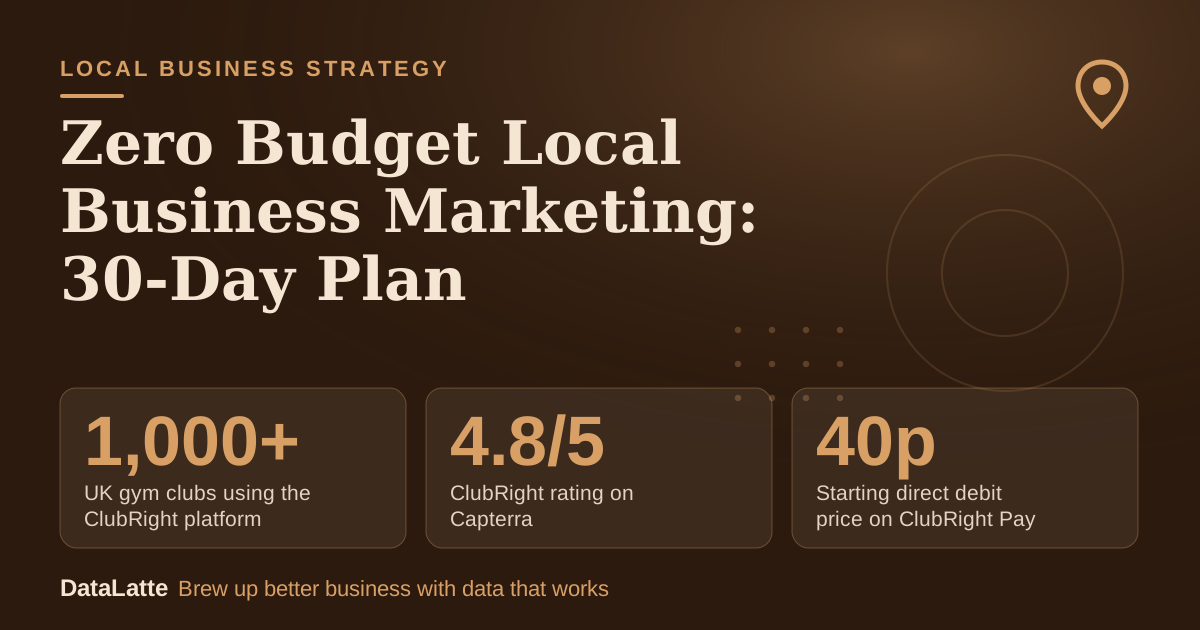
UK gym clubs using the ClubRight platform
ClubRight blog, secondary
→
ClubRight rating on Capterra
ClubRight site, secondary
→
Starting direct debit price on ClubRight Pay
ClubRight site, secondary
→
Prize pool in the SBA Million Dollar Pitch
SBA video banner, primary
See Sources at the end of the article. Cards marked Assumption are examples, not results.
These figures describe a software vendor and a business competition. They are shown so the source trail is visible. They are not results of free marketing, and the plan below does not depend on them.
What Should a Zero-Budget Business Do First?
Work through this order before spending time on anything else:
- Claim or create the Google Business Profile and complete every field: categories, hours, phone, website, services and photos.
- Print a short sign with the review link or QR code and place it at the counter.
- Reply to every existing review, positive or negative, within the same week.
- Open a free Nextdoor business page and post one update about the business.
- Start a paper or tablet sign-up sheet for an email list.
- Set up a simple tally of how each new customer found the business.
Finish steps 1 and 2 first. Profile completeness and review volume are the two things an owner controls without money, and most other channels send people back to them.
Businesses in Australia can compare the same free channels in the
local marketing guide for Australian small businesses, which adds local context.
Which Free Channels Reach Nearby Customers?
Most free channels fall into four groups. Each has a limit that affects planning.
| Channel | What costs nothing | Limit to plan around |
|---|
| Google Business Profile | Listing, photos, posts, replies | Verification may take time; a better position cannot be bought |
| Nextdoor business page | Page and posts | Paid promotion is separate; neighbours decide what they see |
| Email list on a free plan | Sending to a small list | Feature limits on scheduling and automation |
| Own social accounts | Posting and replying | Reach is not guaranteed |
Neighbourhood platforms work best for recommendations rather than broadcasts. Ask a few regular customers to recommend the business, then thank them publicly. Paid scheduling tools are a later step. The
social media scheduler comparison explains the trade-offs once posting volume grows beyond what a free tool handles.
How Do You Ask for Reviews Without Offering Rewards?
Ask in person while the customer is still satisfied. A short line such as "Would you mind leaving a review on the Google profile?" works better than a printed card alone. Hand over the QR code or link at the same moment.
Do not offer discounts, free products or any other reward in return for a review. Check each platform's current review policy before launching a campaign, because rules change and a single incentive can get a listing flagged. Asking every customer, not only the happiest ones, keeps the review volume honest.
Reply to each review with the customer's first name and one specific detail from their visit. Replies show prospective customers that a real person runs the business.
How Do You Build an Email List With No Spend?
Collect addresses at the till, at booking, or on a sheet on the counter, and tell people what they will receive. Send one short update each month: a new service, a seasonal offer or a thank-you. One message, one offer and one link keeps the list easy to read.
Email is a channel the business owns. A social account can change its rules or reach overnight, while a list of people who asked to hear from the business does not depend on an algorithm. Record why each subscriber joined so later messages can match their interest.
Low-commitment offers help here. A free guide, a short checklist or a first-visit consultation gives a hesitant customer a reason to share an email address without buying anything yet.
FLiiP's advice on gym sales makes a similar point for fitness studios: a personalised follow-up tied to the prospect's goals keeps the business top of mind.
What Does a 30-Day Plan Look Like?
All inputs in this example are assumptions for a café or salon with about five hours a week to spend on marketing.
| Week | Task | Time (assumption) |
|---|
| 1 | Complete the Business Profile; print the review QR code; reply to existing reviews | 3 hours |
| 2 | Ask every customer for a review at checkout; log each request in a notebook | 2 hours |
| 3 | Create the Nextdoor page; set up the email sign-up sheet at the till | 2 hours |
| 4 | Send the first email to the list; review the tally of how customers found the business | 2 hours |
Total: 9 hours across four weeks, or about 2.25 hours a week. If a week has less time, stretch the plan to six weeks rather than skipping steps 1 and 2.
Start with the tally. Ask each new customer how they found the business, and write the answer down with the date. A simple lead log that records what the customer wanted also makes follow-up more useful.
FLiiP's guide to closing gym sales describes keeping notes on goals and past contact, so each follow-up can refer back to the customer's own words.
At the end of the month, compare three things: new reviews, the number of people who named each channel, and how many emails were opened. If the tally cannot show which channel brought people in, fix the tally before adding anything new.
Trade and service businesses that track jobs as well as leads may outgrow a notebook. The
field service software comparison shows what those tools add and when the cost is worth considering. When free channels bring steady enquiries and the owner can state what a new customer is worth, a paid option such as
a local SEO service becomes easier to judge.
FAQ
Can a local business market itself with no money at all?
Yes, using a free business profile, in-person review requests, a neighbourhood page and a free email plan. Results depend on the area, the effort and the competition, so track your own numbers from the start.
Does a Google Business Profile cost anything?
The sources reviewed for this article do not state current pricing for the profile. Check Google's current help pages before relying on any specific feature.
Can I offer a discount in return for a review?
No. Offering rewards for reviews is risky on most platforms. Check each platform's current policy before running any review campaign.
When should I start paying for advertising?
When free channels bring steady enquiries and you know roughly what a new customer is worth. Start with a small test and measure it against the tally you have been keeping.
Are the figures in this article reliable?
The figures in the stat row come from a software vendor's website, a vendor blog and a government video banner. They are not independent studies of free local marketing, so do not use them as benchmarks for your own results.
Sources
- FLiiP: Effective Techniques to Close More Sales at Your Gym or Fitness Studio (secondary, vendor blog)
- ClubRight: Budget-Friendly Marketing for Fitness Studios (secondary, vendor blog; source of the 1,000+ UK clubs and 4.8/5 Capterra figures, which appear on the ClubRight site)
- ClubRight Pay (secondary, vendor page; source of the 40p direct debit figure, as shown in the ClubRight site navigation)
- SBA: Marketing your business (primary; the page returned "Page not found", so it is cited only for the SBA Million Dollar Pitch banner, not for any marketing guidance)
Want help turning free channels into steady bookings? See the
Local SEO service or
book a free audit.
Free for local businesses
Want this applied to your business?
I'll review your Google presence, local SEO, and ad accounts — and send you a specific action plan within 48 hours. No pitch, no pressure.