DataLatte☕
Local Business Strategy

Word of Mouth Marketing Alone Won't Grow Local Business
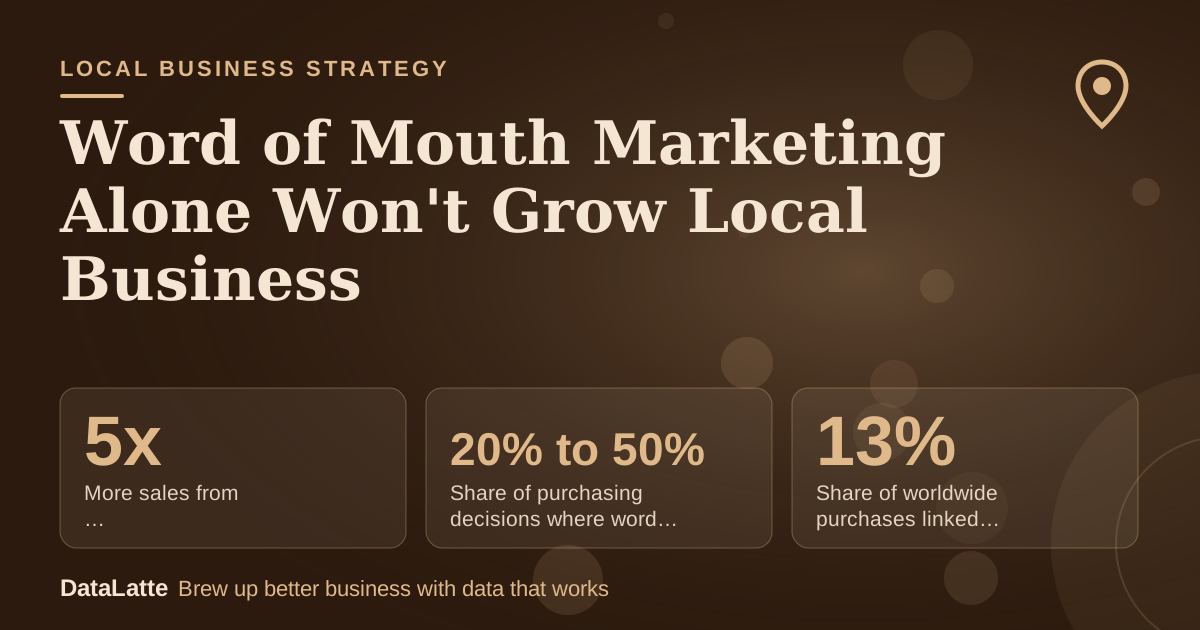
Infographic: Word of Mouth Marketing Alone Won't Grow Local Business

Part of the guide: Local Marketing Strategy

May 19, 2026·Nataliia Rumiantsewa· 7 min read All posts
Word of mouth is powerful, but on its own it caps growth. Review42's summary of referral marketing research estimates that word of mouth represents about 13% of purchases worldwide, and cites McKinsey findings that it is the primary factor behind 20% to 50% of purchasing decisions. Google describes word of mouth as one of the most effective and lasting ways to promote a website, though it can take time. The limit is reach. A recommendation only travels as far as a customer's circle, so growth needs channels that find people who have not heard of you yet.
Referrals still matter. The useful question is what happens after the recommendation is made, and which channels can reach beyond your existing customers.
5x→

More sales from word-of-mouth impressions than paid media impressions

Review42 summary via AdWave (secondary)

20% to 50%↑

Share of purchasing decisions where word of mouth is the primary factor

McKinsey findings via Review42 (secondary)

13%→

Share of worldwide purchases linked to word of mouth

Review42 summary via AdWave (secondary)

35%↑

Better results from CTV plus paid social than either channel alone

AdWave SMB TV report 2025 (as of 2025, secondary)

See Sources at the end of the article. Cards marked Assumption are examples, not results.

Is Word of Mouth Still the Strongest Channel?

It is one of the strongest, and the sources agree on that. Review42's summary reports that word-of-mouth impressions can generate 5x more sales than paid media impressions. That is a secondary figure, reported through AdWave, so treat it as directional rather than a precise benchmark for your shop.
Salesforce's local marketing guide lists the benefits as increased local brand awareness, higher foot traffic, more qualified local leads, improved customer retention from the community, and positive word of mouth. Word of mouth is one output of local marketing, not the whole plan. The practical lesson is that trust is high, but the number of people a single referral can reach is small.

Why Does a Recommendation Stop Before the Sale?

A typical referral sounds like "try the new groomer." The person who hears it does not usually book on the spot. They search your name, look at your listing, and decide whether the details match what they were told.
If that listing is thin, out of date or hard to read, the referral loses force at the last step. Google's guidance on word of mouth makes a related point: people who know a site tell their friends about it, which means the recommendation is only as good as what the friend finds when they look. Your job is to make sure the search result confirms the recommendation rather than undermining it.

Which Channels Should Sit Behind Referrals?

Referrals work best with channels that cover the gap in reach. The table below sets out what each channel does and where it falls short, using only the figures from the sources.
ChannelWhat the sources showMain limit
Word of mouthAbout 13% of worldwide purchases; primary factor in 20% to 50% of purchasing decisions (secondary, via Review42)Reach ends at each customer's circle; can take time
Local marketing overallBrand awareness, foot traffic, qualified leads, retention and word of mouth (Salesforce)Benefits are listed, not quantified
Paid socialGlobal social ad spend forecast to grow 21.3% to $394.6bn in 2026 (WARC, via Turrboo, secondary)Market growth is not a guarantee for your account
CTV plus paid social35% better results than either alone (AdWave, 2025, secondary)Costs more, and the figure is vendor-reported
Small paid boosts$5 to $10 a day targeted to a metro can meaningfully grow a local following (AdWave, secondary)Modest reach, so results build slowly
The pattern is consistent. Referrals bring trust, while paid and profile channels bring new people into the funnel. Neither does the other's job well alone.

How Do You Capture More From Each Referral?

Treat each new customer as a data point. Most owners know referrals are working, but few can say how many came from them or which source drove the most visits.
  1. Ask every new customer how they heard about you, on the booking form or at the till.
  2. Log the answers weekly, so you can see which referral sources repeat.
  3. Ask happy customers to leave a review after the visit, and keep the request simple.
  4. Check your listing the way a referred person would: search your name on a phone and confirm the hours, photos and booking link are right.
  5. Earn third-party mentions too. Our local press coverage guide explains how a local story can give a referred person a second trusted source.
Retention matters as much as acquisition. Raklet's membership marketing guidance notes that regular fees or dues are a common way for membership models to earn money, while traditional sales may happen only occasionally. A salon or studio with recurring bookings gets more value from each referral than one that depends on one-off visits.

Should a Small Business Add Paid Ads?

Paid ads make sense when you need customers faster than referrals arrive, or when referrals dip in a slow season. AdWave's food truck guidance says a paid boost can start at a few dollars a day, and that $5 to $10 a day targeted to a metro can meaningfully grow a local following. That is a small test you can run without a large commitment.
For a larger mix, AdWave says local service businesses with strong word of mouth may layer TV on top of as little as $800 a month in digital spend, as of 2026. That is a vendor claim, so check it against your own market. The mechanics of setting up search campaigns are covered in the Germany Google Ads guide, and the same steps carry over to English-speaking markets.

What Could $150 a Month Return?

This example uses assumptions. Replace each one with your own numbers before deciding.
Input or resultValueBasis
Daily ad spend$5Assumption, low end of AdWave's $5 to $10 range
Monthly ad spend$150Calculated: $5 × 30 days (assumption)
New customers from ads3Assumption
Cost per new customer$50Calculated: $150 ÷ 3
Average customer value over 12 months$240Assumption: $60 per visit × 4 visits
Revenue from those customers over 12 months$720Calculated: 3 × $240
Revenue per $1 of ad spend$4.80Calculated: $720 ÷ $150
This is revenue, not profit. Subtract product, labour and booking costs before judging the result. If only one customer comes from the ads, revenue is $240 against $150 spent, a 1.6x return. That still clears the cost, but the margin is thin. Track your real cost per new customer for at least a month before you scale.

FAQ

Is word of mouth still worth investing in?

Yes. Review42's summary reports that word-of-mouth impressions can generate 5x more sales than paid media impressions. It is one of your most trusted channels, but its reach is limited to your customers' circles, so it works best alongside other channels.

Can a small business run ads on a tight budget?

AdWave's food truck guidance says $5 to $10 a day targeted to a metro can meaningfully grow a local following. Start there, track the cost per new customer, and increase spend only if the numbers hold.

Does word of mouth grow quickly?

Google describes word of mouth as one of the most effective and lasting ways to promote a website, but notes that it can take time. Plan for a gradual build rather than an immediate spike.

Is TV worth considering for a local business?

AdWave says local service businesses with strong word of mouth may layer TV on top of as little as $800 a month in digital spend, as of 2026. This is a vendor claim, so test it against your market before committing.

Sources

Want a steady stream of customers beyond referrals? Explore the Local SEO service or book a free audit.

Free for local businesses

Want this applied to your business?

I'll review your Google presence, local SEO, and ad accounts — and send you a specific action plan within 48 hours. No pitch, no pressure.

local seopaid adsword of mouth marketingsmall business growth

Want hands-on help?

See how DataLatte handles Analytics & Reporting for local businesses.

Learn more
Nataliia — local marketing expert
Nataliia Rumiantsewa

Local marketing strategist with 10+ years at global agencies — OMD, Dentsu, GroupM, and BBDO. Now helping small businesses get the same data-driven edge. Based in Europe, working with clients in the US, UK, Australia, and beyond.

Want this applied to your business?

Let's review your current marketing setup together — free, no obligations.

Get Your Free Marketing Audit