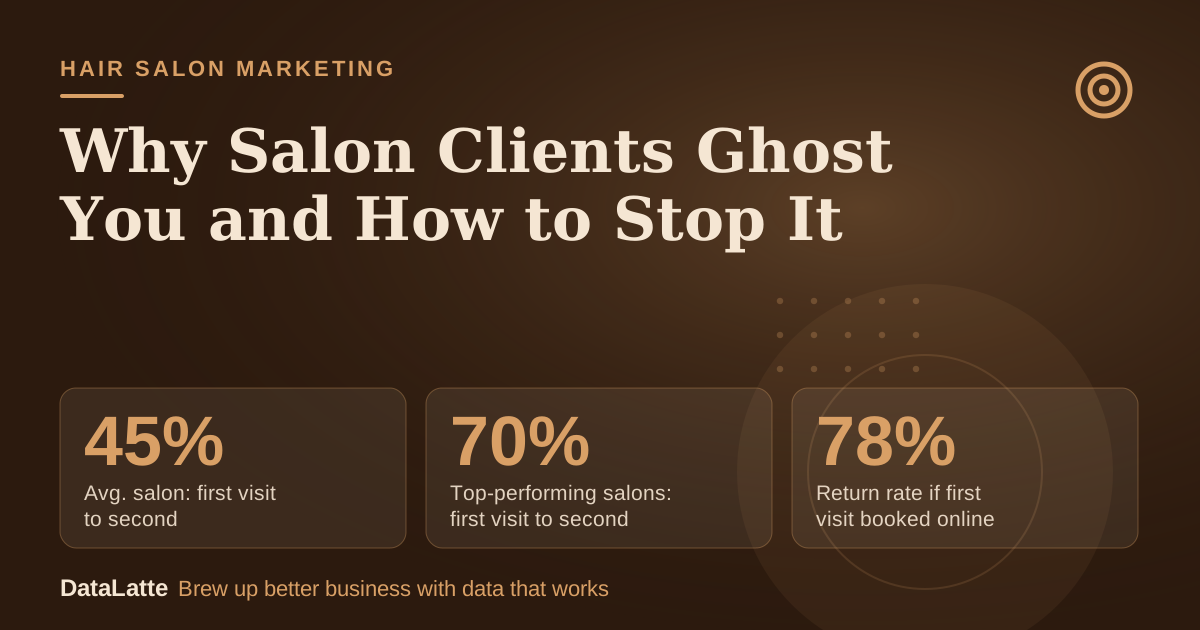
Salon clients ghost when the next visit is hard to book, nobody follows up after the first appointment, or a stylist change or price jump goes unexplained. Lutily, citing Boulevard's retention report, puts the average salon's first-to-second visit rate at 45%, against 70% at top-performing salons. The gap is mostly operational. This guide shows how to find drifting clients, remove booking friction and run a short win-back sequence that respects consent. It is written for salon, barbershop and spa owners in the US, UK, Australia and Canada.
Why do salon clients stop coming back?
Most drift comes from several small failures rather than one big one. Boulevard's figures, as reported by
Lutily, show the average salon converts 45% of first visits into a second appointment. Top-performing salons convert 70%, and 57% of first visits into a third. Industry first-time client retention is listed at 35%, with top salons at 55% or more.
→
Avg. salon: first visit to second
Boulevard via Lutily (secondary)
↑
Top-performing salons: first visit to second
Boulevard via Lutily (secondary)
↑
Return rate if first visit booked online
Boulevard via Lutily (secondary)
↓
Return rate for walk-ins
Boulevard via Lutily (secondary)
See Sources at the end of the article. Cards marked Assumption are examples, not results.
Two other figures show why this matters. Phorest data cited by Lutily says a returning client spends about 31% more per visit than a first-timer. Kitomba data on the same page says regular clients make up about 40% of a typical client base but account for 70% of all appointments. Losing regulars costs more than their share of headcount suggests.
Booking channel also appears to matter. Clients who booked their first appointment online returned 78% of the time, against 39% for walk-ins. That is a correlation, and online bookers may differ in other ways. It still points to the same fix: make the next visit easy to book.
How do you tell which clients are drifting?
Start with a number you can repeat. The
GroomSoft guide defines client retention rate as repeat clients divided by total clients, multiplied by 100. Calculate it for the last 12 months, then again each quarter. A falling figure shows that drift is happening. The groups below show why.
- Export clients whose last visit was 90 or more days ago. Several vendors use 90 days as a win-back trigger, but set the cut-off to match your normal service cycle.
- Sort each lapsed client into one of four groups: visited once and never returned; usual stylist has left or changed hours; last visit followed a price rise or a bill above the quote; regulars who stopped without a clear reason.
- Count each group and start with the largest.
- Check how many clients leave with their next appointment already booked. If your software does not report this, count one week of checkouts by hand.
If one-and-done dominates, your first-visit experience and follow-up need work. If stylist-linked dominates, the problem is handover, not marketing.
How do you make rebooking easy enough that clients do it?
Clients who leave without a booking may still return, so a reminder after a "not yet" is worth sending.
Booksy's salon marketing guide suggests automated SMS or email reminders 48 hours after a client declines to rebook. Booksy also states that with Reserve with Google connected, a client can go from searching to booked in under 30 seconds, so the path from Google matters as much as the in-salon ask. Our
Google Business Profile posts guide for hair salons covers how to keep that listing active.
Make the checkout suggestion specific. Propose a date based on the interval you would give that client, not a vague "see you soon." Put a one-tap reschedule link in every confirmation and reminder. Keep your online calendar showing real availability, because an empty-looking calendar gives clients no reason to commit.
What should you change after a first visit or stylist change?
Write a consultation note after every first visit: what the client asked for, what was done and what to change next time. Whoever sees them next should read it first. Then send a check-in 24 to 48 hours later, asking how the result is and inviting a reply if anything is off. A client who raises a small issue privately is one you can still keep.
If a stylist leaves, contact their clients yourself, introduce the replacement, share the consultation notes and offer a short chat before the first appointment. Publish a price list that shows "from" prices for add-ons, quote before starting, and announce any rise two to four weeks ahead. Avoid permanent discounts to offset price complaints, since they train clients to wait for offers.
How do you run a win-back sequence without annoying clients?
Booksy suggests a "Come back and see us" trigger when a regular client has not booked within 12 weeks.
BonusQR suggests a "We miss you!" offer after 90 days without a visit. Both are vendor suggestions, not benchmarks, so set your trigger from your own average gap between visits. The timings below are suggested starting points.
| When (from usual interval) | Message |
|---|
| Plus 1 to 2 weeks | Friendly nudge with a booking link |
| Plus 6 weeks | Something useful: a care tip or a new service |
| Plus 3 months | A small reason to return, such as a complimentary add-on |
| Plus 6 months | A personal note from the stylist, with a reply option |
Stop the sequence when the client books, opts out or says they are not interested. Booksy advises stopping messages to clients who say they are not interested in welcome-back offers. Opt-out rules vary by platform and country. Bella Booking, for example, uses NO PROMOS or STOP MARKETING for marketing-only opt-out, while STOP halts all SMS to that client. Check the rules where you operate, and keep appointment reminders free of offers. For wording and tooling, see
AI-powered email marketing for hair salons.
Do referrals and loyalty rewards bring clients back?
They can, when they reward clients who already come back. Booksy's example gives a regular client $20 off their next service while offering the new friend 20% off their first visit. BonusQR suggests $20 off the next service for both the referrer and the new client. Brenton Way reports that Le Collage used 20% off haircuts and colour as a referral offer, which the page says improved retention and acquisition.
Other reward ideas in the same sources include a punch card at 6 to 8 punches, a 24-hour head start on sales for top clients, a birthday treat sent seven days ahead, and an SMS to a "Top 50" list when a chair opens at short notice. Booksy also notes that a referral discount should apply only if the referral brings someone in, with the referred person receiving the same discount.
What is a lapsed client worth to your salon?
Adwave's customer lifetime value formula is average ticket × visits per year × years retained. Its illustrative hair salon example uses $75 × 6 × 4 = $1,800. Apply your own numbers. The table below uses assumed inputs to show what the retention gap could be worth. Only the 45% and 70% figures come from sources.
| Worked example, 40 new clients a month | Tough | Base | Strong |
|---|
| Share who return (45% and 70% from Boulevard via Lutily; 55% is an assumption) | 45% | 55% | 70% |
| Returning clients (assumption: 40 new clients a month) | 18 | 22 | 28 |
| Visits per returner over 12 months, including the second (assumption: 4) | 72 | 88 | 112 |
| Revenue at $85 average ticket (assumption) | $6,120 | $7,480 | $9,520 |
Moving from 45% to 70% adds about $3,400 in twelve-month visit revenue per monthly cohort. Only visits from returning clients are counted, so first-visit revenue is excluded from every column. This is revenue, not profit, so subtract product, staff and marketing costs before deciding. Treat 70% as a target rather than a forecast.
What should you do this week?
- Calculate your retention rate as repeat clients divided by total clients, multiplied by 100.
- Export clients last seen 90 or more days ago and sort them into the four groups.
- Measure checkout rebooking for the last 30 days, using your software or a hand count.
- Add a one-tap reschedule link to your confirmation and reminder messages.
- Send a personal message from each client's stylist to your 20 most valuable lapsed clients.
- Write a one-paragraph handover plan covering who contacts clients if a stylist leaves, how fast, and with what notes.
FAQ
Why do salon clients stop coming back?
Common causes are booking friction, price surprises, a stylist change and a feeling of not being listened to. Sort your own lapsed clients into groups, since the largest group tells you where to start.
What is a good rebooking rate?
Boulevard's figures, as reported by Lutily, show 45% of first-time clients return at the average salon and 70% at top-performing salons. That is a first-to-second visit measure, not checkout rebooking. Measure your own checkout rebooking rate for 30 days to set a baseline.
Send a first nudge one to two weeks after their usual interval, then follow with wider gaps. Stop if they book, opt out or say they are not interested.
Should I offer a discount to win clients back?
Start with easier booking and a personal message. Use a modest incentive later in the sequence, so regulars do not feel penalised for staying loyal.
Sources
Ready to put a retention system into practice? Run a
free audit of your salon's booking and follow-up flow.
Free for local businesses
Want this applied to your business?
I'll review your Google presence, local SEO, and ad accounts — and send you a specific action plan within 48 hours. No pitch, no pressure.