A salon rebooking script works best as a recommendation, not a question. Before the client leaves the chair, the stylist says how long the result will last, names a target date and offers two time slots. For example: "Your colour will look its best for about five weeks. Thursday the 18th at 10 or Saturday the 20th at 2 would keep it fresh. Which suits you better?" The sources in this guide do not measure rebooking rates, so the figures here are either labour-market data or clearly marked assumptions. Test the script in your own diary before relying on it.
Why does a rebooking script matter for your market?
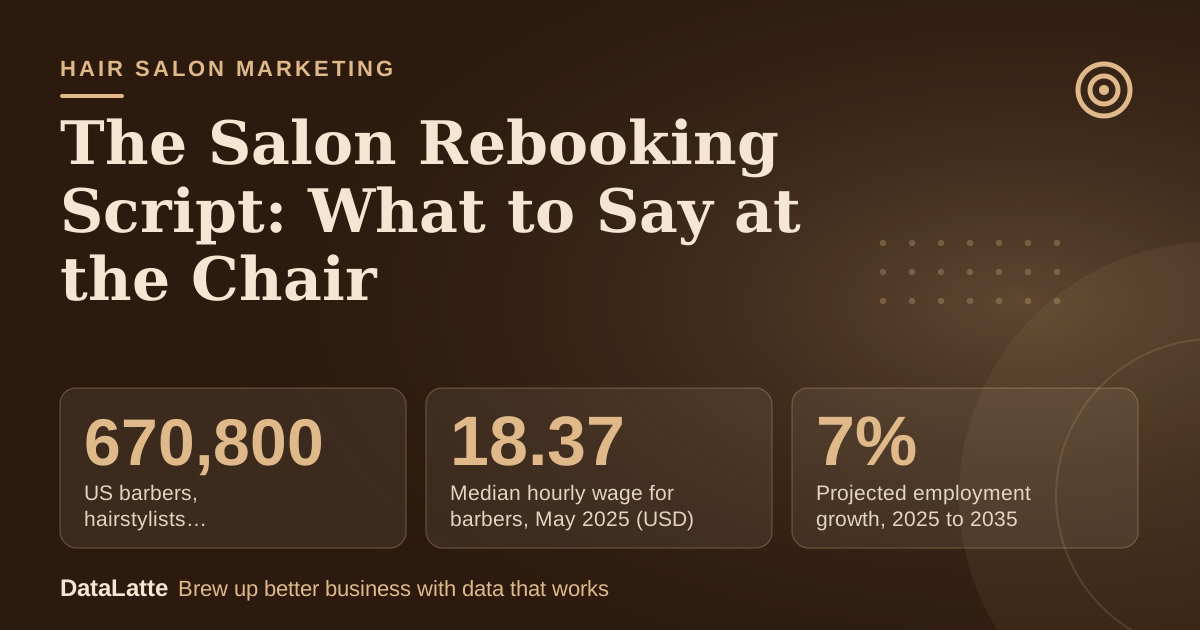
The US Bureau of Labor Statistics counts 670,800 barbers, hairstylists and cosmetologists in 2025 and projects 7% employment growth from 2025 to 2035, which it describes as much faster than the average for all occupations. It also projects about 80,300 openings a year, many of them from workers who transfer or retire. A growing field means more competition for the same clients, so a planned return visit is one of the few things a salon controls directly.
→
US barbers, hairstylists and cosmetologists employed, 2025
BLS Occupational Outlook Handbook
→
Median hourly wage for barbers, May 2025 (USD)
BLS, May 2025 median
↑
Projected employment growth, 2025 to 2035
BLS, much faster than average
→
Projected openings per year, 2025 to 2035
BLS, many from replacement
Source: US Bureau of Labor Statistics, Occupational Outlook Handbook: Barbers, Hairstylists, and Cosmetologists
The same handbook notes that most workers in this field are full time, that schedules often include evenings and weekends, and that many salons are owner-operated. Those facts shape the script. Offer times across the week, including early evening and Saturday, rather than assuming a weekday morning suits everyone.
What should the stylist say at the chair?
The stylist does the recommending, near the end of the service while the result is fresh. The pattern is always the same: state the window, name a date, offer two options. Avoid "when would you like to come back?" because it makes the client do the planning.
Template for a cut: "Your cut will look its best for about six weeks. The week of the 14th would keep the shape. Does a morning or an afternoon suit you better?"
Template for colour: "A touch-up in about five weeks will keep your roots fresh. Thursday at 10 or Saturday at 2. Which works?"
Template for a first-time client: "It was lovely to meet you. Six weeks is a good time to see you again so the shape can be built on. Would the 23rd suit?"
Swap in your team's own phrasing. The structure matters more than the exact words.
How long should you recommend before the next visit?
Return times depend on the service, the hair and the client's goals. The windows below are starting points marked as assumptions, not published standards. Write them on a card by the till and adjust them to your own results.
| Service | Starting window (assumption) |
|---|
| Short cuts and fades | 3 to 5 weeks |
| Longer cuts and trims | 6 to 10 weeks |
| Root colour touch-up | 4 to 6 weeks |
| Highlights or balayage | 8 to 12 weeks, with toner visits in between |
| Blowouts and styling | As needed, or for events |
Check the windows against your own data. Pull the last 100 repeat clients from your booking system and note the actual gap between visits for each service. The real median gap beats any table. If clients booked at five weeks keep returning while those booked at nine weeks drift away, move the recommendation. Spa and wellness businesses can plan a similar rhythm, and the
wellness business marketing strategy explains how to structure it.
How should the front desk finish the booking?
The stylist recommends and the front desk completes the booking. Both should use the same words so the client hears one plan, not two.
Stylist to desk: "Jordan is due in five weeks for colour. Could you look for Thursday morning?"
Desk to client: "The 18th at 10 or the 20th at 2 are open. Which would you prefer?"
Then confirm out loud and by text: "You are booked for Thursday the 18th at 10 with Sam. You will get a reminder two days before." Book before payment is taken, while the client is still enjoying the result. A 2022 technology guide from Salon Today describes salon software as the tool that handles appointment booking, payments and client loyalty in one place, which is why the booking step belongs in that system.
If the client is unsure, offer a hold rather than a refusal. Check that the cancellation policy is written down, clear and matches what the team says. Automated reminders and confirmations can be wired to the calendar with the tools covered in
10 small business automations that save time.
What do you say to common objections?
Short, calm answers stop staff from freezing. Do not push. One friendly second offer is enough.
- "I do not know my schedule yet." Answer: "No problem. A slot can be held, and it can be moved up to 24 hours before." Check that this matches the cancellation rule.
- "I will call you." Answer: "Of course. The week fills quickly, so a spot can be pencilled in and a text sent tomorrow to confirm."
- "It is too expensive." Listen first, then offer a smaller maintenance visit between big appointments, such as a gloss or a trim.
- "I am growing it out." Answer: "A trim every few months keeps the ends healthy. Could one be pencilled in for the spring?"
Which follow-up messages should go out after the visit?
The script handles the client in the chair. A simple message sequence handles the rest. The BookingBee vendor guide argues that a fast, consistent reply helps salons win repeat business, and that automated reminders reduce no-shows. That is a vendor claim, so test it in your own diary.
- A confirmation text straight after booking.
- A reminder 24 to 48 hours before, with an easy reschedule link.
- A thank-you message the next day.
- A gentle nudge once a client passes their usual window without a booking.
For ideas on keeping clients engaged between visits, see
salon marketing ideas that fill your chair every week. For planning content that reaches lapsed clients, the
blog content strategy guide explains the process.
What does a rebooking gain look like in numbers?
The example below uses assumptions throughout. The 30% starting share, the return rates and the average ticket are placeholders for illustration. Replace them with figures from three months of tracking.
Assumptions: the salon serves 200 clients a month. The average ticket is $85. A client who leaves with a booked appointment has a 90% chance of showing up (assumption). A client who leaves unbooked has a 60% chance of returning within the window (assumption).
| Today (assumption) | Modest gain (assumption) | Strong gain (assumption) |
|---|
| Share leaving with a booked appointment | 30% | 45% | 60% |
| Booked clients | 60 | 90 | 120 |
| Expected return visits from booked (x 90%) | 54 | 81 | 108 |
| Unbooked clients | 140 | 110 | 80 |
| Expected return visits from unbooked (x 60%) | 84 | 66 | 48 |
| Total return visits | 138 | 147 | 156 |
| Extra visits vs today | 0 | 9 | 18 |
| Extra revenue at $85 | $0 | $765 | $1,530 |
Moving from 30% to 45% of clients leaving with an appointment adds about 9 return visits a month under these assumptions, or about $765 in revenue. This is revenue, not profit, and it ignores product costs and staff time. A booked chair also fills the diary weeks ahead, which makes income easier to plan. Rebuild the table with your own show and return rates before setting a target.
What checklist keeps the script consistent?
Print this and keep it by the front desk:
- The stylist states how long the result will last.
- The stylist gives a target date, not a vague "soon".
- The desk offers two specific slots.
- The appointment is booked before payment is taken.
- A confirmation text goes out straight away.
- The next-visit plan is saved in the client notes.
- Clients who leave without booking get a friendly text within two days.
For help setting up a local visibility plan that supports bookings, you can
request a free audit.
FAQ
What is a good salon rebooking rate?
The sources here do not set a benchmark, so there is no verified target. Measure the rate for a month, then improve it one step at a time. Compare each stylist against their own past figures, not against other stylists.
Should clients pay a deposit to rebook?
Some salons use deposits for long colour appointments or peak times. Keep the policy clear, fair and visible at booking, and make sure the front desk explains it the same way every time.
What if a client wants to wait and see?
Offer to hold a slot with free changes until a set time, then send a gentle follow-up text. This keeps the door open without pressure.
Do I need special software to use this script?
No. A paper tally and a clear script are enough to start. Booking software makes reminders and reporting easier as the salon grows, and the script works the same way for a barbershop or a nail salon.
Sources
Free for local businesses
Want this applied to your business?
I'll review your Google presence, local SEO, and ad accounts — and send you a specific action plan within 48 hours. No pitch, no pressure.