Influencer Marketing for Cafés and Restaurants
Part of the guide: Coffee Shop Social Media & Meta Ads
What diner surveys say (US, older data)
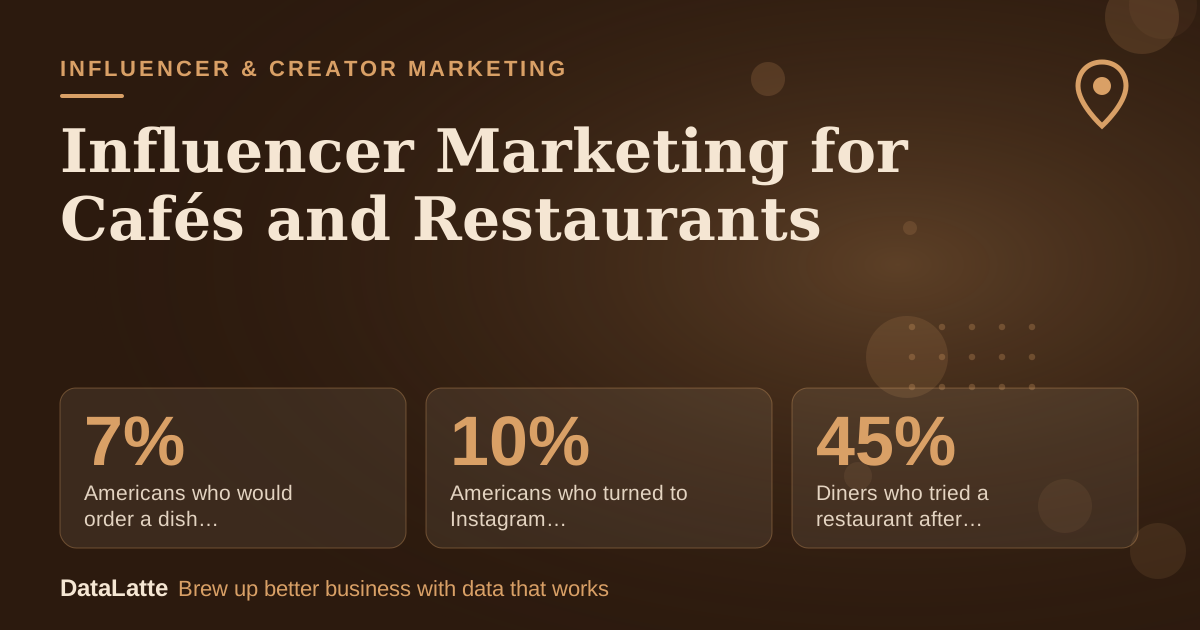
Americans who would order a dish an influencer recommended
SevenRooms and YouGov, Dec 2018
Americans who turned to Instagram for restaurant suggestions
SevenRooms and YouGov, Dec 2018
Diners who tried a restaurant after its own social post
MGH study, Apr 2019
Diners who follow and engage with restaurant brands and say they are more likely to visit
MGH study, Apr 2019
Source: Restaurant Dive reports of SevenRooms/YouGov (December 2018) and MGH (April 2019), both secondary
Do Influencers Actually Fill Restaurants?
- A YouGov survey for SevenRooms, reported by Restaurant Dive in December 2018, found that over half of Americans turned to friends and family for restaurant suggestions, about a third used review sites such as Yelp, 10% turned to Instagram, and only 7% would order a dish an influencer recommended. The article does not give the sample size.
- A study by the agency MGH, reported by Restaurant Dive in April 2019, found 45% of US diners had tried a restaurant for the first time because of a post from the restaurant itself. That is about the venue's own posts, not influencers, and the article does not state a sample size either.
of Americans said they would order a dish recommended by a social media influencer
SevenRooms and YouGov survey reported in December 2018. Older data and no sample size is given, so use it as a caution, not a forecast.
Restaurant Dive, 11 December 2018 (secondary report)
Which Creators Should You Approach?
- Search Instagram and TikTok for your city or suburb plus "eats", "brunch", "coffee" or "food".
- Check who already tags your location. Existing fans accept more readily and sound more believable.
- Scan local Facebook food groups and Reddit threads for people who regularly recommend places.
- Ask regulars who post about you.
- Is the audience local? Ask for a screenshot of their audience location breakdown from Instagram Insights, or check the commenters yourself.
- Are the comments real? Look for specific replies ("is the patio dog friendly?") rather than rows of emoji.
- Does their style fit the room? A moody late-night cocktail account is wrong for a family bakery.
- Have they handled sponsored posts properly before? Clear labels on past posts are a good sign.
What Should You Offer a Creator?
| Structure | How it works | Best for |
|---|---|---|
| Gifted visit | A meal or drinks in exchange for honest content | Smaller local accounts, new venues |
| Fee plus visit | A flat fee and a meal for a defined set of posts | Creators with a proven local audience |
| Event invite | Several creators at a tasting or launch | Openings, new menus |
| Code or phrase | A unique discount or free add-on tied to the creator | Counting real redemptions |
What Goes in the Agreement?
- The deliverables (for example one Reel and three Stories), the posting window and the handles to tag.
- What you provide (the meal, the fee, the date and a quiet time to film).
- Two or three things worth showing: the signature dish, the room, the pour.
- What to avoid, such as quoting prices that might change.
- Usage rights: can you repost it on your own channels and Google profile, and can you run it as an ad? Paid use usually costs extra, so agree it up front.
- The disclosure requirement (next section).
Do You Have to Label Gifted Meals as Ads?
How Do You Give People a Reason to Come Now?
- A unique phrase or code. "Say 'Maya sent me' for a free cookie with any coffee" is trackable if staff tap a button on the till or tally marks on a sheet.
- A limited-time item tied to the creator, with a clear end date.
- A link in their bio to your Google Maps listing or booking page.
How Do You Track Results Without Software?
- Redemptions of the creator's phrase or code, logged at the till.
- Profile visits, follows and direction requests in the week after the post, from Instagram and Google Business Profile insights. Note the baseline for the same weekday in the three weeks before.
- A one-line question at the till for first-time guests: "How did you hear about us?" Record it in a notebook.
- Sales on the day compared with the same weekday in earlier weeks.
Does a Creator Deal Pay Back? The Math
| Per creator | Tough | Base | Strong |
|---|---|---|---|
| Creator fee (assumption) | $100 | $100 | $100 |
| Comped meal, ingredient cost (assumption) | $20 | $20 | $20 |
| Total cash cost | $120 | $120 | $120 |
| New guests who redeem (assumption) | 5 | 15 | 40 |
| Average spend per guest (assumption) | $25 | $25 | $25 |
| Gross margin (assumption) | 65% | 65% | 65% |
| Gross profit from those guests | $81 | $244 | $650 |
| Net after cost | -$39 | +$124 | +$530 |
| Cost per new guest | $24 | $8 | $3 |
Can You Reuse the Content?
Do This Today
- Work out your numbers: ingredient cost of a comped meal, average spend and gross margin. Calculate your break-even number of new guests.
- Shortlist ten local creators, ask three for a rate card and an audience location screenshot, and narrow to two or three.
- Write a one-page brief and agreement covering deliverables, the offer, usage rights and the "ad" label requirement.
- Create a trackable hook (a phrase or code) and a tally sheet at the till, and brief your staff.
- Book the visits for quiet slots, then review redemptions, profile visits and sales a week after each post and invite back only the ones that beat break-even.
FAQ
How much should I pay a local influencer?
Do I have to label gifted meals as ads?
Instagram or TikTok for a cafe?
How long until I see results?
Sources
- FTC: Disclosures 101 for Social Media Influencers
- FTC: The FTC's Endorsement Guides, What People Are Asking
- ASA (UK): Recognising ads, social media and influencer marketing
- Restaurant Dive: Survey, half of diners rely on friends and family, not Instagram (SevenRooms/YouGov, Dec 2018)
- Restaurant Dive: 45% of diners have tried a restaurant because of social media (MGH, Apr 2019)
- Influencer Marketing Hub: Influencer Marketing Benchmark Report 2026 (survey of 600+ respondents, not restaurant-specific)
- Instagram Help Center: Partnership ads on Instagram
Free for local businesses
Want this applied to your business?
I'll review your Google presence, local SEO, and ad accounts — and send you a specific action plan within 48 hours. No pitch, no pressure.
Want hands-on help?
See how DataLatte handles Social Media Management for local businesses.
☕ Industry Guide
Coffee Shop Marketing Guide

Local marketing strategist with 10+ years at global agencies — OMD, Dentsu, GroupM, and BBDO. Now helping small businesses get the same data-driven edge. Based in Europe, working with clients in the US, UK, Australia, and beyond.
Related articles
Yoga Studio Marketing in Berlin: Fill Your Classes
8 min read
Word-of-Mouth Marketing Strategy for Local Business
7 min read
Wolt Promoted Placement: Worth It for Restaurants?
11 min read
5 C's of a Marketing Plan: Small Business Guide
7 min readWant this applied to your business?
Let's review your current marketing setup together — free, no obligations.
Get Your Free Marketing Audit