A local business can test Instagram Reels ads with a small budget by running a split test, setting the same budget for each version, and measuring cost per enquiry rather than cost per click. The sources checked for this article do not publish Reels-specific prices, specifications or results, so no Reels-only cost is claimed here. What the sources do support is the audience size on Instagram and Meta's guidance on fair testing. The budget example below uses labelled assumptions.
→
US adults who use Instagram (2026)
Pew Research, primary
→
US adults who use Facebook (2026)
Pew Research, primary
→
US adults who use YouTube (2026)
Pew Research, primary
→
Average Google search CTR, all industries
WordStream, secondary, 2016 data
See Sources at the end of the article. Cards marked Assumption are examples, not results.
How Many Local Customers Use Instagram?
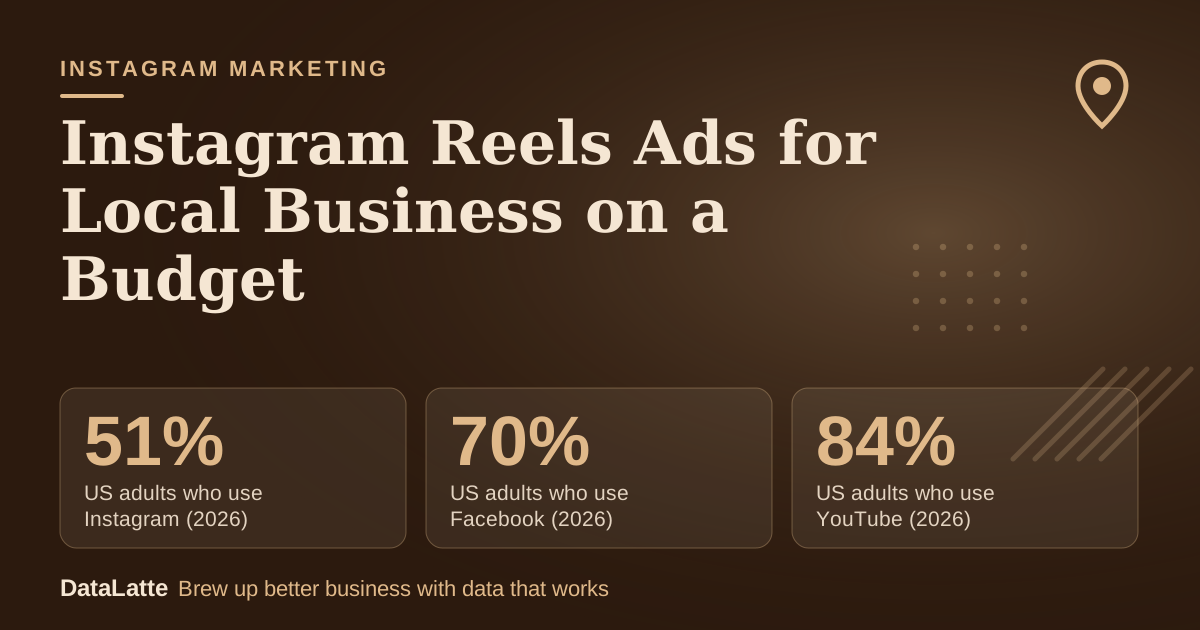
Pew Research Center's 2026 survey found that 51% of US adults use Instagram, compared with 70% for Facebook and 84% for YouTube. The survey covered 5,511 US adults between January 30 and June 18, 2026, with an overall margin of error of plus or minus 1.8 percentage points.
Pew's social media fact sheet gives the full platform breakdown.
Reach is not the same as fit. Half of adults is a large audience, but a local business still needs the people nearby who can visit, book or call. The platform figures show whether Instagram is worth a test at all. The ad itself should be judged by local enquiries, bookings and calls, because those are the outcomes a nearby customer produces.
What Do the Sources Not Cover?
The Meta and Google pages reviewed for this article do not give Reels-specific video specifications, file limits or cost benchmarks. Treat any number you see for Reels without a source as unverified. Check the current requirements in Ads Manager's preview and placement options before uploading anything.
Older benchmark data also needs care. The
WordStream industry benchmarks page is a secondary source and its published date is 2016. Its numbers are useful only as rough context for how click costs vary by industry, not as current prices for Reels or any other placement.
How Should You Structure a Small Reels Test?
Meta's guidance on A/B testing sets the rules for a fair test. It recommends writing a hypothesis first, using the same budget for both versions, and changing one variable at a time. Variables can include ad images, ad text, audience or placement. Meta advises against switching ads or ad sets on and off by hand, because that can overlap audiences and produce unreliable results. The
Meta A/B testing help page explains the setup.
| Step | What to do | Why |
|---|
| 1. Write one hypothesis | Example: a Reel with a booking offer beats a brand video on cost per enquiry | Meta recommends a hypothesis before testing |
| 2. Pick one variable | Change either the creative or the audience, not both | Keeps the result readable |
| 3. Set equal budgets | Give each version the same daily spend | Meta says this ensures a fair comparison |
| 4. Run as an A/B test | Use the built-in test tool, not manual on and off switching | Avoids overlapping audiences |
| 5. Judge on cost per result | Compare cost per enquiry, booking or call | Clicks alone can hide poor leads |
What Does a $300 Test Look Like?
The example below is an illustration. Every input is an assumption, and the click cost is borrowed from a non-Reels search benchmark, so replace it with your own Ads Manager data after the first week.
| Input or result | Value | Label |
|---|
| Test budget | $300 | Assumption |
| Cost per click | $2.62 | Assumption, based on WordStream Health & Medical search CPC (secondary, 2016 data) |
| Clicks | about 114 | Calculated: $300 divided by $2.62 |
| Click to enquiry rate | 5% | Assumption |
| Enquiries | about 5.7 | Calculated |
| Cost per enquiry | about $53 | Calculated: $300 divided by 5.7 |
| Enquiry to customer rate | 25% | Assumption |
| Customers | about 1.4 | Calculated |
| Value of a customer | $120 | Assumption |
| Revenue from customers | about $171 | Calculated |
At these inputs the test returns less than it cost in the first month. That is normal for a first test and a reason to measure, not a verdict on Reels. Keep the test running only if cost per customer falls below what a customer is worth over the next three months, and if one version beats the other on the same budget. A booking link or unique code helps match each customer back to the ad that brought them in.
Compare the result with other paid options before scaling. For a broader view of automated campaigns,
Google's Display campaign page suggests considering Performance Max or Search campaigns for other automated needs. Our readers can find that option explained in the
Performance Max guide for local business.
How Do You Plan Content and Budget Together?
A Reels test works better when the video is ready before the ad budget starts. Plan a short batch of videos, schedule them so the posting calendar does not stall, and then promote the one expected to perform best. A
scheduling comparison for Instagram tools can help choose a tool for that workflow.
Budget size matters as much as creative. The
Facebook ads budget guide covers how to size a first test across Meta placements, which is useful when Reels is one of several placements under consideration.
Lead generation may suit some businesses better than direct ads. If the goal is calls and booked jobs, compare the Reels test with
Google Local Service Ads, which are built around local service leads. Put each channel's cost per customer side by side on the same worksheet so the comparison uses the same definition of a customer.
FAQ
Is Instagram worth testing for a local business?
Pew Research Center found that 51% of US adults use Instagram in 2026, so it reaches a large audience. Whether it reaches nearby customers depends on the category and location, so test it with a capped budget.
Not from the sources reviewed here. They do not include Reels-only costs. The search and display benchmarks in the WordStream and Google materials are either dated or from different placements, so use them only as rough context.
How should I compare two Reels ads?
Use Meta's A/B test tool, give both versions the same budget, and change only one variable. Judge the result on cost per enquiry, booking or call, not on likes or clicks alone.
How long should the test run?
The sources do not give a duration. Run it long enough to collect a meaningful number of enquiries on each version, and check the result inside Ads Manager before making changes.
What should I do if cost per customer is too high?
Change the offer or the audience once, then retest. If cost per customer stays above what a customer is worth over three months, stop the Reels test and move the budget to a channel that performed better.
Sources
Want help designing a low-budget Reels test and tracking cost per enquiry?
Book a free audit and the team will review your current ad setup.
Free for local businesses
Want this applied to your business?
I'll review your Google presence, local SEO, and ad accounts — and send you a specific action plan within 48 hours. No pitch, no pressure.