A local business can work with micro-influencers through four deal types: a free service or product, a flat fee, a recurring ambassador arrangement, or a tracked discount code. The sources reviewed give follower ranges and engagement claims but no reliable per-post rates, so the practical approach is a small pilot. Choose two or three local creators, label every gifted or paid post clearly as an ad, and measure your own cost per new customer. The worked example below uses assumed inputs.
→
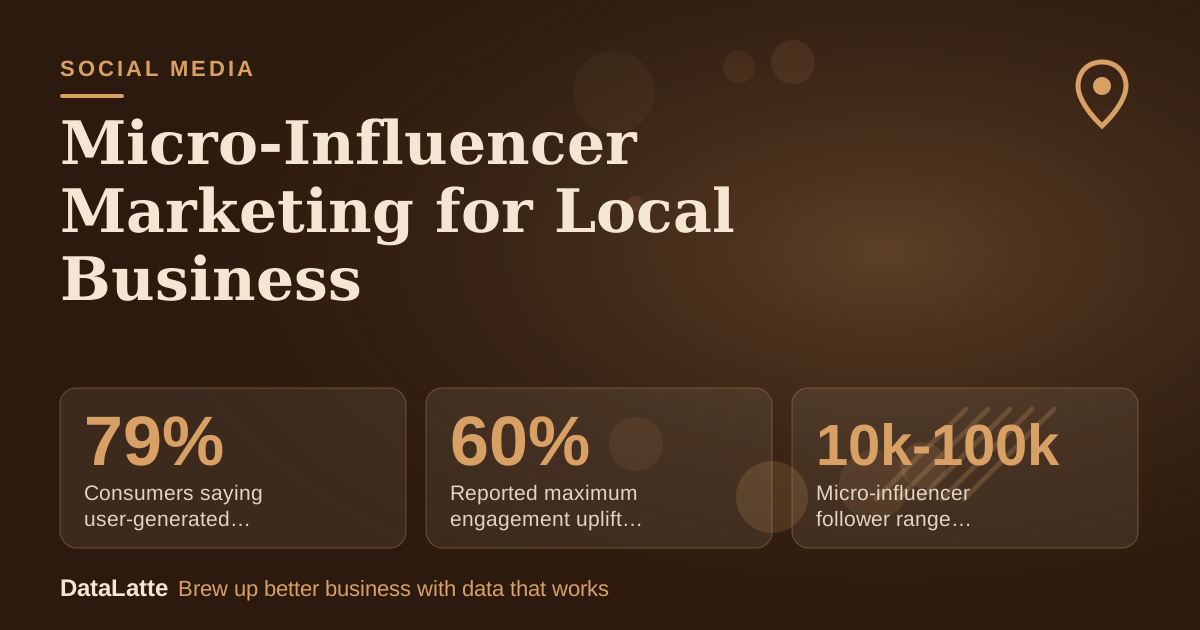
Consumers saying user-generated content affects purchases
Stackla via Forbes Councils (secondary)
↑
Reported maximum engagement uplift for small-scale influencers
HubSpot via Forbes Councils (secondary)
→
Micro-influencer follower range (Forbes Councils)
Citing Later (secondary)
→
Micro-influencer follower range (Marketing Together)
Vendor blog, January 2025 (secondary)
See Sources at the end of the article. Cards marked Assumption are examples, not results.
How Big Is a Micro-Influencer?
Definitions vary. Forbes Councils, citing Later, describes micro-influencers as creators with between 10,000 and 100,000 followers. Marketing Together's 2025 guide gives a wider range of roughly 1,000 to 100,000. Both are secondary sources, so check the creator's own profile rather than relying on a tier label.
Follower count matters less for a local business than where the audience lives. A creator with 3,000 local followers may send more customers to a salon than one with 80,000 followers spread across the country. Check whether the followers appear to be near your location before you judge the account.
Which Four Deal Types Work for a Local Business?
| Deal | What you give | Best for | Watch out for |
|---|
| Free service or product | An experience or package | First test | No guarantee they post; any post still needs a clear disclosure |
| Flat fee | Agreed payment per post or story | Control over timing and content | Usage rights for your own ads, in writing |
| Ambassador | Recurring service plus agreed deliverables | Regular content over months | Needs a written agreement |
| Discount code or link | Percentage or fixed amount per booking | Services booked online | Codes must be tracked per creator |
Start with the free service for two or three creators. It carries the least risk and shows quickly which posts bring customers. Once a creator proves useful, a flat fee or ambassador deal gives you more control over timing.
Businesses that take bookings online, such as salons or studios, can get the most from discount codes. The
Jobber vs ServiceTitan comparison explains how service businesses handle bookings and job records, which helps match a code to a sale.
What Do Micro-Influencers Cost?
None of the sources reviewed publish reliable average rates for local creators. Marketing Together describes micro-influencers as charging less than larger creators and sometimes accepting products in exchange for content, but it gives no figures.
Ask each creator for their rate and whether they would accept an alternative, such as a free service or a product. Compare the answer with the value of a new customer to your business. A rate you can afford is only useful if the posts bring customers.
What Disclosure Rules Apply?
Disclosure is a legal matter, and the sources reviewed do not set out the full rules. The FTC's guidance on endorsements, influencers and reviews is the primary source to check. The copy available for this review returned only site navigation, so read the full guidance directly before writing your creator brief.
If you work outside the US, check your own regulator's guidance. The rules differ by country, so a label that satisfies one authority may not satisfy another.
As a practical step, put the wording you require in writing, such as "Ad" at the start of the caption. A brief that says "no posting required" does not remove the need for a label if a creator posts about your business after receiving something of value.
How Do You Run a Pilot?
A pilot lasts long enough to show a pattern, which is usually a few weeks of posts from each creator. Follow these steps:
- Pick two or three creators whose followers appear to live near you. Check recent posts for a natural local audience.
- Offer a free service or product and state in writing that posts must carry a clear label.
- Agree who owns the content and whether you may reuse it in your own ads, and for how long.
- Give each creator a unique discount code or booking link.
- Ask every new customer how they heard about you, and record the answer.
- Count cost and new customers per creator at the end of the pilot, then decide which creators to repeat.
Keep the spreadsheet simple. A column for creator, a column for cost and a column for new customers is enough. If you already track expenses in accounting software, the
FreshBooks vs QuickBooks guide covers which tools handle that well. If you manage post schedules across several accounts, the
Hootsuite vs Sprout Social comparison explains the scheduling options.
How Do You Measure Results? A Worked Example
The figures below are assumptions, chosen to show the arithmetic. Replace them with your own numbers.
| Input | Value |
|---|
| Creators in the pilot | 3 (assumption) |
| Retail value of the free service | $80 (assumption) |
| Your cost of delivering it | $30 per creator (assumption) |
| New customers per creator using the code | 2 (assumption) |
| Total cost | 3 x $30 = $90 |
| New customers | 3 x 2 = 6 |
| Cost per new customer | $90 / 6 = $15 |
Compare the $15 with what a customer is worth to your business over a year. If one creator brings no customers, drop them and try someone new. Three creators is too few to be confident, so repeat the pilot before you scale it.
Australian businesses can check local context in the
Australia local marketing guide, which covers the same basic measurement steps for that market.
FAQ
How much should I pay a local micro-influencer?
None of the sources reviewed gives a standard rate. Ask for the creator's rate, compare it with your cost per new customer, and start with a free service where the creator agrees.
Do I have to label a post if I only gave a free product?
Check the FTC's guidance on endorsements, influencers and reviews, which covers material connections, and the rules in your own country. Until you have read it, a clear label such as "Ad" at the start of the caption is a safe approach.
Are micro-influencers better than larger ones for local business?
The sources do not rank them. A creator whose followers live near you is easier to track and is usually cheaper to test.
How do I track which creator brought a customer?
Give each creator a unique discount code or booking link, and ask new customers how they found your business.
Sources
Want a local creator programme set up and tracked?
Book a free audit to review your current social channels and plan a pilot.
Free for local businesses
Want this applied to your business?
I'll review your Google presence, local SEO, and ad accounts — and send you a specific action plan within 48 hours. No pitch, no pressure.