July 6, 2026·Nataliia Rumiantsewa· 9 min read All posts
Podcast ads can work for an Australian local business, but only when you can buy by location and count the results. No verified Australian podcast listening or spend figure is included here, because the sources available do not confirm one. What the sources do support is how to plan a small test: check location options inside the platform, calculate a break-even customer count, and track responses without relying on clicks. Start with a budget you can afford to lose and one clear offer.
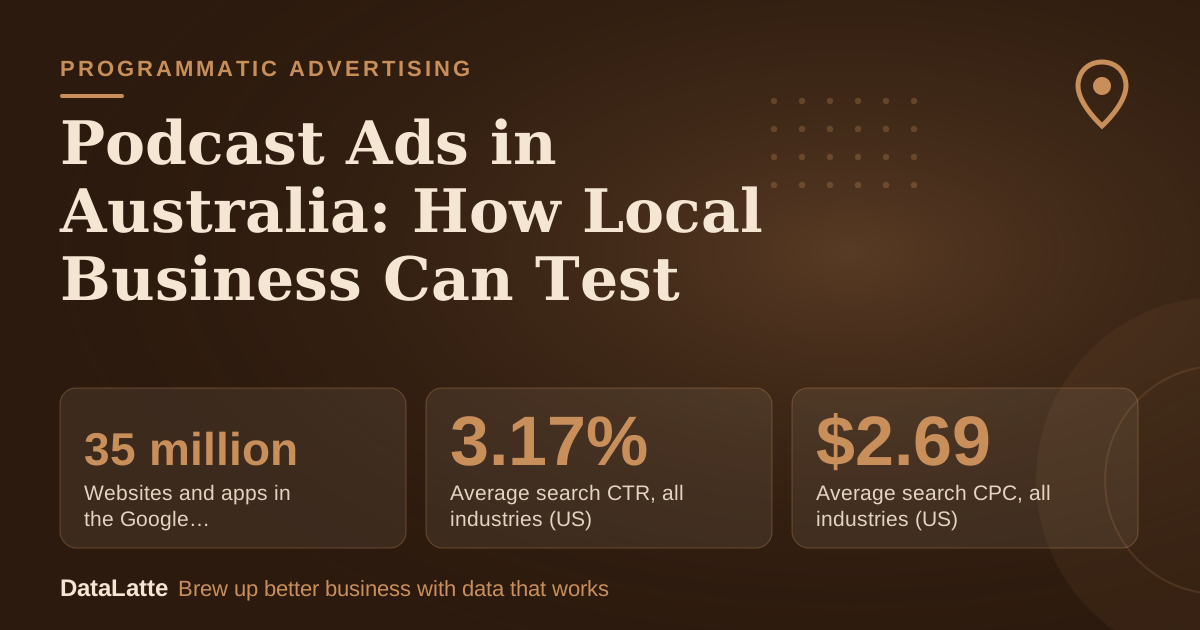
35 million→
Websites and apps in the Google Display Network
Google Ads Help (primary, worldwide reach)
3.17%↑
Average search CTR, all industries (US)
WordStream 2016 benchmarks (secondary, dated)
$2.69↑
Average search CPC, all industries (US)
WordStream 2016 benchmarks (secondary, dated)
$0.63→
Average display CPC, all industries (US)
WordStream 2016 benchmarks (secondary, dated)
See Sources at the end of the article. Cards marked Assumption are examples, not results.
What Does the Verified Data Show About Podcast Ads in Australia?
The verified sources do not include Australian podcast listening figures or ad spend totals. Any number in this guide is either linked to a source below or labelled as an assumption in a worked example. Figures that could not be checked against a primary source have been left out.
This matters for budgeting. Without a verified Australian cost-per-thousand figure, you cannot estimate how far a given budget will reach. Before you commit money, ask the podcast host or network for their audience numbers in writing, including listener location, download counts for a recent period and their current sponsors.
A local business does not need a national average to make a decision. It needs three things: a location it can buy, a result it can count, and a break-even number it has calculated for its own margins. Those three items are the focus of the rest of this guide.
Can You Target a Local Area With Platform Ads?
Google's help pages describe the Display Network as a reach product. Display campaigns can serve ads across 35 million websites and apps worldwide, including YouTube and Gmail, and they use AI-powered targeting, bidding and formats by default (Google Ads Help). The page describes a display network rather than podcast inventory, so it cannot confirm whether a podcast placement will appear in a given suburb.
The same page says Optimized targeting is the default for Display campaigns. It uses information such as keywords on your landing page to find likely customers. You can switch it off and choose another targeting method, which is useful if you want to limit reach to your own postcodes.
List the postcodes or suburbs that your last 50 customers came from. Note how many live within driving distance.
Pick three to five locations that hold the largest share of your customers.
Confirm in the platform that you can target those locations. If you cannot, change platform before you change the script.
Write one offer, one call to action and one tracking method.
Set the test length and budget in advance, and do not change them mid-test.
A very narrow location can limit delivery. If a campaign under-delivers, widen the location list before you raise the bid. That keeps the test fair, because you change the reach rather than the price per result. Record each change with its date so the results can be read later.
What Does a Small Test Need to Break Even?
Break-even is simple arithmetic. Divide the test budget by the gross profit you earn from one new customer. The result is the number of customers the test must bring in to cover its own cost.
The example below uses two assumptions that you should replace with your own figures: a A$500 test budget and A$80 gross profit per new customer. Neither figure comes from a source.
Scenario (assumption)
New customers
Gross profit
Net after A$500 test
Tough
3
A$240
-A$260
Break-even
7
A$560
+A$60
Strong
12
A$960
+A$460
Break-even is A$500 divided by A$80, which is 6.25, so the test needs 7 new customers. If a customer returns several times, use lifetime gross profit rather than the first sale, which lowers the bar. If each purchase is a one-off job, keep the single-sale figure and accept a higher bar.
Decide the break-even number before you spend. Then judge the test against it, not against a headline reach figure. A campaign can reach thousands of people and still fail the test if too few of them become customers.
How Do You Measure a Test Without Clicks?
Audio and offline advertising rarely produce a click you can see, so count responses you can control. Each method below works with a different kind of business, and using two or three together gives a clearer picture than any one alone.
A spoken promo code tied to the show or station shows which customers heard the ad. A phone number that appears only in the ad can show calls, if your phone system records the source. A short web address that redirects to a booking page gives a visit count you can compare across test periods. A tally at the till or in the booking notes, asking "how did you hear about us," catches customers the other methods miss.
Google Display campaigns can also report conversions once tracking is set up. The help page notes that Target CPA bidding lets you pay for conversions rather than clicks. That option belongs to Google's display product rather than podcasts, but it shows how a cost-per-result model can work when clicks are hard to count.
For a wider view of how a local plan fits together, the Australian local marketing guide covers the other channels to compare against your audio test.
Should You Test Audio Before Search?
Search and audio do different jobs. Search reaches people already looking for your service. Display and audio reach people who are browsing or listening and may not be looking yet. A business with weak search visibility may gain more from fixing its search basics first.
The WordStream benchmarks give a rough sense of paid search costs, but they are dated and based on US accounts. Their figures show a search click-through rate of 3.17% and a search cost per click of $2.69 across all industries, with display figures much lower (WordStream). Treat them as a sense check for how expensive paid traffic can be, not as a forecast for Australian businesses.
Before you fund any audio test, make sure your core listings and search presence work, so that people who hear the ad can find you quickly. A check of your listing, your booking route and your contact details is often the best first spend, and it costs nothing to do.
Do Sponsored Reads Need Disclosure?
Sponsored reads are a common format, and any host who reads your offer may need to say that the business paid for or supplied the spot. The rules and their wording come from advertising codes and regulators, and the sources for this guide do not include them, so this guide does not summarise them.
Before you sign a sponsorship, check the current advertising code and the rules for your industry. Health, beauty and financial claims often need extra care. Agree the wording with the host in writing, including whether you supplied free products or a fee was paid.
FAQ
Can I target a podcast ad to my suburb in Australia?
Location options depend on the platform you buy through. Check the current targeting list inside your ad account before you plan a budget. Start with the postcodes your customers already come from, and widen them only if delivery is too low.
Is there a verified figure for podcast listening in Australia?
Not in the sources used for this guide. Look for current listening research from the body that publishes it, and do not rely on older or secondary summaries without checking the original.
How much should a local business spend on a first audio test?
There is no verified minimum in this guide. Pick a budget you can afford to lose entirely, then work out the break-even customer count using your own gross profit. The worked example above uses A$500 as an assumption.
Does Google Display reach podcast listeners?
Google's help page describes reach across 35 million websites and apps, including YouTube and Gmail. It does not describe podcast inventory specifically, so check what your platform serves before assuming podcast placement.
Should I test audio or fix search first?
For most local businesses, fix the basics first: listings, booking route and core search presence. Then run a small audio test with a countable offer. For a quick review of where to start, request a free audit.
Local marketing strategist with 10+ years at global agencies — OMD, Dentsu, GroupM, and BBDO. Now helping small businesses get the same data-driven edge. Based in Europe, working with clients in the US, UK, Australia, and beyond.