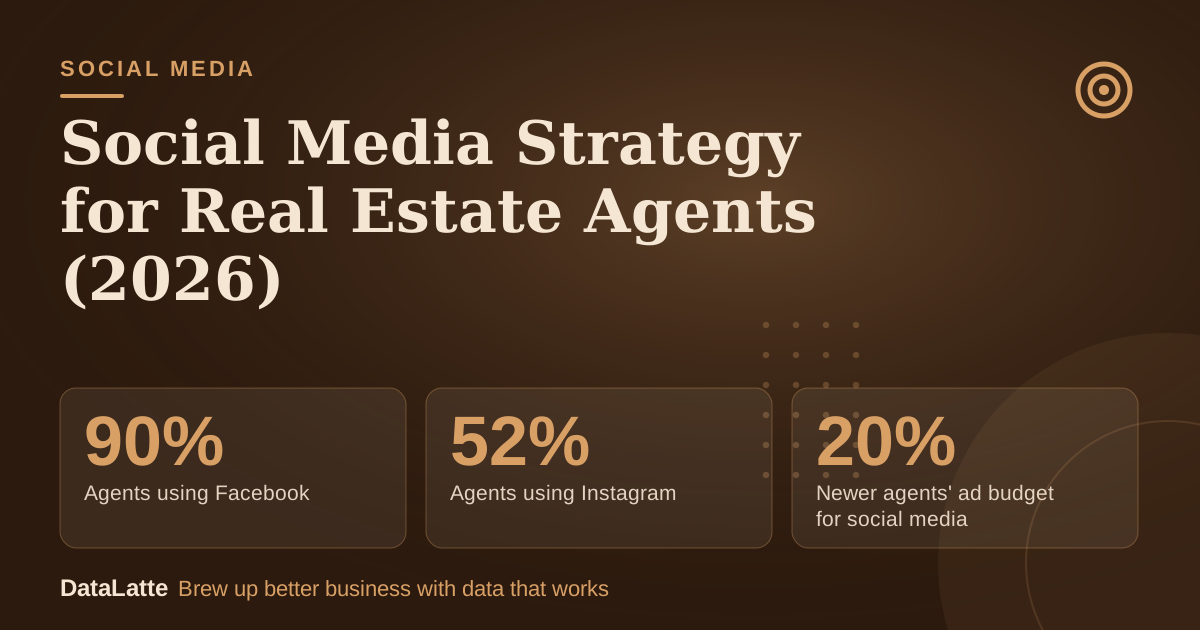
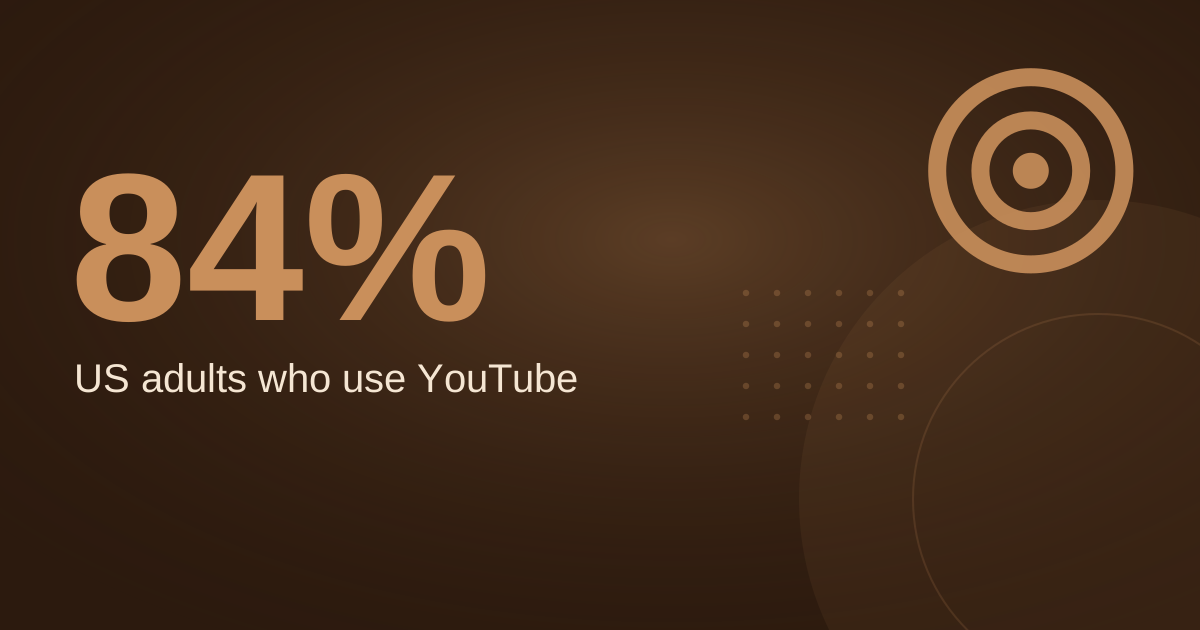
A real estate agent's social media strategy should focus on two or three platforms, announce each listing before it goes live, and hold social media to a fixed share of the marketing budget. Adwave's recommended mix gives social media 20% for newer agents and 15% for top producers. Among agents, Facebook is the most used platform at 90%, followed by Instagram at 52%. Social posts support referrals and listings rather than replacing them, so plan them alongside referral nurturing and your own website.
→
Agents using Facebook
Adwave (secondary)
→
Agents using Instagram
Adwave (secondary)
→
Newer agents' ad budget for social media
Adwave recommended mix
→
Meta CPM for real estate (top of range)
M.Wolf Media (secondary)
See Sources at the end of the article. Cards marked Assumption are examples, not results.
Adwave's summary of agent surveys reports that 90% of agents use Facebook, 52% use Instagram and 48% use LinkedIn (
Adwave: real estate TV advertising spend, secondary). These are figures for agent usage, not buyer usage. They show where your peers already work, not where your buyers spend time.
Pick two platforms to start. For most agents, Facebook suits local groups and listing posts, while Instagram suits photos and short video of homes and streets. A practical content plan for a small local business is set out in
local business social media content creation.
Rich media banners can also support awareness. StackAdapt describes them as an upper-funnel tool that captures attention and gives insight into an audience (
StackAdapt: real estate industry insights). Use them only after your organic posts show what your audience responds to.
How Much of the Marketing Budget Should Go to Social?
Adwave's recommended mix for newer agents splits advertising across five channels. Social media receives 20%, the largest share goes to referral nurturing, and streaming TV receives 25%. For top producers, the recommended social share falls to 15%, with the balance moved toward success stories and market expertise.
| Channel (newer agents) | Share of advertising budget |
|---|
| Referral nurturing | 30% |
| Streaming TV | 25% |
| Social media | 20% |
| Direct mail | 15% |
| Google Ads | 10% |
Total marketing spend varies by source. Luxury Presence research reported an average of $14,200 spent by agents in 2024, up from $12,725 in 2023, and REsimpli research found 54.2% of budgets flowing to digital channels in 2024 (
Adwave: real estate TV advertising spend, secondary). Benchmarks as a share of gross commission income also differ: Adwave cites 5-10% in one guide and 10-15% in another (
Adwave: how to advertise real estate;
Adwave: real estate marketing ideas). Streaming TV planning is covered in
CTV and DOOH for local business.
What Should Each Listing Post Include?
Listing posts work best as a sequence rather than a single announcement. Adwave's guidance gives a clear starting point, and the steps below turn it into a routine you can repeat for every property.
- Start teasing the property on your chosen social channel 3-5 days before it hits the market.
- Make a 15 to 30 second clip for social. Adwave's Wavemaker tool generates clips in this length.
- Export the right shape for each platform: 9:16 for Reels, TikTok and Stories, and 1:1 or 4:5 for feed posts.
- Reuse existing flyers and brochures as posts so the content stays consistent across print and online.
- Plan seasonal campaigns 6-8 weeks ahead to leave time for creation and posting (Adwave: real estate open house ideas).
Adwave charges $6 for each extra social video, so budget for creation alongside posting. Scheduling can be automated; see
AI agents for social media posting.
How Far Does a Paid Social Budget Go? (Worked Example)
Paid social is optional, and the figures below show how a budget converts into reach. Every input marked assumption is an example, not a benchmark. Meta CPM for small business ranges from $7 for low-competition consumer goods to $34 for legal, finance and real estate (
M.Wolf Media: Meta Ads Cost for Small Business in 2026, secondary). The $34 rate is the planning figure for an agent.
| Input or result | Value |
|---|
| Gross commission income per year | $120,000 (assumption) |
| Marketing share of gross commission income | 10% (assumption, inside the benchmark ranges above) |
| Annual marketing budget | $12,000 (calculated) |
| Social share, newer agent | 20% (Adwave) |
| Annual paid social budget | $2,400 (calculated) |
| Monthly paid social budget | $200 (calculated) |
| Monthly impressions at $34 CPM | about 5,900 (calculated) |
| Monthly impressions at $7 CPM | about 28,600 (calculated, consumer goods rate) |
Suppose the agent makes ten extra social videos a month (assumption). At $6 each, that costs $60, leaving $140 for promotion. Test one listing before committing the full $200 monthly. Adwave's social figures are for planning only, so check your own cost per inquiry after 90 days.
How Do You Measure Social Results?
Measure property inquiries separately from inquiries from sellers who want an agent. Adwave's CTV case study recommends this split when running TV, search and social together (
Adwave: real estate CTV case study). Without the split, buyer leads and listing leads blur together and the social numbers look better or worse than they are.
Record the source of every new contact, including a question about how they heard about you. Tools can help with reporting; HubSpot's research found one in three marketers already use AI for content creation and data analysis (
HubSpot: AI agents for social media). For a reporting setup, see
AI-powered social media analytics for local businesses.
Where Do Referral Partners Fit?
Referrals are the main channel NAR-style advice points to, and Adwave's mix gives referral nurturing the largest share for newer agents. Social content should keep you visible to the people who refer clients. Adwave suggests identifying 8-15 centers of influence in your community, including attorneys, insurance agents, real estate professionals and bankers (
Adwave: best advertising for accountants and financial advisors).
Drip campaigns matter because consideration can last months. Adwave notes that drip campaigns keep agents visible through a consideration period that might last months (
Adwave: real estate marketing ideas). A planned series of posts and emails is a reasonable way to cover that gap. A content calendar can help; see
blog content strategy for local business.
FAQ
Facebook is the most used platform among agents at 90%, according to Adwave's summary of agent surveys. Add Instagram once you have a steady supply of photos and short video.
Adwave recommends 20% of advertising for newer agents and 15% for top producers. Total marketing benchmarks range from 5-10% to 10-15% of gross commission income, depending on the source.
When should I post a Coming Soon teaser?
Adwave recommends starting 3-5 days before the property goes on the market.
Is paid social worth it for an agent?
It depends on your cost per inquiry. At a $34 CPM, a $200 monthly budget buys about 5,900 impressions (assumption-based example). Test one listing, track inquiries separately from seller leads, then decide.
Sources
Want a social plan built for your market?
Book a free audit and we will review your current channels and budget.
Free for local businesses
Want this applied to your business?
I'll review your Google presence, local SEO, and ad accounts — and send you a specific action plan within 48 hours. No pitch, no pressure.