Valentine's Day marketing for local businesses works best when you start early, make one clear offer to a specific group of customers, and promote it through one channel you can measure. AdWave recommends building awareness from mid-January, then intensifying through the first two weeks of February. The holiday is large, though the totals are contested: AdWave cites more than $25 billion in US spending, and AppInstitute puts US Valentine's Day spending at $15 billion. Neither page names a primary source, so treat those totals as directional. The sections below cover timing, offers, a worked budget with labelled assumptions, and how to check results.
↓
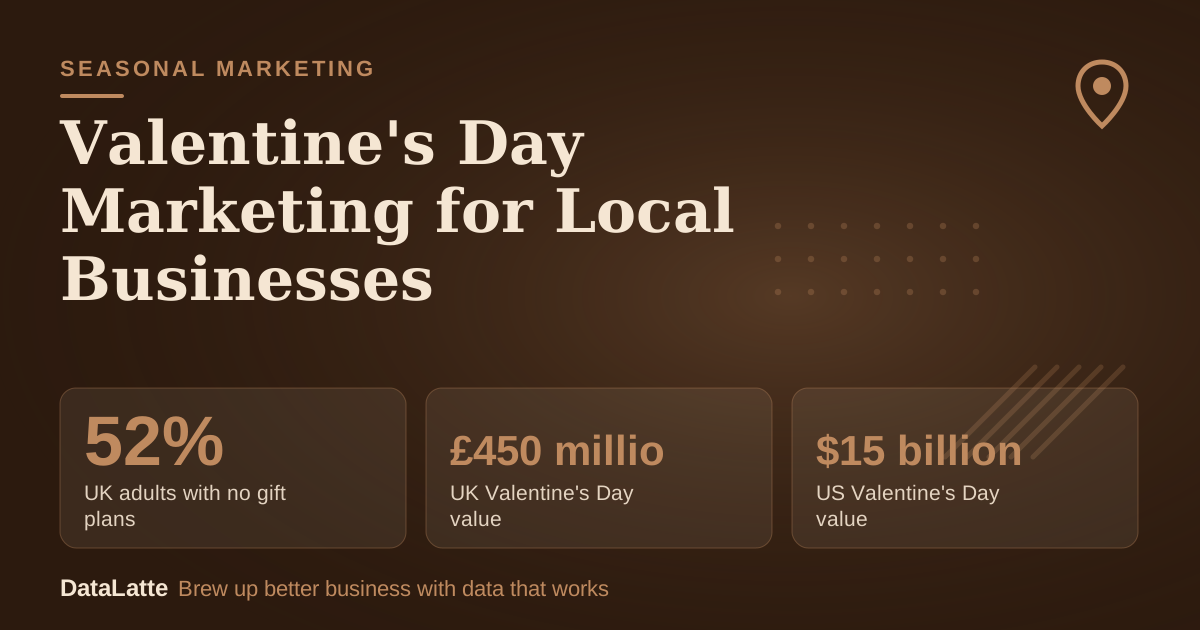
UK adults with no gift plans
2017 poll of over 2,000 UK adults, secondary
→
UK Valentine's Day value
Per AppInstitute, secondary
→
US Valentine's Day value
Per AppInstitute, secondary
↑
US average celebrating spend
Per AdWave, unsourced claim
See Sources at the end of the article. Cards marked Assumption are examples, not results.
When should local businesses start Valentine's Day marketing?
AdWave recommends starting to build awareness in mid-January to capture early planners, then intensifying through the first two weeks of February. That gives a local business roughly four weeks of promotion before February 14, enough time to test one offer and adjust it once early results come in.
The same page says nearly half of Valentine's shoppers wait until the week before the holiday to buy. No source is given for that figure, so use it as a planning hint rather than a forecast.
A late start is the main timing risk. A promotion that begins on February 10 leaves little room for an email send, a window sign and a reminder. If your calendar is already full, a short promotion of a few days can still work, provided the offer is simple and the channel is ready before the first day.
Which Valentine's Day offers suit a local business?
Match the offer to the people who already visit. A couples package will struggle in a studio where most members come alone, while a friends or self-care angle may fit better. The right offer depends on your customer data: past visits, service choices and how often people return.
Pet-focused businesses have one external figure to consider. AdWave says Americans spend over $2 billion on Valentine's gifts for pets, but that is an unsourced claim. Check it before you put it in an ad, and build the offer around what your own customers buy.
Bundles usually protect margin better than straight discounts, but compare the numbers against your own costs. A bundle that adds a second visit can raise total spend even when the price per visit falls. The mechanic can also matter more than the prize. AppInstitute describes Uber's 2017 Valentine's email campaign as encouraging customers to take at least one trip for a chance to win prizes. A local version might enter customers into a draw for booking a visit before the 14th.
How much should you spend on Valentine's Day ads?
Small tests reveal more than large budgets. The example below uses inputs labelled as assumptions, so replace them with your own figures.
| Input | Value | Status |
|---|
| Service price | $50 | assumption |
| Margin per booking | 60%, or $30 | assumption |
| Ad budget over 10 days | $250 | assumption |
| Break-even bookings | $250 divided by $30 = 8.3, so 9 bookings | calculated |
At 5 bookings, the promotion returns $150 in margin against $250 spent, a $100 loss. At 9 bookings, margin is $270, which covers the $250 spend with $20 left. This assumes no other promotion costs and that every booking comes from the ads. If you cannot see a clear route to around 9 bookings, the offer or targeting needs work before the budget does.
Paid search rules and costs differ by market. The
Germany Google Ads guide shows one example of a market-specific approach, which is a useful reminder to check local platform details rather than copy a budget from another country.
Your existing list is the cheapest audience you have. Send one email to past customers with the offer, the booking link and the closing date. For a wider plan, the
email marketing campaign ideas guide lists formats you can adapt for a holiday send.
On social media, AppInstitute advises starting a daily Valentine's poll either from the beginning of February or only from the 7th onwards. A poll gives followers a reason to reply, and the answers show which offer or product people prefer before you commit to more ad spend. Keep the poll question tied to your offer, not to general holiday sentiment.
How big is the Valentine's Day opportunity?
AppInstitute cites a January 2017 poll of more than 2,000 UK adults, which found that 52% did not plan to buy a gift for their loved one. That result shows there is a gap between people who celebrate and people who buy, but it is a 2017 figure reported second-hand, so it does not show today's rate.
The same page puts Valentine's Day at more than £450 million in the UK and $15 billion in the US. Those totals are useful for scale, not for forecasting one shop's sales. Use them to decide whether the holiday deserves a campaign, then use your own sales history to set the goal.
Set up tracking before the first day of the promotion, not after. Keep the list short and check it each day during the run:
- Count bookings or sales tagged with a promo code or a unique link
- Compare promotion-day sales with the same weekdays in the weeks before
- Track email replies, link clicks and redemptions
- Note how many customers are new and how many already visit
Compare the results with the break-even figure from your budget. If the promotion did not reach the bookings you need, record why: the offer, the timing or the audience. That record is the most useful input for next year.
For the search side of the holiday, the
local SEO steps guide covers profile updates that help nearby customers find your offer.
FAQ
Not as a couples promotion. A theme that fits your regulars works better, such as a friends day, a self-care offer or a gift card for someone else. Use your customer data to decide, and test one theme before you commit to a bigger campaign.
It is late for paid ads, because campaigns need time to settle and you may not have it. Send one email to your list, put a sign in the window and keep the offer simple. Skip new ad campaigns unless you can test a small budget without guessing at results.
How much should a first Valentine's ad test cost?
Start small and measure. The worked example above uses a $250 assumed budget over 10 days to show the break-even maths, but your own service price, margin and booking volume will change the figure. Do not scale until the tracking shows which offer and audience produced bookings.
Do these spending totals apply outside the US and UK?
The totals here are US and UK figures, and the sources do not cover Canada or Australia. Use local platform data and your own sales history for those markets, and treat any national total as context rather than a forecast for your shop.
Sources
- AdWave: Valentine's Day marketing for local business (vendor; spending and consumer figures are unsourced claims on the page)
- AppInstitute: 19 Valentine's Day Marketing Ideas for Small Businesses (secondary; the 2017 poll and totals are cited second-hand)
For help turning one holiday offer into a tracked campaign,
book a free audit or review
Google Ads management.
Free for local businesses
Want this applied to your business?
I'll review your Google presence, local SEO, and ad accounts — and send you a specific action plan within 48 hours. No pitch, no pressure.