Customers post about a local business when something in the place is worth photographing, when a staff member asks at the right moment, and when posting takes one easy step. Done well, the content pays off. A roundup summarised by
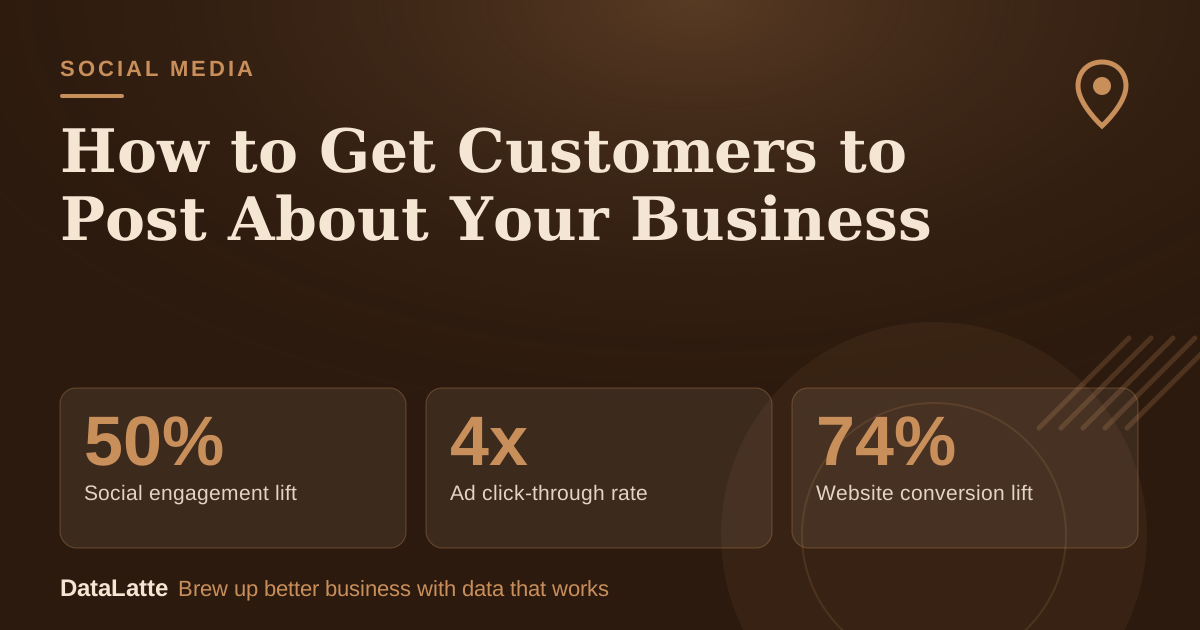
AdWave reports that social campaigns using user-generated content (UGC) achieve a 50% lift in engagement, and that ads with UGC see 4x higher click-through rates. Treat those as direction, not promises. This guide covers how to set up the moment, which rewards are allowed, and how to get permission before reusing a photo. For the wider plan, read the
blog content strategy guide.
Does Customer-Posted Content Move Results?
Several vendor roundups say it does, though none is a controlled test. AdWave, citing Archive's UGC statistics, reports that ads with UGC see 4x higher click-through rates. EveryoneSocial's figures, also relayed by AdWave, say adding UGC to website pages can increase conversions by up to 74%, and that customer photos in email campaigns can boost click-through rates by 78%.
↑
Social engagement lift
Social campaigns with UGC, Archive via AdWave (secondary)
↑
Ad click-through rate
Ads with UGC, Archive via AdWave (secondary)
↑
Website conversion lift
Pages with UGC, EveryoneSocial via AdWave (secondary)
↑
Consumers reporting more trust
MedianUG via AdWave (secondary)
See Sources at the end of the article. Cards marked Assumption are examples, not results.
Read these as directional. Each figure comes from an agency or vendor compiling other people's data, and the underlying studies are not described well enough to compare. The most useful point is simpler: a real customer photo costs nothing to make and looks believable, which is what the trust figure is about. MedianUG reports that 79% of consumers say their trust increased in companies that use UGC in marketing.
Step 1: Make the Place Worth Photographing
Customers post what looks good to them. A GetHookd article on pet grooming suggests asking clients to tag the business in post-grooming photos in exchange for a small incentive, such as 10% off their next visit. That only works if the result is worth photographing in the first place. Walk your space with a phone and look for three things: one spot with good light, one product that looks good in frame, and one place your handle can appear without spoiling the view.
- A clean photo spot with natural light and little clutter
- One product that photographs well, such as a latte, a plated dessert, a finished blowout, a groomed dog or a completed class
- Your handle and location name on a cup sleeve, mirror sticker, receipt or counter sign
A salon can add a ring light at one mirror. A groomer can use a branded bandana. A café can serve drinks in one distinctive cup. Small changes like these give customers a reason to take a picture.
When and How Should You Ask?
Timing matters more than wording. Ask when the drink arrives, when the client sees the finished cut, when the dog trots out fluffy, or when the class ends. A compliment is the signal that the moment has arrived, so train staff to ask only after someone has said something positive. Do not script it onto every customer, because a request that comes at every visit starts to feel like a chore.
Short asks that work in person:
- "If you love it, tag us. We're @yourhandle."
- "Want a quick photo? Tag us and we might share it."
- "Happy with the colour? A photo helps us a lot."
Rotate the ask across staff. The person who does the most face-to-face work should carry most of it, and everyone should use the same line so customers hear one consistent request.
What Rewards Are Allowed, and Where Are the Limits?
Reviews and social posts follow different rules, so keep them separate. Google's
business profile help page states that "Offering incentives, like free or discounted goods or services, in exchange for customers to post reviews" is strictly prohibited. Do not offer a discount, free item or prize for a Google review, and do not let a review request and a tag request blur into one offer.
For social posts, the GetHookd example shows a 10% discount offered for a tagged photo. The source does not cover disclosure rules or contest law, and those vary by country and platform. Check your local advertising rules and the platform's current help pages before you run a reward. As a practical safeguard, do not make the reward depend on what the customer says. A reward for tagging a photo is a different ask from a reward for praise.
Recognition works too. A feature on your page, a Story shout-out, or a "customer of the month" post costs little and many customers value it. Drafting a short thank-you reply for every tag takes a minute with a template, and the
ChatGPT prompts for local business marketing guide has prompts you can adapt.
How Do You Get Permission to Repost?
A tag is not permission to reuse a photo. Follow the same routine every time:
- Comment or send a direct message asking to share the photo, and offer to credit the creator.
- Save the reply as a screenshot in a shared folder, so the record survives staff changes.
- Credit the creator in the caption or by tagging the image.
- Remove the post quickly if the customer changes their mind.
For anything beyond a normal repost, such as paid ads, website banners or printed menus, get written consent. Be especially careful with photos of children and with before-and-after shots, and get consent from the person pictured. Ask an advertising professional or your local regulator if you are unsure whether a use needs more than a simple yes.
Where Should Customer Content Appear?
Website pages are where the conversion figures apply. AdWave's summary of a WordStream roundup reports that user-generated content on 1,200 websites produced a 3.2% conversion rate, and that conversions rose a further 3.8% when visitors engaged with that content. A salon-marketing guide from Bookeo states that engagement on transformation posts is 28% higher when user-generated content is included.
Good placements for a small business:
- Feed and Stories, with one credited customer photo a week
- A "Customers" highlight on your profile, so new visitors see social proof
- A small gallery on your home or booking page, with consent
- A "from our customers" block in your newsletter
If you let visitors leave comments or links on your website, take care with the links. Google's
SEO starter guide recommends that every link posted by users carries a nofollow or similar annotation, added automatically by your content management system.
For content ideas beyond customer photos, a pet-shop guide from Blackstone Infomatics lists six types that work: user-generated content, behind-the-scenes moments, tips and advice, seasonal content, interactive features, and product highlights in context. An
AI content creation tools guide for local business can help you turn those into a weekly schedule without adding hours.
Every input below is an assumption for a single-location café. Replace them with figures from a month of counting. The three columns show a weak, typical and strong month.
| Tough | Base | Strong |
|---|
| Customers asked per month (assumption) | 100 | 200 | 400 |
| Share who post (assumption) | 5% | 10% | 15% |
| Customer posts | 5 | 20 | 60 |
| Views per post (assumption) | 100 | 150 | 250 |
| Total views | 500 | 3,000 | 15,000 |
| Views that become a visit (assumption) | 0.5% | 1% | 1% |
| New visits | 2.5 | 30 | 150 |
| Average spend per visit (assumption) | $8 | $8 | $8 |
| Revenue from those visits | $20 | $240 | $1,200 |
| Staff time at $20 per hour, 1 hour a month (assumption) | $20 | $20 | $20 |
In the Tough case the posts barely cover the staff time. Base is modest. The table does not price the free photos or the trust they add to your profile, and that is where much of the value sits. Twenty usable customer photos a month is a content asset you would otherwise pay for.
The break-even test is simple. New visits needed equals staff time cost divided by spend per visit, which here is $20 divided by $8, or 2.5 visits. The tag sign and QR code are a one-off cost of around $30 (assumption). The two levers that matter most are how many people you ask and what share of them post. Lifting those two rows moves the result far more than any hashtag choice.
Checklist: What to Do This Week
- Pick one photo spot or one photographable product and tidy it.
- Put your handle and location name on a cup sleeve, sign or mirror sticker.
- Give every team member the same ask line, and tell them to use it only after a compliment.
- Write down your reward rules: no incentives for Google reviews, and a clear, separate note for any perk tied to a social post.
- Keep a sheet with three columns, "Post link", "Permission saved" and "Reposted", and update it every Friday.
FAQ
Why will customers post about a local business?
Customers share when they are pleased or proud, or when they want to recommend something to friends. A photogenic product, a friendly ask at the right moment and a one-tap tag are usually enough to make posting feel natural.
Can I offer a discount for a tag or post?
It can be possible for social posts, as the GetHookd example of 10% off for a tagged photo shows, but check your local advertising rules and the platform's current help pages first. Google's policy bans offering incentives in exchange for reviews, so keep review requests separate.
Do I need permission to repost a customer's photo?
Yes. Ask first, keep the reply as a record, and credit the creator. For ads, websites or printed material, get written consent.
How long until I see results?
No reliable benchmark exists for a single business. Count tags each month for three months after you add the sign and the staff ask, then compare the numbers against your own baseline.
Sources
Want help planning a customer-posting system across your channels? Start with a
free audit.
Free for local businesses
Want this applied to your business?
I'll review your Google presence, local SEO, and ad accounts — and send you a specific action plan within 48 hours. No pitch, no pressure.