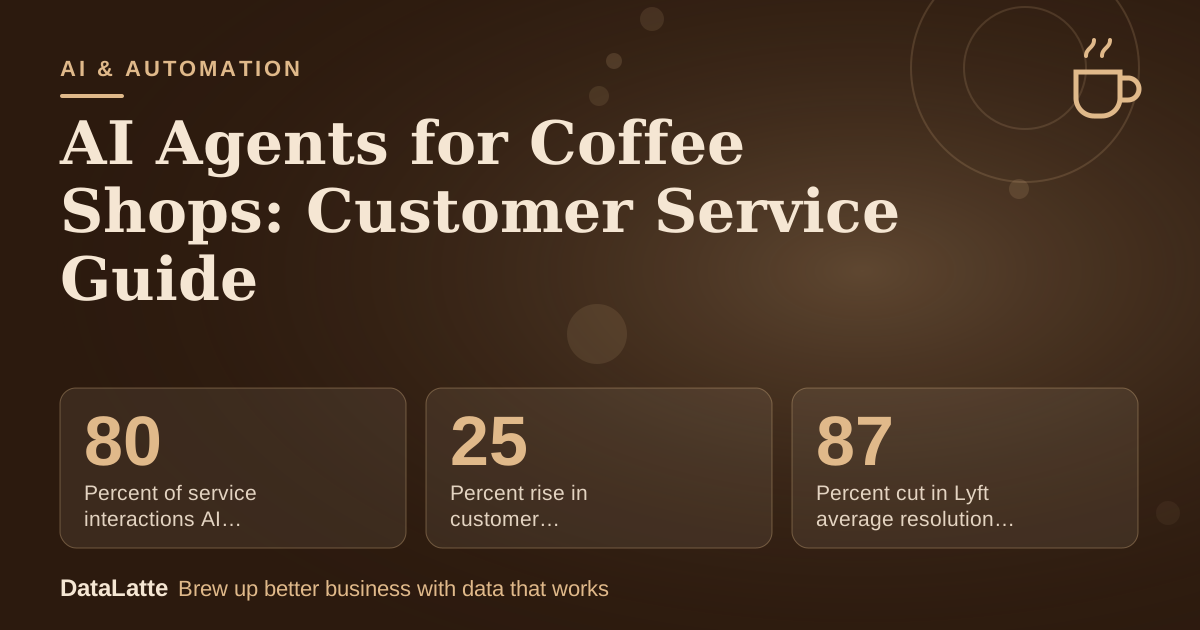
AI agents for coffee shops are software programs that answer customer questions in text, chat, or web forms and complete simple requests, such as sharing opening hours or taking a standard order. They handle repeat, predictable questions well, which frees staff for the counter. Industry forecasts point toward wider use: Gartner expects AI agents to handle at least 80% of customer service and support interactions by 2029, as
HubSpot reports (secondary). The practical starting point is one narrow task, a written answer sheet, and a human fallback.
↑
Percent of service interactions AI agents may handle by 2029
Gartner forecast via HubSpot, secondary
↑
Percent rise in customer satisfaction reported by AI-driven service firms
MindStudio vendor claim, secondary
↓
Percent cut in Lyft average resolution time as of 2025
HubSpot summary, secondary, not a coffee shop
→
Coffee shops in Canada as of 2025
IBISWorld via Square, secondary
See Sources at the end of the article. Cards marked Assumption are examples, not results.
What does an AI agent actually handle in a coffee shop?
Most of the questions a coffee shop receives repeat every week: opening hours, whether there is free Wi-Fi, whether the oat milk is dairy-free, and whether dogs are allowed on the patio.
Per Diem recommends (secondary) answering these in the profile's Q&A section before customers ask. The same answers feed an AI agent, so the listing and the agent should match. The
guide to coffee shop Google Business Profile optimization covers the listing side in detail.
An agent also needs the same facts in one place.
Hightouch states (vendor, secondary) that agents require governed customer data and operational brand knowledge. For a café, that means a single document with menu items, allergen notes, seasonal changes, and policies. Answers scattered across a chalkboard, a PDF, and a staff member's memory produce inconsistent replies.
Which customer service tasks suit an AI agent?
Review replies are a strong first candidate.
SOCi describes (vendor, secondary) review response automation as AI that generates personalized replies, adjusts tone based on sentiment, and includes location-specific details. For a single shop, the location detail is the useful part, because it keeps replies specific rather than generic.
Order-ahead questions, menu lookups, and booking requests follow the same pattern: a short question with a fixed answer. Shops that want a simpler build can begin with
a custom GPT for local business customer service, then move to a full agent once the answer sheet is stable.
Complaints, refunds, and allergy concerns need a person. An agent can collect the details and hand the conversation to staff, which is a safer division of work than letting the agent decide.
The four numbers above frame the category, but each has limits. Gartner's 2029 forecast covers customer service in general, not coffee shops, and it describes interactions handled, not jobs removed. MindStudio reports that companies implementing AI-driven customer service see 25% increases in customer satisfaction and a 28% reduction in churn (
MindStudio, secondary). That is a vendor-cited figure with no café breakdown.
Lyft reported an 87% reduction in average customor service resolution times across channels as of 2025 after automating parts of its support (
HubSpot, secondary). A rideshare company is far larger than a café, so treat that result as an upper bound, not a benchmark. Canada had over 8,000 coffee shops as of 2025, according to IBISWorld as cited by
Square (secondary). In a market that crowded, consistent answers help a single shop stand out.
What does a worked budget look like for one shop?
The example below uses assumption inputs, not benchmarks. Replace each one with your own numbers before deciding.
- Customer questions per month across text and web chat: 300 (assumption).
- Share the agent resolves without staff: 60%, or 180 questions (assumption).
- Staff time per question handled manually: 4 minutes, so 720 minutes, or 12 hours (assumption).
- Loaded staff cost: $18 per hour (assumption), so savings are $216 per month.
- Platform cost: $120 per month (assumption).
- Weekly review time: one hour at $18 (assumption), about $78 per month.
Net result: $216 minus $120 minus $78 equals $18 per month. The margin is thin, and the monitoring hour is the cost most owners forget. Raise volume to 600 questions per month with the same assumptions and savings reach $432, leaving $234 net. Agents pay off on volume, not on novelty.
Where do AI agents fall short?
Agents struggle when the answer lives in someone's head rather than in writing. A stale price list produces a confident wrong answer, which damages trust faster than a slow reply does. Keeping the answer sheet current is an ongoing job, not a one-time setup.
Support access also matters before you commit.
Thinkific's review (secondary) notes that Mailchimp customer service is limited to chat at standard and lower tiers. Check what help you can reach before the tool fails at a busy hour. The
AgentOps guide to monitoring and debugging AI agents explains how to catch errors early.
How do you start without overbuilding?
Follow this checklist in order:
- Pick one task that repeats weekly, such as hours or allergen questions.
- Write one answer sheet and assign someone to update it monthly.
- Set a handoff rule: any conversation the agent cannot resolve goes to a staff member.
- Record a 30-day baseline: questions per week, staff minutes spent, and repeat visits.
- Launch, then compare the same measures after another 30 days.
- If the Google profile is new, expect verification by mail. A BrewRound page from 2020 (secondary) states that the profile does not appear in results until verified.
If you want help choosing that first task, a
free audit can show which customer questions your listing and website currently leave unanswered.
FAQ
Will an AI agent replace my staff?
The published forecasts describe customer service interactions being handled, not staff being removed. In practice, the agent takes repetitive questions while staff handle in-person service, complaints, and anything the answer sheet does not cover.
Do customers need to download an app?
Not necessarily. The available channels depend on the platform you choose, so check its setup guide for text, web chat, or messaging options before you commit.
How do I know the agent is working?
Measure the same things before and after launch: questions handled without staff, staff minutes spent, and repeat visits. Run the worked budget above with your own numbers, and review the results after 30 days.
Should the agent match my Google Business Profile?
Yes. Per Diem recommends answering common questions in the profile's Q&A, so the profile and the agent should give identical answers about Wi-Fi, dairy-free options, and dog policies.
Sources
Free for local businesses
Want this applied to your business?
I'll review your Google presence, local SEO, and ad accounts — and send you a specific action plan within 48 hours. No pitch, no pressure.