An AI agent takes actions toward a goal, such as drafting a social post or moving a booking forward, with limited supervision. A chatbot answers questions along paths you set in advance. For most local businesses, a chatbot is the simpler starting point for hours, prices and FAQs, while an agent suits one specific task that needs follow-through. The difference affects cost, staff time and risk, so this guide compares the two and works through a sample budget.
What separates an AI agent from a chatbot?
One vendor definition describes AI agents as self-learning systems that take action without human intervention, such as autonomous chatbots handling complex customer inquiries (
StackAdapt, vendor blog). The definition is useful, but vendors use these labels loosely. A product marketed as a chatbot may include agent features, and the reverse is also true.
A practical test is what happens after the customer replies. A scripted chatbot ends at an answer from a set list. An agent carries the task forward, for example by checking availability, proposing a slot and recording the booking. The
AI agents for local business guide explains these mechanics in more depth.
Ask any vendor to show this test in a live demo before you pay.
How do they differ on oversight, scope and setup?
| Question | Scripted chatbot | AI agent |
|---|
| Typical job | Answers defined questions along set paths | Works toward a goal across several steps |
| Unscripted wording | Limited to the paths you built | Designed to interpret free text, with accuracy that varies |
| Oversight | You control the answers in advance | Vendors may require approval first |
| Good first use | Hours, directions, FAQs | Booking follow-up, lead replies, social drafts |
The oversight row matters most. HubSpot's Social Media Agent requires a person to approve every post before it goes live, although the agent researches and drafts the content (
HubSpot, vendor blog). The vendor's own article calls it semi-agentic for that reason, which shows that an agent can still need a human in the loop.
Before you sign a contract, apply the five evaluation criteria in
Hightouch's guide to AI agent platforms (vendor). The guide recommends using them during the vendor conversation rather than as an audit after purchase.
What do the published numbers show?
→
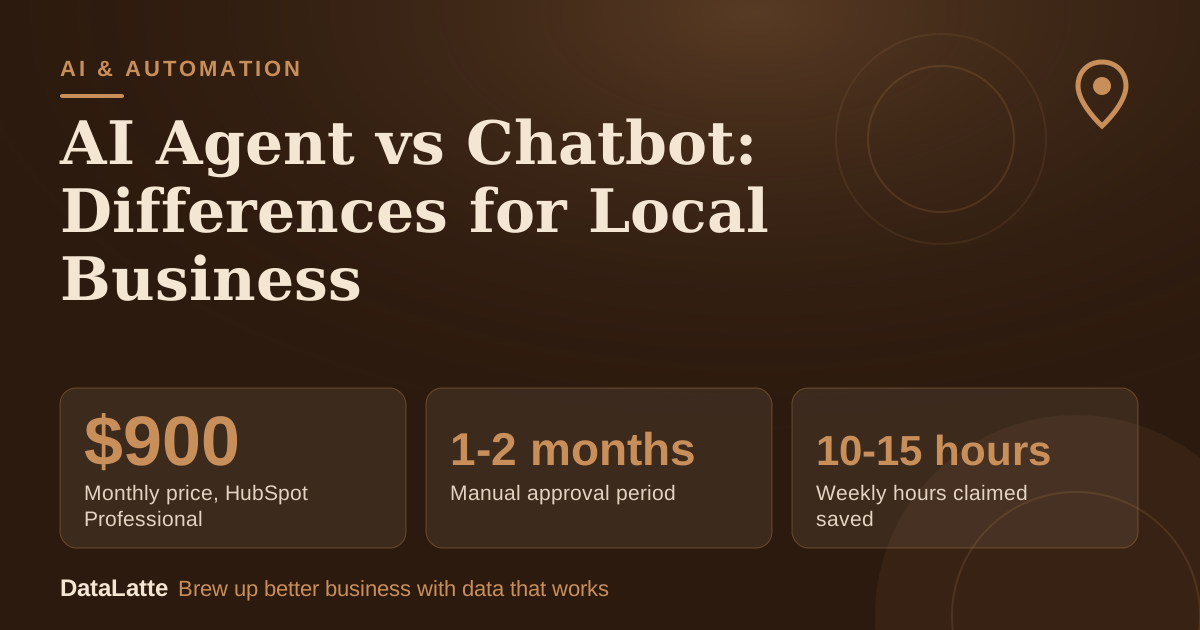
Monthly price, HubSpot Professional
HubSpot blog; a comparison lists $800 (secondary)
→
Manual approval period
Author's recommendation before agent drafts posts
↑
Weekly hours claimed saved
Sintra vendor claim for social drafting (secondary)
↑
Stated availability
ElevenLabs vendor claim for call center chatbots
See Sources at the end of the article. Cards marked Assumption are examples, not results.
Each figure comes from a different vendor page, so treat them as reference points rather than guarantees. HubSpot lists its Social Media Agent as included in Marketing Hub Professional at $900 per month (
HubSpot, vendor blog). A comparison page lists the same plan from $800 per month, and it notes that the Free and Starter tiers, from $7 per seat per month, exclude the agent (
Sintra, secondary). Check the live pricing page before you budget.
The 10 to 15 hours a week figure is a Sintra vendor claim about drafting and adapting posts across platforms, not an independent measurement. The 24/7 availability figure is ElevenLabs' own description of its call center chatbots (
ElevenLabs, vendor). The HubSpot author recommends approving every post for the first one to two months, then a 30-60 day probationary period before letting the agent draft content.
What does a worked cost example look like?
The inputs below are assumptions for a hypothetical hair salon, not measured data. Replace them with your own figures before deciding.
Assumption: the front desk answers 20 routine questions a day about hours, prices and availability, at about 5 minutes each. Assumption: the salon is open six days a week, so routine messaging takes 600 minutes, or 10 hours, each week.
Assumption: an agent handles 60% of those questions after the approval period. That frees 6 hours a week, or about 26 hours a month (6 × 52 ÷ 12). Assumption: staff time is worth $20 per hour, so the saved time is worth $520 per month. Assumption: the tool costs $100 per month. The net monthly benefit is $420.
During the first one to two months, the saving shrinks because staff review outputs. Assumption: a 15-minute daily review adds 7.5 hours a month, or $150 at the same rate. The net benefit in that period falls to $270. A plain chatbot with no approval step costs less in staff time, but it covers a narrower set of questions.
How should a local business roll out an AI agent?
- Pick one task with a clear finish line, such as booking follow-up or social drafts. The appointment booking agent guide covers one common case.
- Test on a free tier first. Botnation AI reportedly offers a free plan with no time limit for building and testing a chatbot before going live (RingCentral, secondary).
- Approve every output for the first one to two months, as the HubSpot author recommends (HubSpot, vendor blog).
- Allow drafting only after a 30-60 day probation period, and keep the approval step for anything public.
- Confirm a clear handoff to a person for complex or unhappy customers.
- Measure hours saved against the tool fee, using the worked example above.
For social drafting specifically, the
social media posting agent guide covers the approval workflow.
When is a plain chatbot the better choice?
A plain chatbot is often enough when customers mostly ask about hours, directions, prices or services. Endless Media Solutions, which sells AI content systems to local businesses, says it does not promise chatbots or deep CRM automation unless a business is genuinely ready for them (
Endless Media Solutions, vendor). That is a useful test for any vendor. The
chatbot vs live chat comparison looks at which format gets more bookings, and the
booking and FAQ chatbot guide covers setup.
Start with one problem, measure it, and then decide whether an agent's extra oversight is worth the cost. If you want a second opinion on which task to automate first,
request a free audit.
FAQ
Do customers mind talking to a bot instead of staff?
Some do. The practical answer is a clear handoff to a person for complex or frustrated customers, so no one gets stuck in a loop. Scripted chatbots are easier to predict here than agents, which is one reason many businesses start with FAQ-level flows.
Do I need a website to use either one?
No. Automation can run through messaging channels and booking tools, and the setup depends on the platform you already use. Check the platform's live help pages for supported channels, because those change often.
Can an AI agent replace a receptionist?
It can take over repetitive questions such as opening hours and availability, which frees staff for in-person service and sales conversations. The worked example above shows the time arithmetic. Your own message volume decides whether the trade is worth it.
Start with software you already pay for. Check its built-in automation and any free tier, then test one task before buying a new platform. Apply the vendor evaluation criteria in the Hightouch guide before you sign a contract.
Sources
Free for local businesses
Want this applied to your business?
I'll review your Google presence, local SEO, and ad accounts — and send you a specific action plan within 48 hours. No pitch, no pressure.