July 6, 2026·Nataliia Rumiantsewa· 7 min read All posts
Connected TV (CTV) advertising lets a Las Vegas, NV business show video ads on streaming services such as Hulu, Peacock and Tubi, aimed at households in chosen ZIP codes. It builds brand familiarity rather than clicks, so it works best alongside search ads. The sources behind this guide do not include CTV pricing, so no CPM figures appear here. The budget example uses labelled assumptions, and the search benchmarks come from Google-linked data.
What is CTV advertising for a Las Vegas business?
CTV ads run on the television screen through streaming apps, not on a phone or desktop. The practical difference for a local business is targeting. Households can be selected by location and demographics rather than buying a slot on a national broadcast. A salon, gym or restaurant in Las Vegas can focus on the ZIP codes its customers actually live in.
Las Vegas has a large resident base alongside its visitor traffic. Household-level targeting helps a local business reach residents who can return to the shop or studio, rather than paying for visitor impressions that cannot convert into regular visits.
How do CTV benchmarks compare with Google Ads?
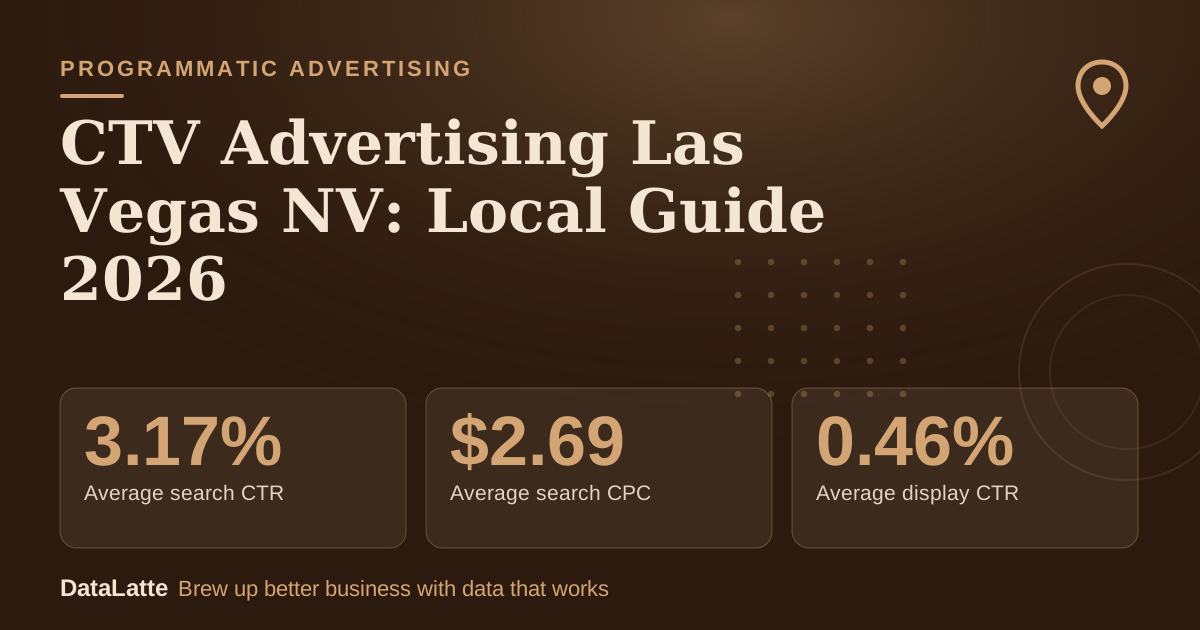
Google Ads benchmarks are among the most widely cited published figures for paid search and display, so they give a useful reference point. One benchmark puts the average search click-through rate across all industries at 3.17% and the average search cost per click at $2.69. Display averages are lower: 0.46% click-through and $0.63 per click (WordStream, secondary).
3.17%→
Average search CTR
WordStream benchmark (secondary)
$2.69→
Average search CPC
WordStream benchmark (secondary)
0.46%→
Average display CTR
WordStream benchmark (secondary)
35 million→
Websites and apps on Display Network
Google Ads Help (primary)
See Sources at the end of the article. Cards marked Assumption are examples, not results.
The Google Display Network reaches people across 35 million websites and apps, plus Google-owned properties such as YouTube and Gmail (Google Ads Help, primary). That describes a different channel from CTV. CTV is a separate buy with its own rates, so quotes should be compared from each platform's own ad manager rather than assuming a Google figure carries over.
Which streaming platforms should Las Vegas businesses test?
The platforms covered here are Hulu, Peacock, Tubi, Amazon Prime Video and Paramount+ with Pluto TV. Each reaches a different mix of viewers, so the platform should match the customer profile. Buying all five at once makes it hard to tell which one produced any result.
Business type
Starting platform to test
Why it fits
Fitness studio or gym
Hulu or Peacock
Broad household reach for a membership pitch
Family salon or pet groomer
Tubi or Pluto TV
Lower-cost inventory suits a neighbourhood service
Restaurant or café
Peacock
Sports co-viewing can suit evening and weekend slots
Confirm current minimums and inventory on each platform before committing. The table reflects likely fit, not performance, because no comparative results appear in the sources. A small test on one platform keeps the comparison clean, and a second platform can be added once the first shows whether households in the target ZIP codes respond.
How should you set ZIP-code targeting?
ZIP-code targeting is the main lever for a local business. Start with the ZIP codes where existing customers already live. A booking system or CRM usually holds customer postcodes, and the top five or so areas make a sensible first list. A tighter list concentrates spend on the households most likely to return.
Demographic filters come second. A fitness studio might narrow to adults in a target age band, while a family salon might focus on households with children. Keep the first campaign simple so the results are readable. Set a frequency cap in the platform settings, and review it after two weeks of data, since repeated exposure builds recall but too much wastes spend on the same homes.
What does a worked budget look like?
The example below is for a hypothetical Las Vegas fitness studio. Every input is an assumption and should be replaced with the business's own figures before any decision is made.
Inputs (assumption):
Total monthly marketing budget: $500
Share allocated to CTV: 60%, so $300
Share allocated to Google search: 40%, so $200
Search cost per click: $2.69, the all-industry average from the benchmark above
Calculation:
Search clicks purchased: $200 divided by $2.69 is about 74 clicks per month
CTV budget: $300 per month, to be checked against the platform's quoted rate
The search line shows how much traffic a fixed budget buys at an average rate, which gives a comparison point. The CTV line cannot be completed from these sources, because CTV pricing and impression volume are not provided. Obtain a quote from the platform before filling in that side.
A four-week trial is a practical first step. Spend the CTV share, track branded search and direct visits, then decide whether to extend. Set the length and budget around the business's own cash flow. For a comparable paid channel with its own cost structure, the Amazon Ads guide for local businesses covers marketplace advertising, and the Bing Ads guide explains how a second search network can supplement Google.
What creative specs apply to CTV?
Specifications vary by platform, so check the requirements in each ad manager before uploading. The checklist below covers points most platforms share:
Export a 16:9 landscape video, which suits most television screens.
Keep the file within the length the platform accepts. Fifteen and 30 seconds are common, but confirm the limit.
Include audio, because television ads play with sound on.
Put the business name and location early, and repeat the phone number or address at the end.
Test two cuts, one focused on the service and one on a customer outcome, before committing the full budget.
Keep the message simple. A single clear offer is usually easier for a viewer to remember than several competing claims. Other CTV market guides, such as the Phoenix CTV guide, cover how local businesses in other cities have approached the same format.
How do you measure a CTV campaign?
CTV rarely produces a direct click, so measurement relies on indirect signals. Track these during the campaign and for a period afterwards:
Searches for the exact business name in Google
Direct visits to the website
Branded search clicks in Google Ads, if the business runs them
Answers to "how did you hear about us?" on new enquiries
Record a baseline for four weeks before launch so the comparison is fair. Continue the same tracking after the campaign ends to see whether any lift holds. Without a baseline, it is hard to tell whether a change came from the television ads or from seasonal demand.
For search, the Google Ads service page covers how to set up branded and category campaigns that capture the attention CTV creates.
FAQ
Is CTV advertising worth it for a small Las Vegas business?
It can be, if the business serves customers within a reasonable drive and can measure indirect signals such as branded searches and direct visits. Run a baseline first and a trial of defined length before committing a larger budget.
Which CTV platform should a business start with?
Start with one platform that matches the customer profile. The table in this guide is a fit guide, not a performance ranking. Check current minimums and inventory with each platform before buying.
How long before CTV shows results?
The sources here do not give a timeline for CTV results. Plan for a multi-week window, record a baseline beforehand, and judge the campaign on indirect measures after the trial period.
Can CTV be combined with Google Ads?
Yes. CTV builds awareness, and search captures the people who then look up the business. Keep the search budget focused on the business name and core services so traffic lands on relevant pages.
What if CTV pricing is not yet known?
Request quotes from the platform's self-serve ad manager or an authorised reseller. Put the quoted rate into the budget calculation above in place of the assumption figures.
Local marketing strategist with 10+ years at global agencies — OMD, Dentsu, GroupM, and BBDO. Now helping small businesses get the same data-driven edge. Based in Europe, working with clients in the US, UK, Australia, and beyond.