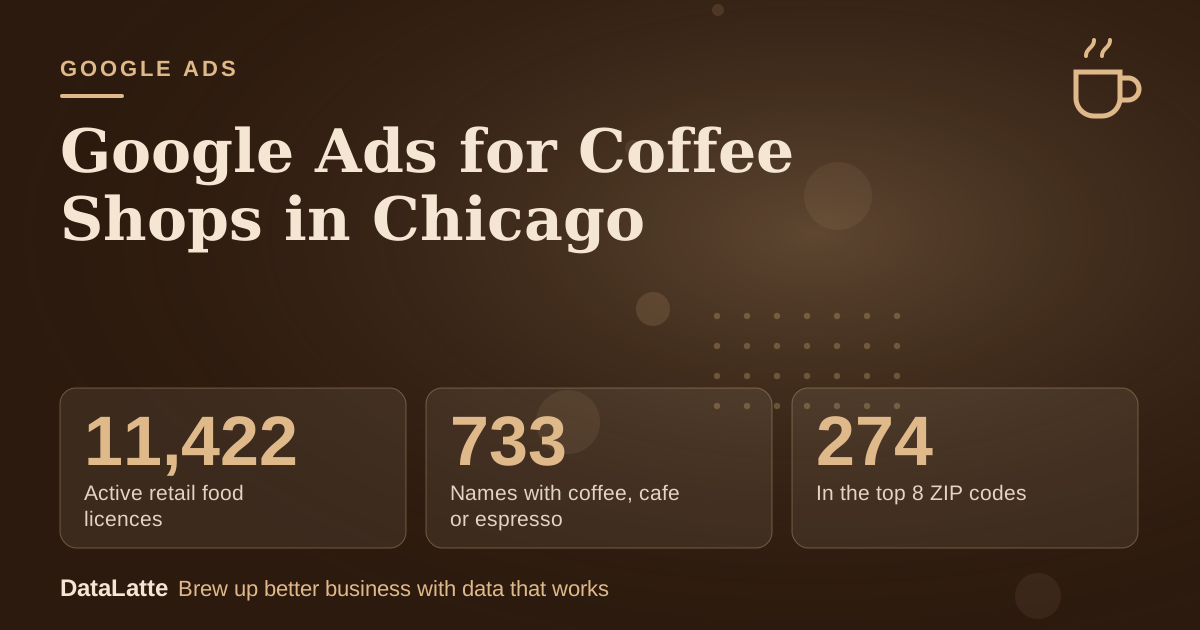
Chicago's business licence database lists 733 active retail food licences with "coffee", "cafe" or "espresso" in the business name. Just eight ZIP codes hold 274 of them, more than a third. If your shop sits in one of those eight, the person typing "coffee near me" can see a dozen options within walking distance, and your ad has to win on location and a specific reason to choose you.
This guide is for coffee shop owners in Chicago, and the setup logic applies to any big US city. The first half shows what public Chicago data says about your competition and your market. The second half turns that into a campaign and a break-even calculation.
For the general step-by-step, see our
complete Google Ads guide for coffee shops and the
one-day campaign build. This page is the Chicago layer on top.
What the City's Licence Data Says About Your Competition
The City of Chicago publishes active business licences on its open data portal. The "Business Licenses - Current Active" dataset was queried on 10 October 2026.
Three honest caveats first: the dataset counts licence records, not shop locations; matching on the business name catches restaurants and bakeries called "Cafe Something" as well as coffee shops; and it misses coffee shops with names like "Dollop" or "Gaslight" that contain none of those words.
Treat the numbers as a floor-and-ceiling picture of density, not a census.
→
Active retail food licences
City of Chicago data portal
→
Names with coffee, cafe or espresso
Name match, licence records
→
In the top 8 ZIP codes
37% of the 733
→
Names containing Starbucks
Licence records
See Sources at the end of the article. Cards marked Assumption are examples, not results.
Here are the ZIP codes with the most name-matched licences. The neighborhood labels are an approximate mapping, so check a ZIP map before you rely on them.
| ZIP | Active licences (name match) | Roughly covers |
|---|
| 60647 | 43 | Logan Square, Bucktown area |
| 60614 | 41 | Lincoln Park |
| 60618 | 38 | North Center, Avondale, Irving Park area |
| 60657 | 36 | Lakeview |
| 60611 | 32 | Streeterville, Gold Coast area |
| 60625 | 30 | Lincoln Square, Albany Park area |
| 60640 | 28 | Uptown, Edgewater area |
| 60606 | 26 | Western edge of the Loop |
What this means for your ads:
- In a dense ZIP, a generic "coffee shop near me" ad is one of dozens. Your headline has to carry something a neighbor cares about: the street, the hours, the patio, the pastry source.
- Outside the top eight, you may face less direct competition. A smaller radius with a plain, clear offer can be enough. Count the shops within a ten-minute walk yourself on Google Maps before you decide how hard to bid.
- Chains are part of the search results. Starbucks alone appears on 146 licence records. You do not need to out-spend them; you need to be the clearly different option for the people who prefer an independent.
The Market Around You: Jobs, Commuters and Visitors
Three more public sources give Chicago-specific context.
Your industry is mostly small employers. The US Bureau of Labor Statistics' Quarterly Census of Employment and Wages (QCEW) reports, for Cook County in 2024, 1,122 private establishments in NAICS 722515, "Snack and nonalcoholic beverage bars", with an annual average employment of 14,457 and an average weekly wage of $562. That category includes coffee shops but also other snack and drink bars, so it is a close cousin of your business rather than an exact match. It works out to about 13 employees per establishment. For comparison, all industries and ownerships in Cook County average 1,672 a week. One practical read: a $900 monthly ad budget is about a week and a half of one average worker's pay in your category, so every dollar needs a job to do.
Chicagoans commute a long way. Census Reporter's profile of Chicago, built on the American Community Survey 2024 one-year estimates (Census Reporter is a mirror of Census Bureau data, not the Bureau itself), shows a population of 2,721,326, a median household income of $80,613 and a mean travel time to work of 33.5 minutes. A long commute means two coffee moments you can aim ads at: near home before the train, and near the office or transit stop after it. Radius targeting can cover both, with separate campaigns if you have the budget.
Visitors add a layer downtown. Choose Chicago, the city's tourism organization, estimated 55.3 million visitors in 2024, up 6.5% on 2023 but still below the 61 million of 2019, according to a report by the Chicago Sun-Times republished by WBEZ. If you are in the Loop, River North or Streeterville, tourists searching "coffee near me" on a phone are real traffic, and they will never become regulars. Do not pay regular-customer prices for them. Keep a tourist-heavy shop's budget lower, or run ads only in the hours when your commuters, not visitors, are walking by.
Build the Campaign Around Your ZIP
Location: radius, not "Chicago"
Google's
location targeting help says that for most campaign types you can target a radius around a location, and that the default option reaches people in or regularly visiting an area as well as people who have shown interest in it. It also warns targeting is best effort, not perfectly accurate.
A practical Chicago rule: pull your last 50 loyalty-card or POS-linked regulars if you have them, or just ask for ZIP codes at the counter for a week. Draw your radius from that. In a dense neighborhood that may be a mile or less; near a train station, it may be a short walk.
Targeting all of Chicago pays for clicks from people 40 minutes away by train. In the Settings, consider choosing presence-based targeting for a walk-in business. That is a suggestion, not a Google rule.
Keywords and match types
Google's
match type guide defines broad match as reaching related searches, phrase match as searches carrying your keyword's meaning, and exact match as the most control and the fewest searches. Google also says it is critical to use Smart Bidding with broad match. With a small budget, start on phrase and exact.
| Ad group | Example keywords | Match |
|---|
| Near me | "coffee shop near me", [coffee near me], "cafe open now" | Phrase + exact |
| Neighborhood | "coffee shop Logan Square", "cafe Lincoln Park", [coffee shop lakeview] | Phrase + exact |
| Transit and work | "coffee near [train line] station", "cafe with wifi [neighborhood]" | Phrase |
| Specific need | "oat milk latte near me", "pastries [neighborhood]", "dog friendly cafe [neighborhood]" | Phrase |
| Your brand | [your shop name] | Exact |
Only use neighborhoods you serve. Keep negatives on from day one: jobs, hiring, barista course, coffee maker, coffee beans, recipe, wholesale, franchise. Our negative keywords guide shows how to apply them, and you should read the search terms report weekly.
Ads that sound like the neighborhood
Google's
responsive search ad rules allow 3 to 15 headlines of up to 30 characters and 2 to 4 descriptions of up to 90 characters. Fill them with specifics that fit in 30 characters:
Espresso Bar in Lakeview,
Open 6am, Right by the Brown Line,
House-Baked Pastries Daily,
Patio Seating, Dogs Welcome.
Only claim what is true on the day someone walks in. Then connect your Business Profile so your address and distance appear, and see our
Google Business Profile tips for coffee shops before turning ads on.
Track visits, not just clicks
Add call tracking for ad calls and a tracked "directions" or "order" action. Our call tracking guide covers the options. For walk-ins, use a simple counter offer ("mention the ad for a free cookie with a drink") and tally redemptions. A tally sheet is rough, but it is the only way to see whether the ads bring a real person through the door.
The Math
Every number below except the Chicago licence data and the benchmark CPC is an assumption. WordStream by LocaliQ's 2026 benchmarks list an average click of $2.05, a 6.83% click-through rate and $30.57 per lead for Restaurants & Food in the US. That is not Chicago and not coffee shops specifically, so the Strong column uses it as a best case and the Tough and Base columns are placeholders. Replace them with what Google Ads Keyword Planner and your first two weeks show.
| Tough | Base | Strong (benchmark CPC) |
|---|
| Monthly budget (assumption) | $900 | $900 | $900 |
| Cost per click | $5.00 (assumption) | $3.50 (assumption) | $2.05 (LocaliQ 2026) |
| Clicks | 180 | 257 | 439 |
| Click to first visit rate (assumption) | 3% | 6% | 10% |
| First visits | 5.4 | 15.4 | 43.9 |
| Cost per first visit | $167 | $58 | $21 |
| Visit to regular rate (assumption) | 15% | 20% | 25% |
| New regulars | 0.8 | 3.1 | 11 |
| Ad cost per regular | $1,111 | $292 | $82 |
Now the value side, also assumed: a regular visits 75 times a year, spends $7 a visit and you keep 65% after ingredients and cups. That is 75 x $7 x 0.65 = about $341 gross profit a year, or $28 a month.
- Payback in months is ad cost per regular divided by $28: about 39 months in Tough, 10 in Base, 3 in Strong.
- Break-even click price: maximum CPC = the most you will pay for a regular x visit rate x regular rate. If you will pay $170 (six months of a regular's profit), at 6% and 20% your ceiling is $170 x 0.06 x 0.20 = $2.04 a click. A dense ZIP may not offer clicks that cheap, which is a signal to use a tighter radius, sharper keywords or a different channel.
- The lever you control most is the visit rate. A clear offer and a good Business Profile move it more than bid tweaks. See our New York coffee shop marketing guide for another dense-city example.
Do This Today
- Open Google Maps, search "coffee" on your street and count the shops within a ten-minute walk. That is your real competition, not the city-wide number.
- Ask for ZIP codes at the counter for one week, then draw your ad radius from the answers.
- Create one Search campaign for one location with the ad groups above, phrase and exact match, and the negative list.
- Write 8 headlines that each name a neighborhood detail, a time or a product, and set up a counter offer you can count.
- Work out your own numbers: ticket, visits per regular, margin. Use the break-even formula to set a maximum CPC before you spend.
FAQ
Q: How much should a Chicago coffee shop spend on Google Ads?
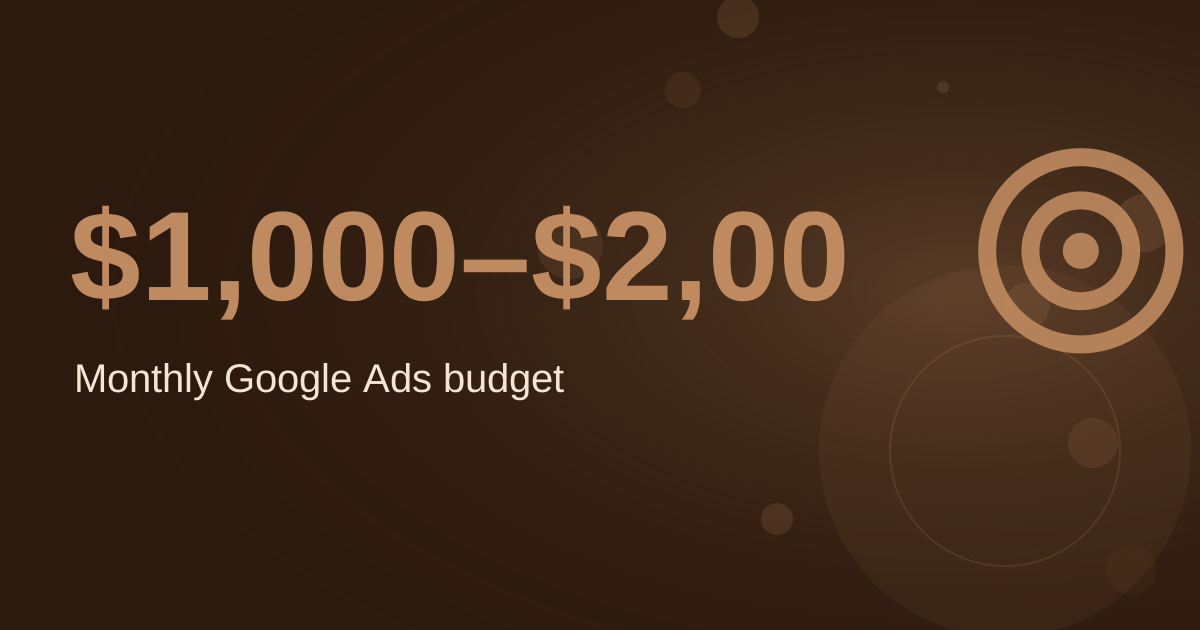
A: There is no verified Chicago figure. LocaliQ's 2026 US benchmark for Restaurants & Food is $2.05 a click, a rough reference only. Start from your break-even click price, then pick a budget that buys enough clicks to learn from. At an assumed $3.50 click, $900 a month buys about 257 clicks. Judge it by cost per regular, not clicks.
Q: Should I target Chicago or my neighborhood?
A: Your neighborhood or a radius around the shop. Google lets most campaign types target a radius, and a coffee run rarely crosses town.
Q: Do tourists make downtown ads worth it?
A: They add searches, not loyalty. Choose Chicago estimated 55.3 million visitors in 2024, but a visitor rarely becomes a weekly regular. Count them separately if you can.
Q: How do I know which ZIP codes are crowded?
A: Use the City of Chicago data portal's business licence data or count on Google Maps. The portal figures above are name matches and an approximation.
Q: How long before I know if it works?
A: Google gives no fixed timeline. Wait until you have enough clicks and counted redemptions to compare against your break-even.
Sources
Want a Chicago campaign built around your ZIP and tracked to real visits? See our
Google Ads service, the
coffee shop marketing page, or
contact DataLatte.
Free for local businesses
Want this applied to your business?
I'll review your Google presence, local SEO, and ad accounts — and send you a specific action plan within 48 hours. No pitch, no pressure.