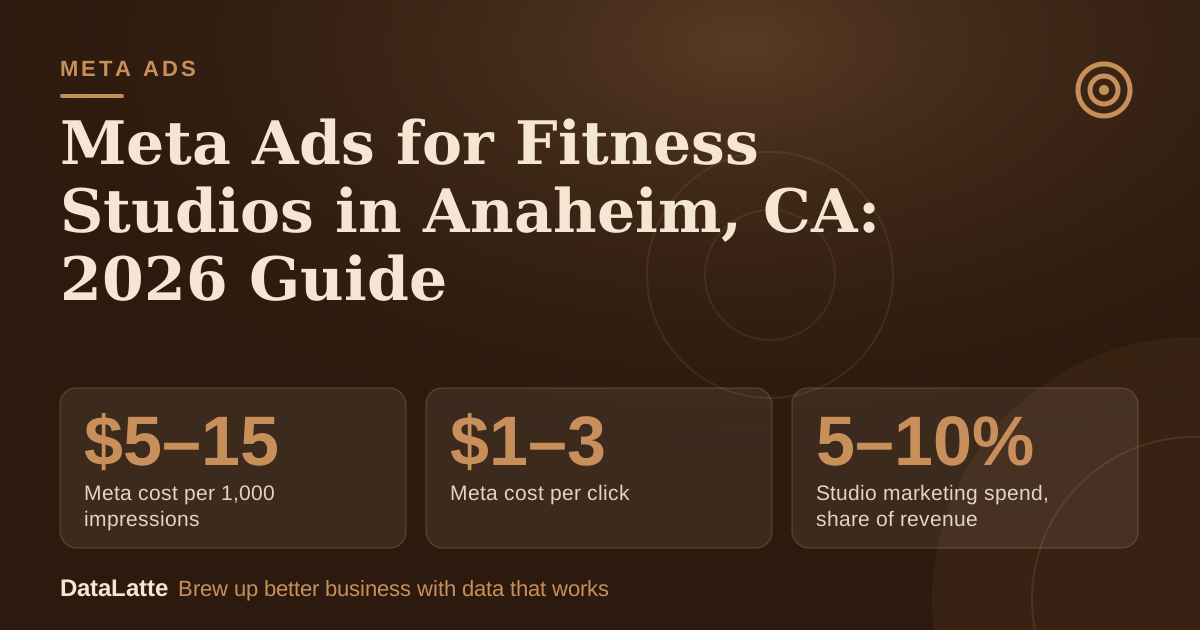
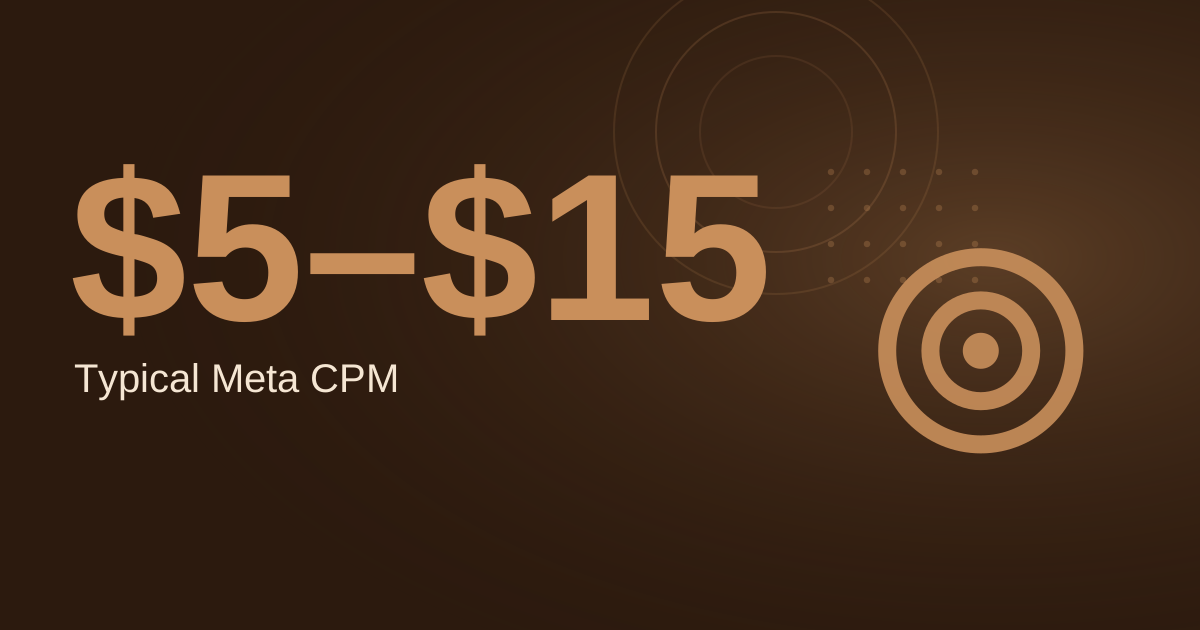
Meta Ads run on Facebook and Instagram from one system, Meta Ads Manager, and they can put a fitness studio's classes in front of nearby adults. Typical Meta costs are $5–15 per 1,000 impressions and $1–3 per click, according to
Adwave's small business marketing guide. For a studio in Anaheim, CA, the practical starting point is a free-trial offer, short video of real classes, and a Meta share of roughly 45 to 55 percent of total ad spend. Local Anaheim benchmarks vary, so treat the ranges below as planning inputs and check your own booking data.
→
Meta cost per 1,000 impressions
Typical range, vendor guide
→
Meta cost per click
Typical range, vendor guide
→
Studio marketing spend, share of revenue
Boutique studios, Mariana Tek
→
Short-form videos per week
Realistic pace for most studios
See Sources at the end of the article. Cards marked Assumption are examples, not results.
Meta pricing is usually quoted two ways. Cost per mille (CPM) is what you pay for every 1,000 times an ad appears, and cost per click (CPC) is what you pay when someone taps through.
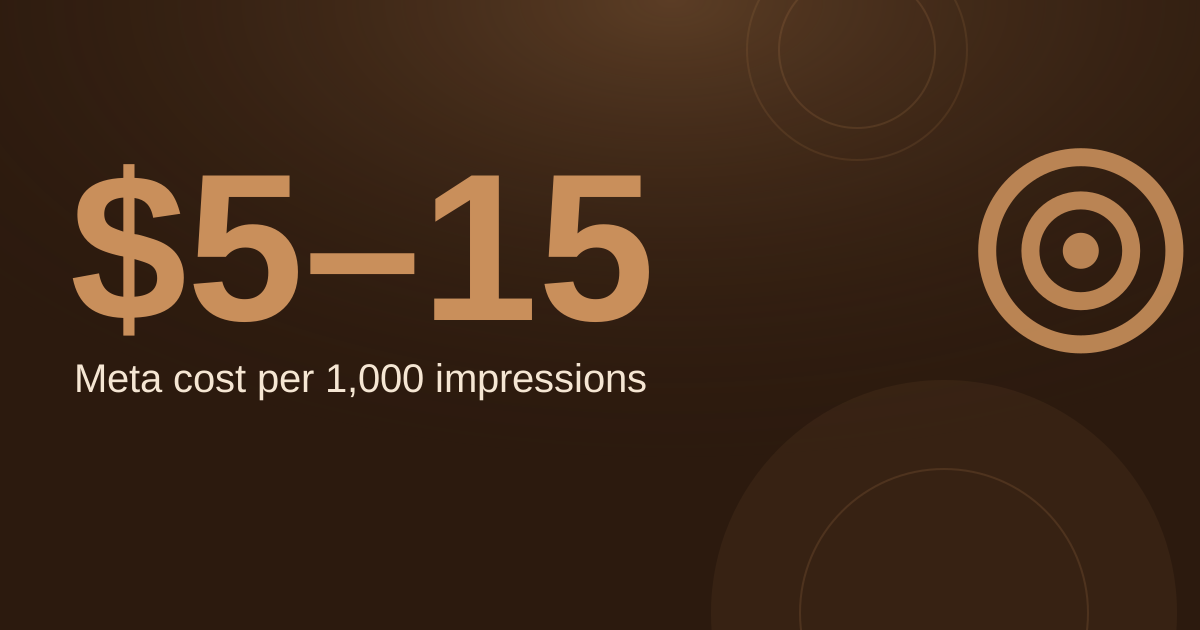
Adwave's guide lists $5–15 per thousand impressions and $1–3 per click for Meta, and a
separate Adwave comparison says a standalone Meta buy often costs $300–$1,000 per month.
Those figures are vendor estimates across industries, not studio-specific data. A studio with a narrow radius and a single class type may pay less per click than a wide national campaign, and a crowded January may push costs up. Use the ranges to set a starting budget, then compare your own cost per click after two or three weeks of delivery.
For fitness studios and wellness businesses,
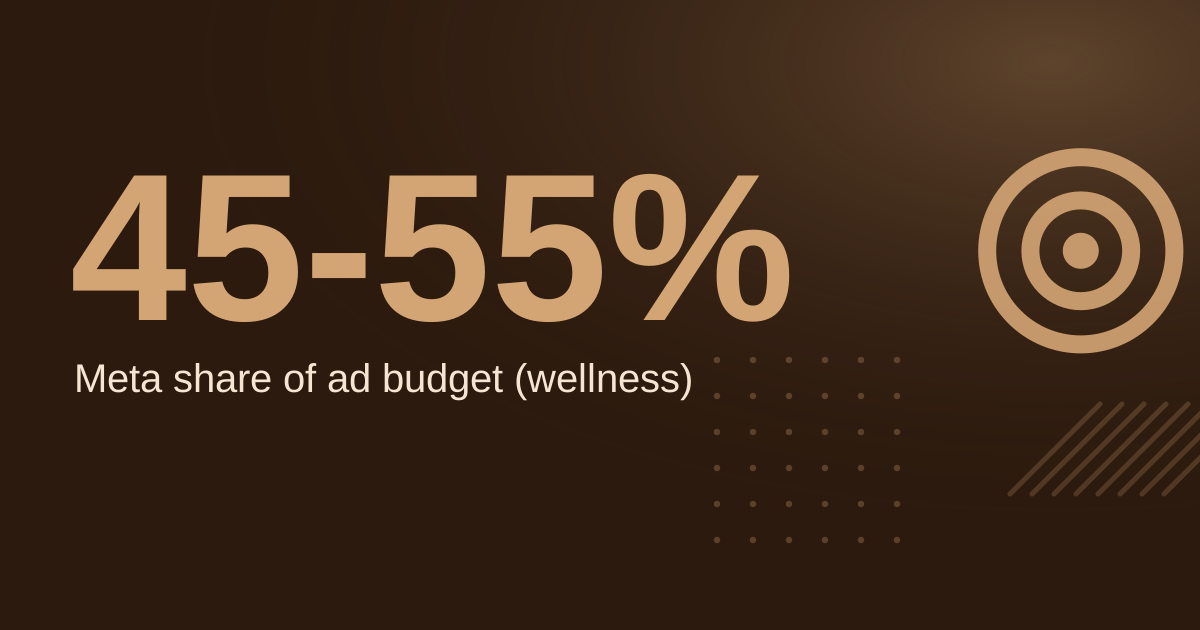
Adwave recommends a 45–55% Meta budget split, with 30–40% going to connected TV and the balance to local platforms. That split is a planning guide, not a rule, and it assumes the studio already has a paid budget.
Total marketing spend matters more than the split.
Mariana Tek notes that many boutique studios budget between 5 and 10 percent of monthly revenue for marketing. A studio that brings in $12,000 a month would therefore have $600–$1,200 for all marketing. Meta would sit inside that envelope, not on top of it.
The numbers below use assumptions for a hypothetical studio. Replace them with your own revenue and results.
Assumptions:
- Monthly studio revenue: $12,000 (assumption)
- Total marketing budget: 7.5% of revenue, the midpoint of the 5–10% range, so $900 (assumption applied to the cited range)
- Meta share: 50%, the midpoint of the 45–55% split, so $450 (assumption applied to the cited split)
- Share of clicks that book a free trial: 10% (assumption)
Calculation:
- Impressions: $450 ÷ $15 CPM × 1,000 = 30,000 at the high CPM, and $450 ÷ $5 × 1,000 = 90,000 at the low CPM
- Clicks: $450 ÷ $3 = 150 at the high CPC, and $450 ÷ $1 = 450 at the low CPC
- Trial bookings: 15 to 45 (assumption: 10% of clicks)
- Cost per trial booking: $450 ÷ 45 = $10 at best, and $450 ÷ 15 = $30 at worst
The spread is wide because it reflects the cited ranges, not a forecast. The useful step is to replace the assumed 10% booking rate with your own measured rate after a few weeks.
Short video is the format to start with.
Adwave, citing Meta's 2025 Creative Best Practices report, says short-form video generates 2.5 times more engagement than static images on Facebook and Instagram. Treat this as a vendor summary of a platform report rather than a guaranteed result.
Mariana Tek advises studios to post three to five short-form videos a week, at a steady pace rather than in bursts. For a deeper look at video planning, see
Instagram Reels for fitness studios and
Instagram Stories ads for fitness studios.
Instagram and Facebook both support a Book Now button on profiles, which
Appointy notes. Pair the ad with a single booking action so a viewer is not sent to a generic homepage.
Meta Ads Manager is the central place to run ads across Instagram and Facebook, and
Turrboo lists Messenger as covered too.
Adwave notes that one campaign can run on Instagram, Facebook, or both. Before spending, complete these steps:
- Install the Meta Pixel on your website and confirm it fires on the booking confirmation page.
- Set a Lead or booking event for the form or booking step.
- Add UTM parameters to every ad URL so your analytics tool can separate Meta traffic from other sources.
- Set a separate budget for each ad set so you can see which audience or format earns the bookings.
- Check results against bookings, not only reach or impressions.
Meta offers free advertising courses through Meta Blueprint with a certificate on completion, according to
a secondary summary of the program. Check Meta's own help pages for current course details.
How Fast Should a Studio Follow Up on Leads?
Speed matters because interest fades quickly.
Mariana Tek advises studios to follow up within 24 hours with an automated welcome sequence, since interest fades fast after a pop-up or trial ends. A paid click that books a trial but then gets no reply has cost you the ad spend without a membership.
A simple sequence might send a booking confirmation at once, a reminder before the first class, and a message after the trial asking the new client to book again. For setup details, read
marketing automation for fitness studios.
Where Does Anaheim Targeting Fit In?
Meta's audience tools let you choose a radius around your studio, an age range, and interests. Both Instagram and Facebook are owned by Meta, which
allows advertisers to identify detailed customer profiles and set a budget for each ad. Set the radius around your studio location and start broad enough to gather data, then narrow the audience once you see which areas book.
Avoid building a targeting plan on unsourced population or income numbers. Use Meta's own audience estimates inside Ads Manager when you set the radius. For a comparison with another California market, see
Meta ads for fitness studios in Los Angeles, CA. For wider strategy, see
Facebook ads for gyms and fitness studios.
Next Steps
Start with a Meta budget inside your 5–10% marketing envelope, run one short-video offer with a free trial, and measure cost per booking for two to three weeks before changing the split. If you want a review of your current setup,
book a free audit.
FAQ
Vendor guides suggest a standalone Meta buy often costs $300–$1,000 per month, and Adwave recommends a 45–55% Meta share of total ad budget for fitness and wellness businesses. Set the amount as a share of your total marketing budget, which Mariana Tek places at 5–10% of monthly revenue for many boutique studios.
Is Instagram or Facebook better for studio ads?
Both run through Meta Ads Manager, and one campaign can run on either or both. Test placements separately, then keep the ones that produce bookings at a lower cost per booking.
Short-form video is the strongest starting point. Adwave cites Meta's 2025 report as showing 2.5 times more engagement than static images, and Mariana Tek recommends three to five videos a week.
How quickly should I follow up with a trial lead?
Follow up within 24 hours with an automated welcome sequence, according to Mariana Tek. Delay reduces the value of the click you paid for.
Sources
- How to Market a Small Business guide, Adwave (vendor)
- Connected TV vs social media ads comparison, Adwave (vendor)
- How to choose advertising channels, Adwave (vendor)
- Group fitness studio marketing strategies, Mariana Tek (vendor)
- Electrician advertising, citing Meta's 2025 Creative Best Practices report, Adwave (secondary)
- Social media marketing for fitness studios, Appointy (vendor)
- Instagram advertising for local business, Adwave (vendor)
- Organic vs paid social media, Turrboo (secondary)
- Digital marketing for beginners, summary of Meta Blueprint courses (secondary)
- Coffee shop marketing ideas, The Restaurant HQ (secondary)
Free for local businesses
Want this applied to your business?
I'll review your Google presence, local SEO, and ad accounts — and send you a specific action plan within 48 hours. No pitch, no pressure.