Meta Ads for Fitness Studios in Los Angeles (2026)
Part of the guide: Fitness Studio Social Media & Meta Ads
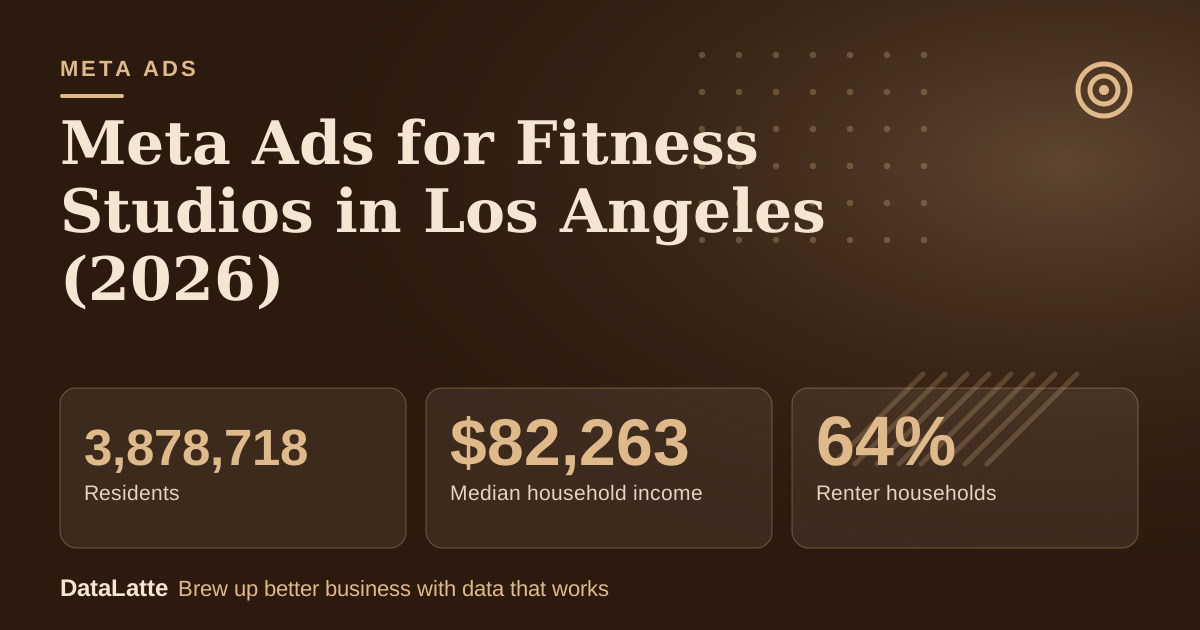
Who Lives in Los Angeles
Residents
ACS 2024 1-year
Median household income
1,480,869 households
Renter households
of households
Workers who drive alone
only 6.2% use public transit
See Sources at the end of the article. Cards marked Assumption are examples, not results.
| ZIP | Roughly covers | Median household income (margin of error) | Renter households | Work from home | Drive alone |
|---|---|---|---|---|---|
| 90291 | Venice | $122,738 (±$11,126) | 67% | 45% | 43% |
| 90025 | West LA, Sawtelle | $103,894 (±$7,781) | 76% | 32% | 48% |
| 90064 | Rancho Park, West LA | $135,383 (±$9,567) | 51% | 34% | 54% |
| 90036 | Miracle Mile, Fairfax | $109,785 (±$5,813) | 86% | 34% | 53% |
| 90046 | Hollywood Hills | $96,250 (±$3,433) | 78% | 31% | 55% |
| 90028 | Hollywood | $61,349 (±$4,148) | 97% | 26% | 45% |
| 90026 | Silver Lake, Echo Park | $87,334 (±$6,504) | 77% | 27% | 51% |
| 91423 | Sherman Oaks | $109,461 (±$6,495) | 63% | 33% | 58% |
| 91367 | Woodland Hills | $108,653 (±$5,291) | 55% | 26% | 63% |
| 90003 | South Los Angeles | $56,030 (±$3,054) | 73% | 5% | 68% |
- High work-from-home neighborhoods (Venice at 45%, Miracle Mile and Rancho Park at 34%) may support midday classes, because a large share of residents are not commuting at lunchtime.
- Low work-from-home, high-driving areas (90003 at 5% working from home and 68% driving alone) may favour early-morning and evening classes that fit around commutes.
- Income gaps of more than 2x between ZIP codes mean a boutique price point has a very different addressable audience in 90064 than in 90003. Set your offer, and your radius, accordingly.
How Many Fitness Businesses Are You Up Against?
- 1,459 establishments, up from 1,268 in 2019, a rise of about 15%.
- 21,447 employees, almost level with 21,350 in 2019.
- $27,135 average annual pay, up from $23,253 in 2019.
The Calendar and the Visitors
- Visitors. LA Tourism reports 49.5 million visitors to Los Angeles in 2025 (43.1 million domestic and 6.4 million international), $42.6 billion in business sales and more than 530,000 jobs in the visitor industry across Los Angeles County. Visitors rarely join a studio, but a drop-in class or short-term pass can be an add-on if your location is near hotels.
- Running events. The 41st Los Angeles Marathon took place on Sunday, March 8, 2026, with more than 27,000 runners, according to NBC Los Angeles. If you teach strength, mobility or running-adjacent classes, a spring campaign can borrow the moment. The 2027 date is not confirmed in the sources used here, so check the official race site.
- Big events ahead. LA Tourism names Super Bowl LXI and the 2028 Olympic and Paralympic Games as future drivers. Neither is likely to change your January sign-up pattern.
Rules That Touch Your Offer
California auto-renewal and health club rules
- Automatic renewal law. Amendments (AB 2863) took effect July 1, 2025. According to Barnes & Thornburg's summary, businesses must obtain the consumer's express affirmative consent to automatic renewal or continuous service terms, and the law now reaches free-to-paid conversions. Cancellation must be offered through the same channel used to sign up (online, by phone or in store). Consumers must receive an annual reminder stating the renewal frequency, the amount charged and how to cancel. Proof of consent must be kept for at least three years or one year after the contract ends, whichever is longer.
- Health studio contracts. California's Civil Code has a separate health studio services contract law (section 1812.80 onward). According to the 2016 Assembly floor analysis of AB 2810, every health studio contract must include a statement that the buyer may cancel before midnight of the fifth business day after the agreement. That bill added cancellation in person, by email from an address on file or by first-class mail, and required contracts to disclose the initial or minimum term. The law may have been amended since 2016, so check the current text.
Meta's advertising policies
What the Benchmarks Say
Traffic CPC
traffic campaigns
Traffic CTR
traffic campaigns
Lead CPC
lead campaigns
Cost per lead
7.98% conversion rate
See Sources at the end of the article. Cards marked Assumption are examples, not results.
Set Up the Campaign
- Offer. One clear, low-commitment offer: a free class, a first-week pass or an intro price. Put the end-of-trial terms in writing on the form and landing page.
- Objective. Start with a lead campaign using an instant form, or send traffic to a landing page with a short form. Our landing page best practices cover the layout.
- Location. Pick two or three neighborhoods near the studio where your members already live, using the postcodes of your last 50 sign-ups. In a driving city, think in drive times from your door, then check your Meta location options for the radius controls available to you.
- Creative. Use real photos or short video of your coaches, your room and a class in progress. Avoid before-and-after claims and appearance-based messaging.
- Follow-up. Call or text new leads within minutes. Fast follow-up is a recommendation here, not a measured figure; see Facebook ads for fitness studios for more on the funnel.
- Tracking. Set up conversion tracking for the lead form and log which leads become members. Our conversion tracking guide covers the principles.
The Math
| LocaliQ benchmark | 2x (assumption) | 3x (assumption) | |
|---|---|---|---|
| Monthly budget | $1,200 | $1,200 | $1,200 |
| Cost per lead | $27.11 | $54 | $81 |
| Leads | 44 | 22 | 15 |
| Lead to attended trial (assumption) | 50% | 50% | 50% |
| Attended trial to member (assumption) | 30% | 30% | 30% |
| New members | 6.6 | 3.3 | 2.2 |
| Ad cost per new member | $181 | $361 | $542 |
| Monthly fee (assumption) | $140 | $140 | $140 |
| Months of fees to pay back the ad cost | 1.3 | 2.6 | 3.9 |
Do This Today
- Pull your last 50 sign-ups and map their ZIP codes. Choose two or three neighborhoods for your first campaign.
- Calculate your allowable cost per member: monthly fee times the number of months a typical member stays, times the share of that revenue you are willing to spend on acquiring them.
- Write your free-trial terms in plain language: what is free, for how long, what it costs after, and how to cancel. Put them on the form and the landing page.
- Build one campaign, one offer and one form, with real photos and no weight-loss or appearance claims.
- Decide who answers new leads within 15 minutes, and log every lead's outcome (attended, joined, not interested) for four weeks before judging results.
FAQ
Sources
- Census Reporter: Los Angeles city and county, ACS 2024 1-year (tables B01003, B19013, B25003, B08301, B03003, B16004)
- Census Reporter: ZIP code tabulation areas, ACS 2024 5-year (2020-2024)
- BLS QCEW open data: Los Angeles County, 2025 annual averages (NAICS 713940; 2019 and 2024 files used for comparison)
- LA Tourism: Visitors to Los Angeles generated $42.6 billion in business sales
- NBC Los Angeles: 2026 LA Marathon results and winners
- Barnes & Thornburg: California expands automatic renewal law (law-firm summary of AB 2863)
- California Legislature: AB 2810 Assembly floor analysis, 2016 (summary of health studio contract law; may be outdated)
- Meta: Health and wellness advertising policy
- LocaliQ: Facebook Advertising Benchmarks 2026
Related guides
- Meta Ads for Fitness Studios in Anchorage, AK
- Meta Ads for Fitness Studios in Raleigh, NC
- Google Ads for San Diego Fitness Studios: 2026 Guide
- Google Ads for Fitness Studios in Fresno: 2026 Guide
- Local SEO for Fitness Studios in Charlotte, NC: 2026
- Meta Ads for Fitness Studios in Oklahoma City, OK
- Meta Ads for Hair Salons in San Diego: 2026 Guide
- Meta Ads for Fitness Studios in Fort Worth, TX
Free for local businesses
Want this applied to your business?
I'll review your Google presence, local SEO, and ad accounts — and send you a specific action plan within 48 hours. No pitch, no pressure.
Want hands-on help?
See how DataLatte handles Meta Ads Management for local businesses.
🏋️ Industry Guide
Fitness Studio Marketing Guide

Local marketing strategist with 10+ years at global agencies — OMD, Dentsu, GroupM, and BBDO. Now helping small businesses get the same data-driven edge. Based in Europe, working with clients in the US, UK, Australia, and beyond.
Related articles

Want this applied to your business?
Let's review your current marketing setup together — free, no obligations.
Get Your Free Marketing Audit