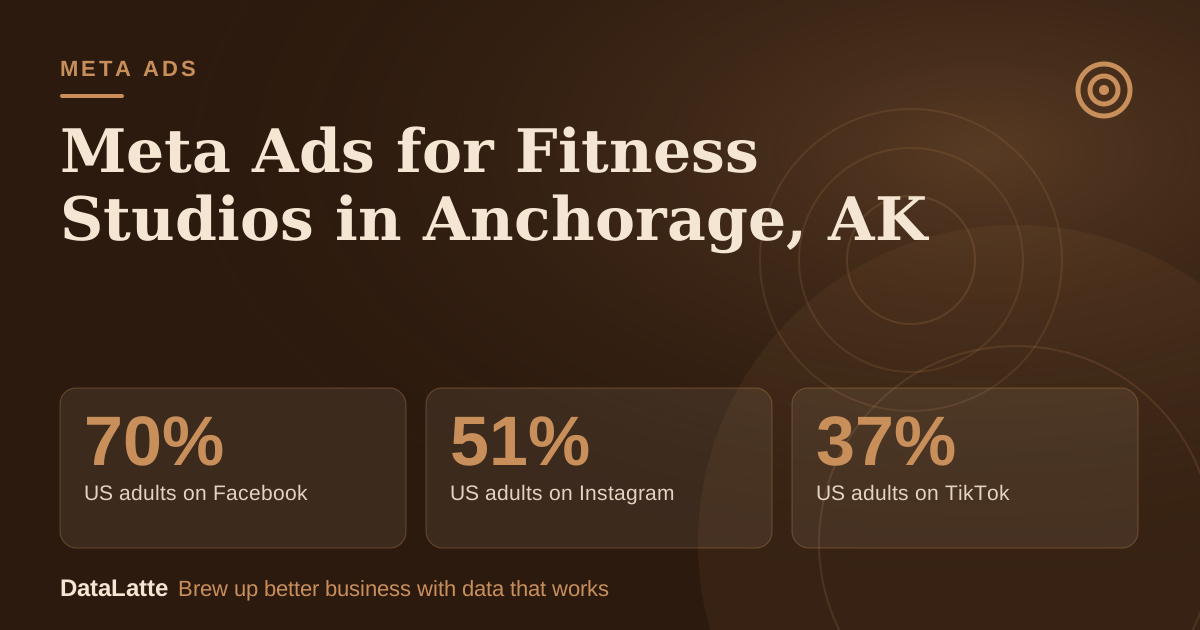
Meta ads on Facebook and Instagram can bring new members to a fitness studio in Anchorage, AK, when the audience, creative and tracking are set up deliberately. Pew Research Center's 2026 survey finds that 70% of US adults use Facebook and 51% use Instagram, so both platforms have the reach a local studio needs. The sources behind this guide contain no Anchorage-specific ad costs, so every budget figure is a labelled assumption to replace with your own account data after a test month.
↓
US adults on Facebook
Pew 2026, down from 71% in 2025
↑
US adults on Instagram
Pew 2026, up from 50% in 2025
→
US adults on TikTok
Pew 2026, unchanged from 2025
↑
US adults on Snapchat
Pew 2026, up from 25% in 2025
See Sources at the end of the article. Cards marked Assumption are examples, not results.
Pew's figures describe all US adults, not Anchorage residents. They show that Facebook and Instagram are mainstream, which makes them a reasonable first paid channel for a studio that serves people within driving distance. They do not show how many of those users live near the studio, so local targeting does the real filtering.
Meta ads work best with a clear entry offer, such as a free first class or a trial week. Cold audiences rarely commit to a full membership on first contact, so the ad's job is to start a conversation or capture a booking. For a broader overview of the platform, see
the complete Facebook ads guide for gyms and fitness studios.
Start with one format on each platform rather than running everything at once. Video is a sensible first test because it can show the class format, the instructor and the space within a few seconds. Static images work too, but they convey less about what a class feels like.
Instagram and Facebook do not perform identically for every business, so compare them directly. The differences are covered in
Instagram ads vs Facebook ads. Keep the offer identical across both platforms so the platform is the only variable. Authentic footage from the studio itself can suit a local, personal brand better than polished stock imagery, which may look like a national chain.
How Should Targeting and Audiences Be Set Up?
Begin with a radius that prospective members would realistically drive, then narrow it in a dense area and widen it only if the audience is too small to deliver results. The right radius depends on the local map, so test it rather than assume it.
Interest targeting should match the class type. A yoga studio, a boxing gym and a strength facility attract different people, so a broad interest such as "fitness" is too vague to be useful. Build separate ad sets for each class category if the studio offers several.
Custom audiences built from past visitors or members can perform well once there is enough data. Meta's help pages describe these options without promising results, so judge them on cost per lead. Once enquiries arrive, response speed matters too, and the
AI chatbot guide for fitness studios covers handling them.
What Does a $600 Monthly Budget Realistically Produce?
The worked example below uses assumed inputs throughout. None of the figures come from a source, so replace them with your own numbers after the first month.
| Step | Input or result | Basis |
|---|
| Monthly budget | $600 | Assumption |
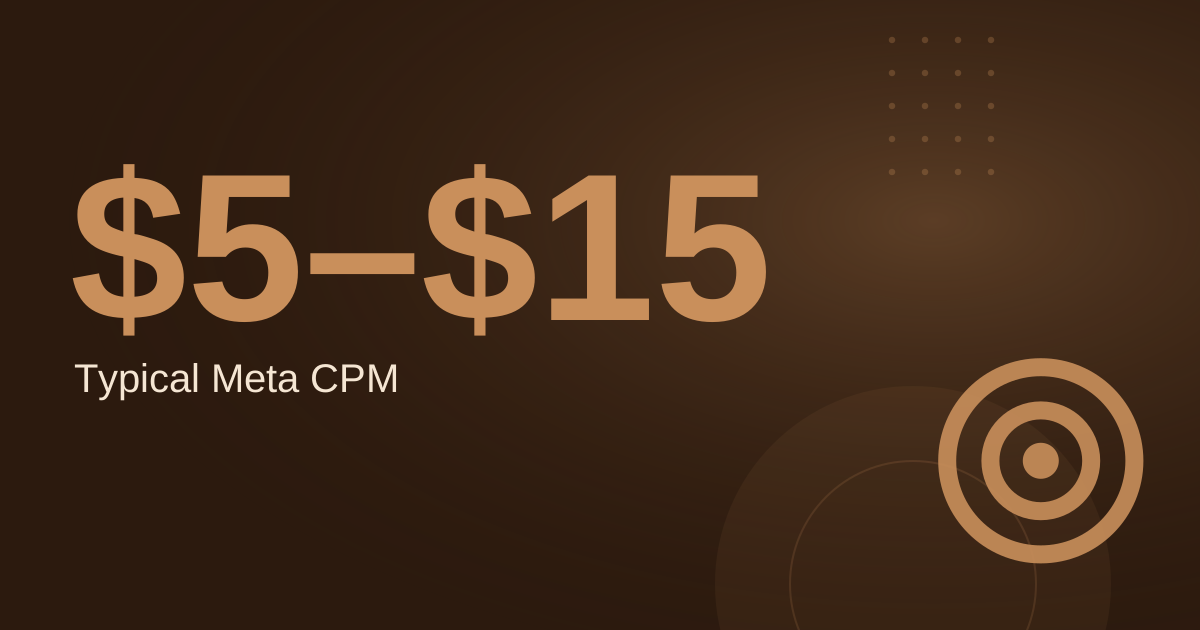
| CPM (cost per 1,000 impressions) | $10 | Assumption |
| Impressions | 60,000 | $600 ÷ $10 × 1,000 |
| Click-through rate | 1.0% | Assumption |
| Clicks | 600 | 60,000 × 1.0% |
| Cost per click | $1.00 | $600 ÷ 600 |
| Lead rate from clicks | 5% | Assumption |
| Leads (trial bookings) | 30 | 600 × 5% |
| Cost per lead | $20 | $600 ÷ 30 |
| Lead-to-member rate | 30% | Assumption |
| New members | 9 | 30 × 30% |
| Cost per new member | About $67 | $600 ÷ 9 |
The useful comparison is between the roughly $67 cost per member and what a typical member is worth to the studio over their time there. If lifetime value is well above that figure, the campaign is worth scaling. If the two are close, the landing page and trial process usually move the lead-to-member rate more than extra ad spend does.
How Should Ads Be Tested Without Skewing Results?
Meta recommends its A/B testing tools rather than switching ad sets on and off by hand. Manual switching can create overlapping audiences and unreliable results, according to
Meta's guidance on A/B testing. The same guidance advises giving both versions the same budget so the comparison stays fair.
Change one variable at a time, such as the video or the headline, and write the hypothesis down before the test starts. Run the test long enough to collect a meaningful number of leads for each version. Judging a campaign after two quiet days usually reflects noise rather than performance.
How Do You Check Tracking Before Spending?
Confirm that the Meta Pixel is installed on the website and fires on the booking confirmation page. Without it, the platform cannot learn which ads produce bookings, and impressions and clicks become the only signals available.
Set up a lead event for the booking or trial form, then complete the form yourself and check that the event appears. Add UTM parameters to ad links so analytics tools can separate Meta traffic from other sources. For search coverage alongside social, compare results against the
best Google Ads keywords for fitness studios, since search intent differs from social targeting.
Track bookings, trial attendance and paid memberships as separate outcomes. Cheap leads who never attend are not a good result, even if the cost per lead looks strong in Ads Manager.
FAQ
The sources used here do not give Anchorage-specific ad costs, so no recommended figure is supported. The worked example uses a $600 monthly budget as an assumption. Start with an amount that can be sustained for at least one full test cycle, then adjust based on the studio's own cost per lead and member value.
Is Facebook or Instagram better for a local studio?
Pew's 2026 data shows Facebook has wider adult reach than Instagram in the United States, at 70% against 51%. Reach alone does not decide performance, because the right platform depends on the audience and the creative. Run a controlled test with the same offer on both before committing most of the budget to one.
Meta's A/B testing guidance focuses on fair splits and identical budgets rather than a fixed duration. Run the test long enough to gather a meaningful number of leads for each version, and avoid switching ads off after a few quiet days. Lead volume should determine the timeline.
Ads can run without a pixel, but the studio loses the ability to see which ads lead to bookings. Install it on the website and set up a lead event for the booking or trial form so the platform and analytics tools can connect spend to outcomes.
Sources
Ready to see where a studio's Meta spend is leaking?
Book a free audit to review tracking, targeting and offer before spending more.
Free for local businesses
Want this applied to your business?
I'll review your Google presence, local SEO, and ad accounts — and send you a specific action plan within 48 hours. No pitch, no pressure.