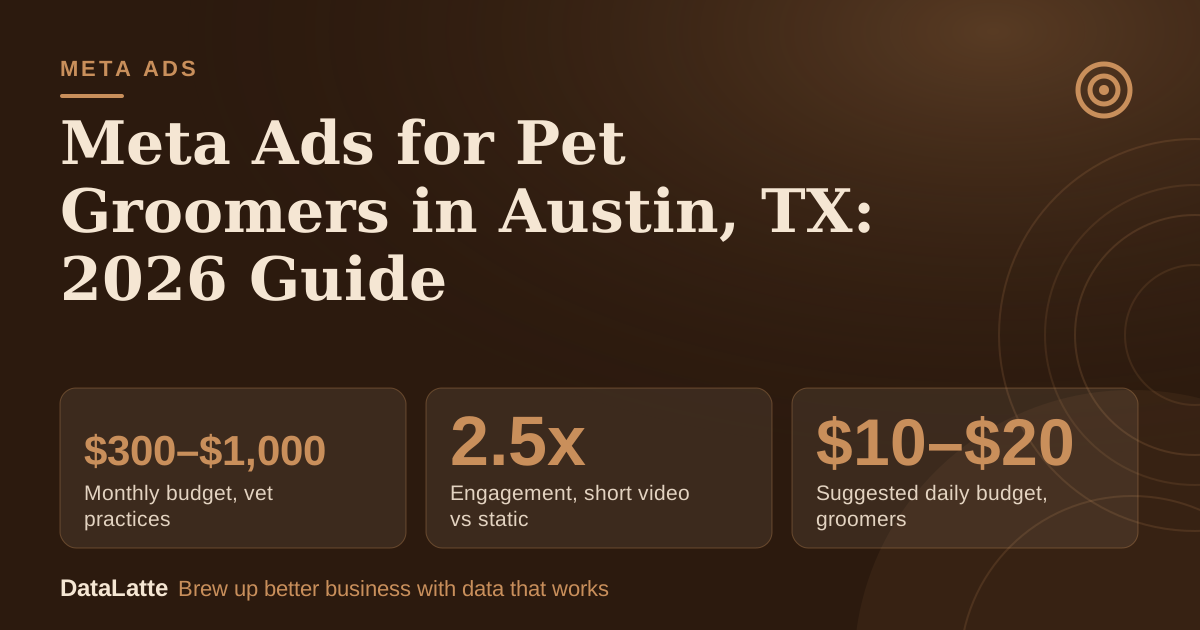
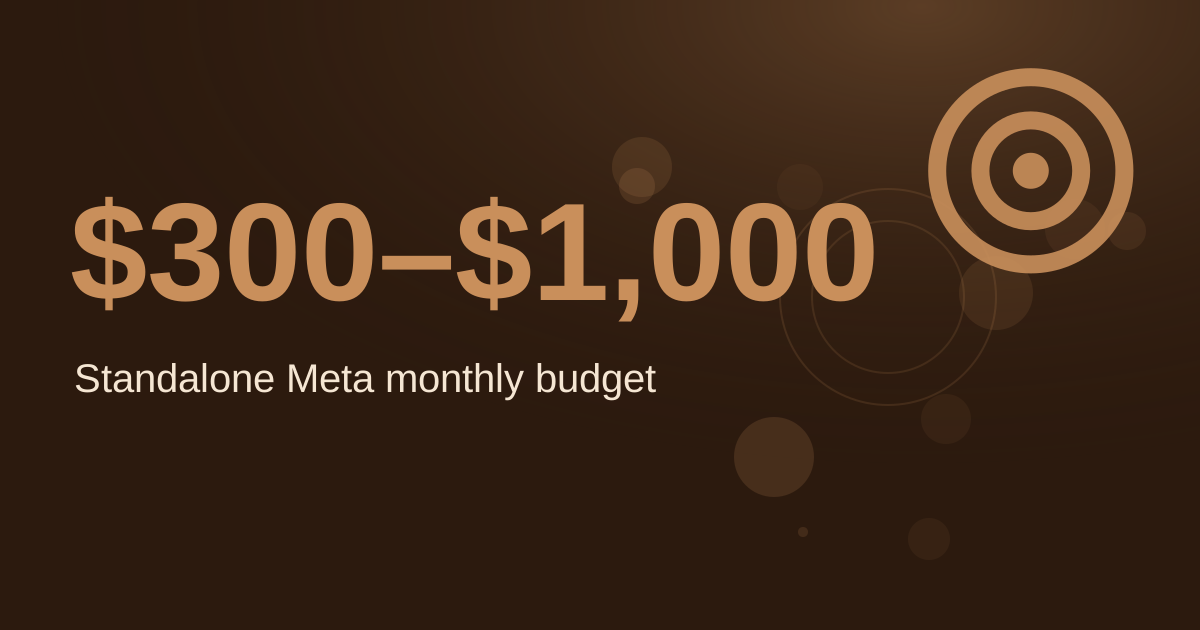
Meta ads on Facebook and Instagram can bring new clients to a pet grooming business, but results depend on budget, audience, and the booking offer. Adwave's veterinary guide estimates that most practices can run effective Meta campaigns for $300 to $1,000 per month, and a secondary grooming guide suggests starting at $10 to $20 a day. This guide covers how to set up Meta ads for a grooming business in Austin, TX, what budget to plan for, and how to measure bookings. The benchmarks below come from vendor and industry pages, so treat them as starting points and test with your own numbers.
→
Monthly budget, vet practices
Adwave veterinary guide, per month
↑
Engagement, short video vs static
Meta 2025 report, cited by Adwave
→
Suggested daily budget, groomers
Barklead grooming guide, secondary
→
Daily active people across Meta apps
Adwave Facebook guide
See Sources at the end of the article. Cards marked Assumption are examples, not results.
Meta's apps reach an average of 3.56 billion daily active people, according to
Adwave's Facebook advertising guide for small business. That global scale matters less than local reach, because a groomer only serves people who can reach the shop or book a mobile visit. Meta Ads Manager is the central tool for running ads across Instagram and Facebook, as
Adobe Express explains, and
Turrboo (secondary) notes that it also covers Messenger.
Instagram ads run through the same system because Instagram is owned by Meta. A single campaign can run on Instagram, Facebook, or both, as
Adwave's Instagram advertising guide describes. If you are deciding between the two,
Instagram ads vs Facebook ads compares them in more detail. No Austin-specific reach figure is included here, so check the estimated audience size in Ads Manager for your chosen radius.
Adwave's veterinary guide says most veterinary practices can run effective Meta campaigns for
$300 to $1,000 per month. Vet practices are the closest pet-care comparison on that vendor's site. Its channel guide also lists a standalone Meta buy as
often $300 to $1,000 per month.
A secondary grooming guide from Barklead recommends a
starting budget of $10 to $20 per day and advises increasing spend once high-performing ads are identified. Across a 30-day month, that is roughly $300 to $600 (our calculation). Timing matters too: Adwave's restaurant guide lists
1 to 4 weeks to results, and its small business guide notes that Meta
takes weeks to optimize.
Adwave cites Meta's 2025 Creative Best Practices report, which says
short-form video generates 2.5 times more engagement than static images on Facebook and Instagram. For a groomer, that points toward short clips of a dog after a groom, a bath, or a mobile van arriving at a driveway. Plan a simple test: one video ad and one static photo ad with the same offer, then compare cost per booking after two to four weeks.
For objectives, Fork Manager notes that restaurants can
set paid campaigns with goals like traffic or reservations across Facebook, Instagram, or both. A grooming business can use the same logic by choosing traffic to a booking page as the goal. Organic posting and paid video work well together, which is covered in
the pet groomers guide to Instagram marketing. For a similar short-form approach in another local niche, see
fitness studio marketing with Instagram Reels.
Who should you target, and how far should the ads reach?
Barklead (secondary) suggests
targeting users within a 10 to 15 mile radius of the groomer's location, and targeting
pet owners aged 25 to 60 who are likely to have disposable income. Treat the age range as a starting test rather than a rule. A fixed salon should set its radius to match how far clients realistically drive, while a mobile groomer may need a wider area with fewer ad sets.
Meta's platform runs across Facebook, Instagram, Messenger, and the Audience Network, according to
Bons and Frazer (secondary). Review placements in Ads Manager and remove any that do not fit a local service. Similar radius decisions apply to other local service businesses, as explained in
barbershop Instagram marketing.
What does a worked budget look like for a grooming business?
The inputs below are assumptions, combined with typical ranges from Adwave's guide, which lists
$5 to $15 per thousand impressions and $1 to $3 per click for Meta ads. Assumed inputs: a $300 monthly budget, a 5% click-to-booking rate, and a $60 average booking value. These are not Austin figures.
| Scenario | Spend | Impressions (at CPM) | Clicks (at CPC) | Bookings (5% assumption) | Revenue ($60 assumption) | Return |
|---|
| Low cost | $300 | 20,000 ($15 CPM) | 100 ($3 CPC) | 5 | $300 | 0% |
| High efficiency | $300 | 60,000 ($5 CPM) | 300 ($1 CPC) | 15 | $900 | 200% |
Impressions equal spend divided by CPM, multiplied by 1,000. Clicks equal spend divided by CPC. Return equals revenue minus spend, divided by spend. The two rows are the ends of the range, not paired conditions. The calculation excludes creative production, staff time, and software costs, so the true return is lower. At the low end, the campaign only breaks even, which is why the booking rate and average ticket are worth tracking from the first month.
Track bookings rather than impressions or reach. Install the Meta Pixel on the booking confirmation page and on the contact form, and configure a Lead or booking event so Ads Manager can report on it. Add UTM parameters to every ad URL so that Google Analytics also records Meta-sourced visits. Compare the bookings reported by the booking system with the Meta figures each month, because small differences are normal and large gaps point to tracking errors.
For a review of budget, audience, and tracking across your current campaigns,
request a free audit.
FAQ
Adwave's veterinary guide cites $300 to $1,000 per month for most veterinary practices, and its channel guide lists a standalone Meta buy at a similar range. Barklead (secondary) suggests starting at $10 to $20 per day. Start within your comfortable budget and increase only after you see bookings.
Yes. Instagram ads run through Meta Ads Manager, and one campaign can run on Instagram, Facebook, or both, according to
Adwave's Instagram advertising guide.
Adwave's restaurant guide lists
1 to 4 weeks to results, and its small business guide says Meta takes weeks to optimize. Judge a new campaign after several weeks of data, not after the first few days.
Meta Blueprint offers free Facebook and Instagram advertising courses with certification on completion, as described by
Sascom247 (secondary). Check Meta's own Blueprint page for the current course list before enrolling.
Sources
Free for local businesses
Want this applied to your business?
I'll review your Google presence, local SEO, and ad accounts — and send you a specific action plan within 48 hours. No pitch, no pressure.