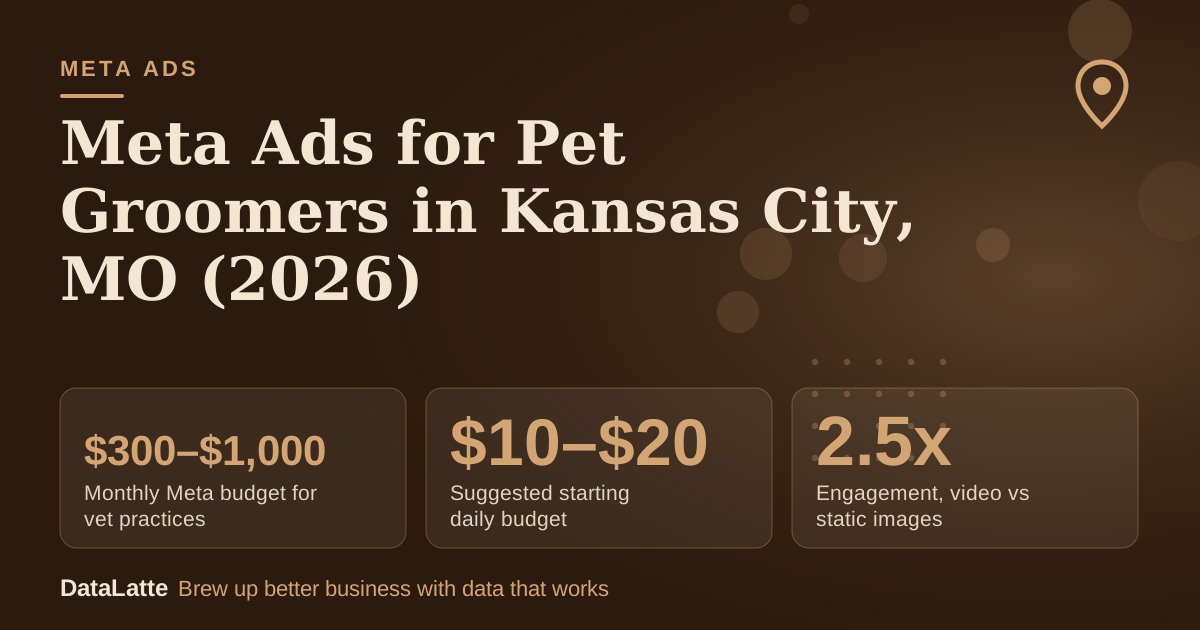
Meta Ads on Facebook and Instagram can bring bookings to a Kansas City, MO pet groomer when the budget, audience and tracking are set before launch. Vendor estimates put a monthly Meta budget for veterinary practices at $300 to $1,000, and one groomer guide suggests starting at $10 to $20 a day. This guide covers what to spend, which placements to use, who to target, and how to measure bookings in 2026.
Assumption→
Monthly Meta budget for vet practices
Adwave vendor estimate
→
Suggested starting daily budget
Barklead groomer guide (secondary)
↑
Engagement, video vs static images
Meta 2025 report as cited by Adwave
→
Daily active people across Meta apps
Adwave vendor page
See Sources at the end of the article. Cards marked Assumption are examples, not results.
Vendor estimates give a few planning points.
Adwave's veterinary guide says most veterinary practices can run effective Meta campaigns for $300 to $1,000 per month, and its
channel comparison lists a standalone Meta buy at a similar $300 to $1,000 per month. For broader local businesses, its
restaurant guide estimates $500 to $2,000 per month for single-location restaurants.
A groomer-focused guide from
Barklead recommends starting with $10 to $20 per day, then increasing spend once high-performing ads are identified. That approach suits a Kansas City groomer testing one or two offers before committing a larger monthly figure.
No Kansas City-specific CPM figure is published in the sources used here. Check live delivery estimates in Ads Manager for your own market. Adwave's restaurant comparison lists 1 to 4 weeks to results for Meta, so judge a test campaign over several weeks rather than days.
Instagram and Facebook run through the same system.
Adwave explains that Instagram ads run through Meta Ads Manager because Instagram is owned by Meta, and one campaign can run on Instagram, Facebook, or both.
Adobe describes Ads Manager as a central point for running ads across both apps. Starting with one campaign placed on both gives you comparison data without managing two separate accounts.
Video deserves priority. According to Meta's 2025 Creative Best Practices report, as cited by
Adwave, short-form video generates 2.5 times more engagement than static images on Facebook and Instagram. For a groomer, that means short clips of a real dog before and after a groom, filmed in your own shop or van.
Reels work best when they are unpolished. The same format logic is covered in
Instagram Reels marketing for fitness studios, and the
pet groomers' Instagram guide covers content planning for organic posts that support paid ads.
Barklead suggests targeting pet owners aged 25 to 60 who are likely to have disposable income, and users within a 10 to 15 mile radius of the grooming location. Both are one vendor's starting points, not fixed rules. A mobile groomer or a shop with a small service area may need a tighter radius, so adjust using the reach and booking data your campaign produces.
Past clients belong in a separate audience.
Adwave lists a typical retargeting CPM on Meta of $5 to $15, which is a useful planning band when you build a campaign aimed only at people who already visited your site or engaged with your posts. Retargeting suits a service that clients repeat every few weeks, though the exact interval depends on the coat type and service.
Meta's apps are large enough that targeting, not reach, is the constraint.
Adwave reports that Meta's apps reach an average of 3.56 billion daily active people, so a narrow local audience can still be a large pool of pet owners.
The table below is an illustrative model, not a forecast. Cost per click of $1 to $3 comes from
Adwave's cost guide, which gives typical Meta costs of $1 to $3 per click. The middle $2 figure and the 5% click-to-booking rate are assumptions for this example, and so is the $60 average ticket.
| Monthly budget (assumption) | Clicks at $3 per click | Clicks at $1 per click | Bookings at $2 per click and 5% conversion (assumption) | Revenue at $60 average ticket (assumption) |
|---|
| $300 | 100 | 300 | about 8 | about $450 |
| $600 | 200 | 600 | 15 | $900 |
| $1,000 | 333 | 1,000 | 25 | $1,500 |
Revenue is not profit. Subtract ad spend, product costs and your own time before deciding whether a campaign paid off. Replace the 5% and $60 assumptions with your real booking rate and average ticket after the first month of data.
Tracking matters more than impressions. A campaign can produce many clicks and few bookings, so set up measurement before spending.
- Install the Meta Pixel on your website and confirm it fires on the booking confirmation page.
- Configure a conversion event for booking form submissions so Ads Manager optimises for bookings, not clicks.
- Add UTM parameters to every ad URL so Google Analytics can show Meta traffic separately.
- Compare cost per booking across campaigns each week, and pause any ad set that spends without producing bookings.
Without these steps, decisions rest on reach figures instead of appointments.
Meta ads reach people who are scrolling, while local search reaches people who already want a groomer. Both can feed the same booking page. A
Marketing 360 case study describes a mobile pet groomer that chose Facebook and Google as its advertising channels, which reflects how many groomers combine social and search. For the search side, see
local SEO for pet groomers in Kansas City.
Start with the platform that matches how clients find you. If bookings come mostly from search, improve your local listing first. If they come from social content, put the Meta budget behind the best-performing videos.
FAQ
Vendor estimates vary. Adwave's veterinary guide cites $300 to $1,000 per month for effective campaigns, and a groomer guide from Barklead suggests $10 to $20 per day to start. Begin at the level you can sustain for several weeks, then adjust based on cost per booking.
Should I run Instagram and Facebook ads separately?
Not necessarily. Adwave explains that one campaign can run on Instagram, Facebook, or both through Meta Ads Manager. Starting with one combined campaign makes testing simpler, and you can separate placements later if the data shows a difference.
Who should a dog grooming Facebook ad target?
Barklead suggests pet owners aged 25 to 60 who are likely to have disposable income, within a 10 to 15 mile radius. Use these as starting settings and narrow the radius if your service area is small.
Judge campaigns by bookings and cost per booking, not impressions or reach. Set up the Meta Pixel, a booking conversion event and UTM parameters before launch so Ads Manager and Google Analytics both show appointment outcomes.
Sources
Ready to build a Meta Ads plan for your grooming business? Start with a
free audit, or see how
Google Ads management can cover the search side of your pipeline.
Free for local businesses
Want this applied to your business?
I'll review your Google presence, local SEO, and ad accounts — and send you a specific action plan within 48 hours. No pitch, no pressure.