November 13, 2026·Nataliia Rumiantsewa· 8 min read All posts
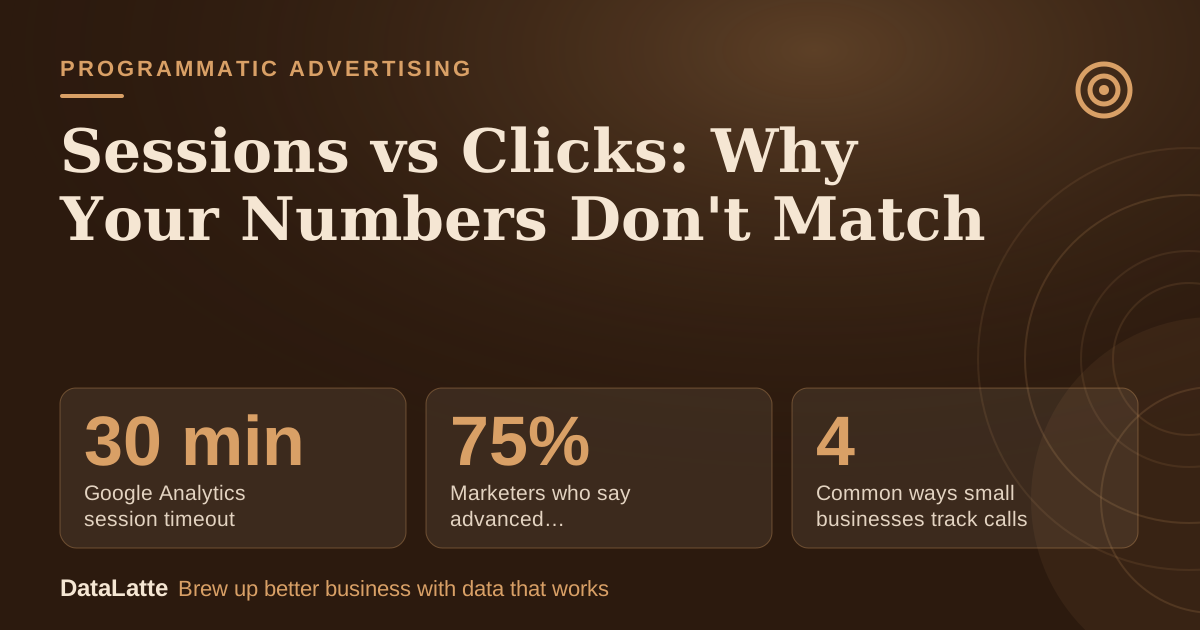
Ad clicks and analytics sessions differ because they count different things. A click is logged by the ad platform each time someone taps an ad. A session is a block of activity on the website that ends after a period of inactivity. Google Analytics ends a session after 30 minutes of inactivity, so two clicks from one person inside that window become one session (StackAdapt, secondary). A modest gap is normal. The job is to explain it.
30 min→
Google Analytics session timeout
StackAdapt (secondary)
Assumption
1→
Sessions logged for two ad clicks inside 30 minutes
StackAdapt example (secondary)
75%↓
Marketers who say advanced measurement falls short
IAB research, cited by StackAdapt (secondary)
4→
Common ways small businesses track calls
Adwave (secondary)
See Sources at the end of the article. Cards marked Assumption are examples, not results.
What is the difference between a click and a session?
A click is an event recorded by the ad platform at the moment of the tap. A session is a grouping built by the analytics tool. It starts when a visitor lands and closes after inactivity. The two systems run separately, with separate rules, so the same visit can produce different counts in each.
The StackAdapt example is simple. A user clicks an ad, goes back, and clicks the ad again. The ad platform registers two clicks, while Analytics registers only one session (StackAdapt, secondary). Nothing is broken in that case. Each tool is following its own definition.
The timeout also varies by tool. The same source notes that sessions typically time out anywhere between 30 minutes and two hours, depending on the platform. A report from one tool may therefore not line up with a report from another, even before ads enter the picture.
For a small site, the practical takeaway is to compare like with like. Check which tool produced each number and what that tool counts as one unit. Setup basics for the analytics side are covered in the Google Analytics 4 guide for small business.
Which reasons explain the gap between clicks and sessions?
Several mechanisms can push the two numbers apart. The table below lists the ones that are documented in the material cited in this article, plus one row for causes that are often mentioned but not quantified.
Reason for the gap
What happens
Usually higher number
Documented?
Repeat clicks inside the timeout
Two taps by one person within 30 minutes become one session in Google Analytics
The last row matters. No figure is given here for how many visits bots, slow loading or consent choices remove. The platform's click reports, the analytics acquisition report and the site's speed tools are the places to look for real numbers. Guessing a percentage would only create a new mismatch.
Why do click-through and conversion rates disagree between tools?
Rates inherit the gap. Click-through rate is calculated as clicks divided by impressions, times 100. Conversion rate is conversions divided by clicks, times 100 (Adwave, secondary). Notice that conversion rate uses clicks as its base.
If an analytics dashboard divides conversions by sessions instead, the result will differ from the ad platform's figure even when both tools count conversions correctly. The denominator changed, not the outcome.
A second source of disagreement is the conversion event itself. One tool may count a booking form submission, another a phone tap, another a completed call. Each is a legitimate conversion, but they are not interchangeable.
A reasonable approach for a small business is to name one primary conversion, write down the denominator used in each report, and compare rates only when both reports use the same one. Everything else is directional.
The same logic applies to channels beyond search. Streaming and connected TV campaigns often send viewers to a site later, not by click, which is why OTT advertising for local business is usually judged on more than click counts.
How do phone calls and TV change the count?
For many local businesses, the most valuable action is a call, and calls break the click-to-session model in two ways.
First, tapping a phone number on a mobile page is a click event, but it is not a conversation. Event-level tracking of tel: link clicks measures intent to call, not an actual connected call (Adwave, secondary). A groomer who sees 10 taps may have fewer than 10 real calls.
Second, TV works differently from digital. There is no click trail, no form fill and no browser session to stitch together, so the phone number itself is the signal (Adwave, secondary). A viewer might call or search later without producing anything that links back to the ad.
Adwave lists four common approaches to tracking calls: static numbers, dedicated tracking numbers, dynamic number insertion and website-level event tagging. Dynamic number insertion swaps the on-site phone number based on the visitor's source. Pricing usually comes per number, per minute, per call or as a platform tier, and the page gives no specific prices.
Call recording brings consent rules, especially across state lines or where consent rules are stricter. For streaming budgets and what to expect from them, see is CTV advertising worth it on a small budget.
What does a worked example look like for a pet groomer?
All inputs below are assumptions, chosen to show the arithmetic. They are not benchmarks.
Input (assumption)
Value
Search ad spend for the week
$300
Clicks in the ad platform
120
Sessions attributed to the ad in analytics
96
Phone number taps
10
Connected calls logged by a tracking number
6
Booking form submissions
7
The click-to-session gap is 120 minus 96, which is 24 clicks, or 20% of clicks. Cost per click is $300 divided by 120, which is $2.50. Cost per session is $300 divided by 96, which is $3.125.
Next, assume 10 of the 24 missing clicks were repeat taps from the same people inside 30 minutes (assumption). By the one-session rule described by StackAdapt, those would collapse. That leaves 14 clicks, about 11.7% of the total, still unexplained. Those 14 are the ones worth investigating.
Conversion rate on the ad platform's base is 7 divided by 120, about 5.8%. On the sessions base it is 7 divided by 96, about 7.3%. Neither is wrong. They answer different questions.
Phone intent is similar. Ten taps and six connected calls mean four taps did not turn into a call, which is a separate leak from the click gap.
How can a small site reconcile the numbers week by week?
Adwave recommends one weekly check-in and one monthly review for a small-business social analytics routine (Adwave, secondary). The same rhythm can be borrowed for ad reconciliation. The calendar below is a suggested layout built on that cadence and on Adwave's call-tracking launch checklist.
Week
Task
Output
Week 1
Write down the definitions: which tool counts clicks, which counts sessions, the timeout setting, and the one primary conversion
A one-page measurement note
Week 1
Verify analytics events fire on tel: link taps, and confirm call forwarding works
Test log with dates
Week 2
Load the dynamic number insertion script on every major page, if call tracking is used, and check that CRM fields capture source and outcome
Confirmed call-tracking setup
Week 2
First weekly check-in: record clicks, sessions, taps, calls, forms
Baseline gap percentage
Week 3
Weekly check-in; compare the gap with the baseline and look for repeat-click patterns
Gap trend
Week 4
Monthly review: compute cost per click, cost per session, cost per qualified call
Summary against ad spend
The checklist items for week 2 follow the launch list in the call-tracking article: confirm forwarding, load the script on every major page, verify analytics events on tel clicks, and make sure CRM fields capture source and outcome.
Avoid changing several settings at once. If the gap moves after a single change, the cause is clear.
When does the gap matter, and what should decide the budget?
A stable gap is usually harmless. A gap that suddenly widens is worth a check, because it can mean a broken tag, a changed landing page or a new tracking script that slowed loading. This article gives no threshold for "too big," since the cited material does not provide one. Compare against the business's own baseline from the weekly check-ins instead.
Counting alone also cannot answer whether ads caused sales. Propensity to convert is not incrementality, because someone can be very likely to convert even if the ads made no difference (StackAdapt, secondary).
The same source suggests marketing mix modeling for higher-level planning and budget allocation over time, especially when user-level tracking is limited. It suggests multi-touch attribution for directional optimization, treated as less definitive on causality. It reports that 52% of US brand and agency marketers use incrementality experiments, citing eMarketer.
IAB research cited there says up to 75% of marketers believe leading advanced measurement approaches fall short of core needs. In other words, imperfect measurement is the norm, not a sign of a mistake.
For a fitness studio, a simple lift check such as new trial sign-ups before and after a campaign window is often more telling than a click count. Format details for that audience are in CTV ads for fitness studios. Platforms differ in what they report, so Roku ads for local business is a useful read before comparing numbers across channels.
FAQ
Is it normal for clicks to be higher than sessions?
Yes. The ad platform logs every tap, while Google Analytics folds activity into one session until 30 minutes of inactivity have passed. Two clicks within that window produce two clicks and one session in the StackAdapt example. A gap in the direction of more clicks than sessions is expected, and the size of it is what to track over time.
Can sessions ever be higher than clicks?
The cited material does not cover that case. Sessions can include visits that did not come from a paid click, so a report must be filtered to the paid source before comparing. If sessions from the ad source still exceed clicks, check the tagging and the date ranges, and ask the ad platform or analytics provider for an explanation.
Do bots and consent banners explain the missing sessions?
They are commonly suggested causes, but the material cited here gives no numbers for them. Look at the platform's own click reports, the analytics traffic quality views and the page speed results. Treat any single explanation as unconfirmed until the site's own data supports it.
Does a phone number tap count as a conversion?
It counts as intent. A tel: link click measures intent to call, not an actual connected call. For real call counts, Adwave describes dedicated tracking numbers and dynamic number insertion. Reporting taps and connected calls as separate lines keeps the totals honest.
Local marketing strategist with 10+ years at global agencies — OMD, Dentsu, GroupM, and BBDO. Now helping small businesses get the same data-driven edge. Based in Europe, working with clients in the US, UK, Australia, and beyond.