View-Through vs Click-Through Conversions Explained
November 13, 2026·Nataliia Rumiantsewa· 9 min read All posts
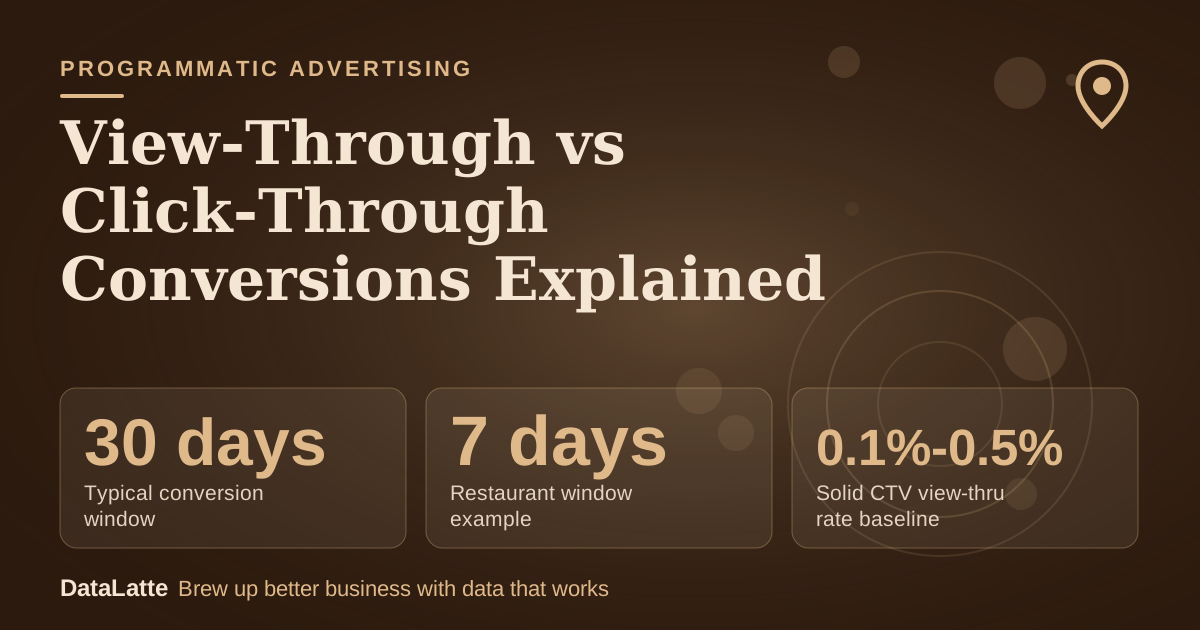
A click-through conversion is a booking, purchase or signup that follows a click on an ad. A view-through conversion follows an ad that was shown but not clicked, and it is credited only if it lands inside the attribution window, which StackAdapt (secondary) describes as typically 30 days. Click-through is the more direct signal. View-through is a correlation inside a timer. Report the two separately, and compare the total against a baseline before trusting it.
30 days→
Typical conversion window
StackAdapt, 2021 (secondary)
Assumption
7 days→
Restaurant window example
Adwave, 2026 (secondary)
0.1%-0.5%→
Solid CTV view-thru rate baseline
Adwave (secondary)
40-70%↓
Claimed CTV under-reporting
ATTN Agency, unsourced claim (secondary)
See Sources at the end of the article. Cards marked Assumption are examples, not results.
What is the difference between view-through and click-through conversions?
A click-through conversion has a simple chain: someone clicks an ad, then converts as a direct result of that click. The clock starts at the click. StackAdapt's explainer (secondary) gives examples of a conversion: booking a test drive after clicking a 300x600 banner, or downloading an eBook after seeing a native ad.
A view-through conversion has a weaker chain. Per the same source, it happens when someone is served an ad for the first time, does not click, and converts later. Adwave (secondary) describes the typical outcome as a viewer who later visits the website or buys something.
The practical difference is evidence. A click leaves a trail from ad to action. A view-through credit only says an ad was shown before an action happened. Other things may have caused the action: a Google search, a friend's recommendation, a walk past the storefront.
That does not make view-through worthless. Streaming TV screens cannot be clicked like a phone, so clicks alone would miss most of the effect. It means the number needs context.
What do the main view-through metrics mean, and where do they mislead?
Several terms sound alike and measure different things. The table below puts each metric next to what the sources say it means and the main risk when reading it.
Metric
What it means
Risk when reading it
Click-through conversion
Conversion after a click on the ad, clock starting at the click (StackAdapt)
Misses people who saw the ad and acted later without clicking
View-through conversion
Ad served, not clicked, conversion later inside the window (StackAdapt)
May credit the ad for an action that would have happened anyway
View-thru rate, conversion-based
View-through conversions divided by impressions, times 100 (Adwave)
Shares a name with a different formula
View-through rate, completion-based
Completed views divided by measurable impressions, times 100 (Adwave)
Measures finishing the ad, not taking action
Video completion rate
Share of people who started the ad and watched to the end (Adwave)
Different denominator than the completion-based rate above
Viewability
Whether the ad was in a position a human could see (Adwave)
An ad can be served and counted without being seen
Attribution window
A stopwatch that starts when someone sees the ad; conversions before it expires can be credited (Adwave)
Longer windows produce more credited conversions
The naming clash matters. One Adwave guide (secondary) calls 15% to 35% a great view-through rate for streaming TV, using a completed-views formula. Another Adwave page (secondary) calls 0.1% to 0.5% a solid baseline, using a conversions formula. Always ask which formula a report uses.
How long should the attribution window be?
StackAdapt's guide (secondary), dated 2021, says a conversion window is typically 30 days and that its DSP defaults to 30 days for both view-through and click-through. It adds that the longer the window, the more conversions advertisers typically see. That is a reporting effect, not proof of better results.
Other sources give a range. Adwave suggests a 7-day window for a local restaurant and 30 days or longer for a realtor. The ATTN Agency guide (secondary) suggests 14 to 30 days for CTV view-through, lists 14 days as a primary window for beauty and skincare, and 21 days for apparel. The guide also claims a 28-day extended window captures 85% or more of beauty conversions.
No source here sets a window for coffee shops, salons, pet groomers or studios. The closest documented match for a coffee shop is the restaurant example, which suggests a short window. For a salon, groomer or studio, a decision that takes more than a week argues for a longer one. That is reasoning, not a benchmark.
Pick one window before launch and keep it fixed so week-to-week comparisons stay honest.
How should view-through be read for streaming, display and social ads?
Streaming TV is where view-through carries the most weight, because viewers rarely click. Adwave's page (secondary) says completion rates for non-skippable CTV ads often exceed 95%, without naming a source, and notes that platforms often keep view-through data under wraps. A high completion rate therefore says little about whether anyone acted. For platform and format differences, see CTV vs OTT advertising explained.
Display and social ads sit in between. The same page says most big digital platforms, such as Facebook and YouTube, offer some way to track view-throughs. Those platforms also record clicks, so both columns can be filled in. Read the click-through column first, then use view-through as supporting context.
Newer interactive CTV formats may shift the balance toward measurable actions. A QR code on screen produces a scan that can be tracked, which is closer to a click. The new CTV ad formats guide covers those.
Direct mail follows the same logic. StackAdapt's direct mail page (secondary) measures view-through as conversions after a piece is delivered, and click-through as conversions after a QR scan or custom URL visit.
What goes wrong with view-through numbers on a small budget?
Several problems stack up at small scale.
Inflated credit. A 30-day default will credit an ad for any signup in the month after delivery, including people who were already planning to visit. Adwave's own definition, someone who saw an ad and "looked you up later," also describes a regular customer who happened to see it.
Under-reporting claims. The ATTN guide asserts that platform reporting often shows 40% to 70% fewer CTV conversions than reality. The claim is unsourced and comes from an agency selling measurement, so treat it as a reason to check, not a correction factor. Inflation and under-reporting can both be true, which is why a single platform report cannot settle the question.
Tests out of reach. The same guide's geo-holdout design calls for 20 or more matched market pairs, roughly $100K per month in spend, and 6 to 12 weeks. Its marketing mix modeling needs 2 or more years of daily sales data. Neither fits a single-location shop.
Tiny counts. With 10 to 20 conversions a month, one extra booking moves cost per conversion noticeably. Read trends over several weeks, not single days. For budget context, see is CTV advertising worth it on a small budget.
What does a worked example look like for a fitness studio?
The figures below are all assumptions, built to show the arithmetic. They are not benchmarks. Studio-specific channel notes are in CTV ads for fitness studios, and actual rates are in the CTV CPM data.
Inputs (all assumptions):
Impressions over 4 weeks: 60,000
CPM: $25, so spend is 60 x $25 = $1,500
Attribution window: 14 days
Click-through trial signups: 6
View-through trial signups: 14
View-through website visits: 150
Trial signups in the previous 4 weeks without ads, same area: 9
Reading the results:
Reported conversions: 6 + 14 = 20, so cost per reported conversion is $1,500 / 20 = $75.
Click-through only: $1,500 / 6 = $250 per signup. This is the strictest and highest figure.
View-thru rate using Adwave's formula: (150 / 60,000) x 100 = 0.25%, inside the 0.1% to 0.5% baseline cited earlier.
Baseline-adjusted: 20 - 9 = 11 extra signups, so $1,500 / 11 is about $136 per extra signup.
The honest range is $75 to $250, with roughly $136 as a middle estimate. The caveat is that the baseline period may differ because of seasonality, a promotion or a new class schedule. The adjusted figure is a sanity check, not proof.
What week-by-week checklist keeps the reading honest?
This six-week calendar fits a single campaign. It uses only checks that need no special tooling beyond conversion tracking, which Google Analytics 4 for small business covers.
Week
Task
What to record
Before launch
Choose the attribution window and write it down; confirm conversion tracking fires on the booking or signup page
Window length; test conversion visible
Before launch
Count signups, calls or bookings from the prior 4 weeks
Baseline number
1
Launch; check impressions are delivering and the page loads from the ad link
Impressions, clicks
2
Pull click-through and view-through conversions separately; ask which view-through-rate formula the report uses
Two conversion counts; formula named
3
Compare total signups against baseline pace; note holidays, promotions or weather
Signups versus baseline
4
Calculate cost per click-through conversion and cost per reported conversion
Two cost figures
5
Ask staff how new customers say they found the business
Tally of answers
6
Compare the reported total, baseline lift and staff tally; decide whether to extend, change creative or pause
One-page summary
If the platform total rises while baseline signups and staff answers stay flat, the view-through credit is probably overstated. If all three move together, the ads are more likely contributing.
Creative also affects what shows up in the reports. Adwave's guide says viewers give an ad less than three seconds before attention wanders, and that 15-second ads often see the best completion rates.
FAQ
Can view-through conversions be trusted?
They can be used, with limits. A view-through conversion only shows that an ad was served before an action, inside a timer. Compare the total with a pre-campaign baseline and ask customers how they heard about the business. If those signals line up with the platform report, the number is more credible.
What is a good view-through rate for a local business?
No single number applies. Adwave states that a good rate depends on industry and where ads run. Its conversion-based baseline is 0.1% to 0.5% for most CTV campaigns, while its completion-based guide calls 15% to 35% great for streaming TV. Confirm which formula a vendor reports before comparing.
Does a longer attribution window always help?
A longer window produces more credited conversions, according to StackAdapt, but that increases the chance of crediting actions the ad did not cause. For short-cycle purchases such as coffee, a shorter window such as the 7 days Adwave suggests for restaurants is easier to defend. For longer decisions, extend and compare against baseline.
Do view-through and click-through apply to direct mail?
Yes, in StackAdapt's programmatic direct mail setup. View-through is measured by conversions after delivery, and click-through by conversions after a QR code scan or custom URL visit. The same caution applies: delivery followed by a purchase is not proof the mailer caused it.
For a second opinion on how current ad reports are being read, request a free audit.
Local marketing strategist with 10+ years at global agencies — OMD, Dentsu, GroupM, and BBDO. Now helping small businesses get the same data-driven edge. Based in Europe, working with clients in the US, UK, Australia, and beyond.