November 13, 2026·Nataliia Rumiantsewa· 8 min read All posts
Consultative selling means asking about a customer's situation first, then recommending the service that fits what they said. For a salon, pet groomer, or fitness studio, it is a short structured conversation, not a months-long sales cycle. The method runs in four stages: open, discover, recommend, follow up. Each stage has a few questions that turn a price inquiry into a booking matched to a real need.
Does consultative selling fit low-priced services?
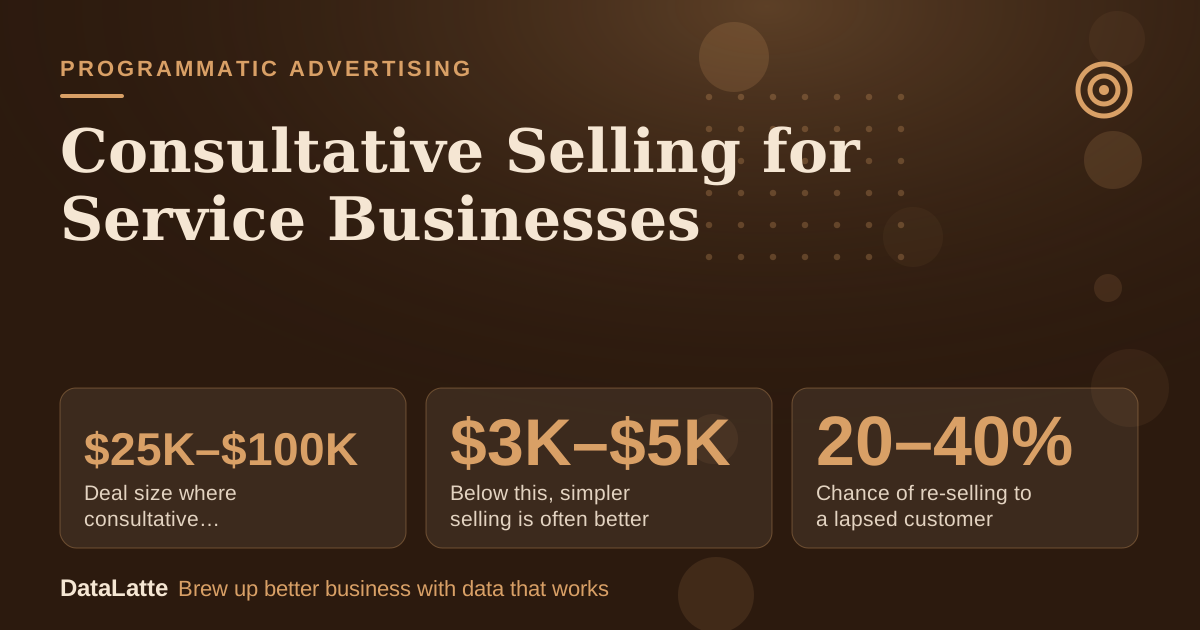
Most published guidance on consultative selling is written for large deals. One guide, cited by Adwave, places the range where the approach works best at roughly $25K to $100K, with sales cycles of 3 to 6 months (Adwave, secondary). The same page says transactions under $3K to $5K are often better served through self-service or a simplified motion.
A haircut, a groom, or a drop-in class sits far below that line. Discovery calls and written proposals would be excessive there. The part worth keeping is the core habit: understand the problem before naming a price. A simplified version keeps that habit and drops the paperwork.
Higher-ticket offers can justify more structure. Bridal hair packages, multi-month training programs, and recurring grooming plans involve comparison and a decision that may take days. For those, a fuller consultation and a written recommendation make sense. The dollar thresholds above describe business-to-business deals, so they work as a rough guide, not a rule for local services.
$25K–$100K→
Deal size where consultative selling fits best
Prospeo guide via Adwave (secondary)
$3K–$5K↓
Below this, simpler selling is often better
Prospeo guide via Adwave (secondary)
20–40%↑
Chance of re-selling to a lapsed customer
Marketing Metrics via Propello (secondary)
5–20%→
Chance of selling to a cold prospect
Same Propello article, no source named (secondary)
See Sources at the end of the article. Cards marked Assumption are examples, not results.
How should a service consultation be structured?
Four stages cover most service businesses. The names matter less than the order: understanding comes before recommending, and the follow-up is planned before the customer leaves.
Open. Tell the customer what the consultation covers and roughly how long it takes. This lowers the sense of being sold to and signals that questions are coming.
Discover. Ask about the goal, the history, the constraints, and the timeline. The aim is to hear the problem in the customer's own words, because those words are reused later.
Recommend. Restate what was heard, present one primary option (and at most one alternative), and connect the price to the outcome the customer described.
Follow up. Agree on the next appointment, get permission for reminders, and set a plan for customers who go quiet.
The same skeleton works in person, by phone, and in chat. Only the length of each stage changes.
Which questions work at each stage?
Open questions beat yes-or-no questions during discovery, because they surface details a price list never captures. The table below gives three questions per stage, with examples of what each answer reveals across salons, groomers, and studios.
Stage
Question
What the answer reveals
Open
What brings you in today?
The stated goal, in the customer's words
Open
Has anything worked or gone wrong before?
Past experience and likely objections
Open
Is a date or event driving this?
Urgency and timeline
Discover
What does a normal week look like for you?
Upkeep time for a color, a dog's coat, or gym schedule
Discover
What bothers you most about the current situation?
The real problem, worded by the customer
Discover
What would a great result look like in a month?
The success measure to tie the price to
Recommend
Here is what was heard. Is that right?
Confirmation, or a correction before any pitch
Recommend
Of these two options, which fits better?
Preference and price sensitivity
Recommend
What would make this a clear yes or no?
Remaining objections and budget range
Follow up
How often would a return visit make sense?
Rebooking cadence
Follow up
Is a reminder by text or email okay?
Permission and preferred channel
Follow up
Who else might want this?
Referral opening
How should the recommendation be presented?
A proposal guide on Adwave's site recommends three parts: restate the buyer's problem in their own language, present the recommended solution as the direct answer to it, and tie the investment to the expected business outcome (Adwave, secondary). For a local service, "business outcome" becomes the customer's own goal, such as a color that lasts between visits or a dog that is comfortable on the table.
Upselling and cross-selling fit naturally here. Upselling persuades a customer to buy a more expensive version of what they are already considering. Cross-selling offers complementary products or services (Funds for Companies, secondary).
The same page describes a bundled offer, a travel package discounted against buying each part separately. A groom plus a coat treatment, or a color plus a gloss, follows the same logic.
The difference between advice and pressure is the discovery answers. An add-on that answers something the customer said reads as a recommendation. An add-on offered with no connection to those answers reads as a pitch.
What does a worked example look like for a pet groomer?
The numbers below are illustrative assumptions, not benchmarks. Replace each with real figures from the business.
Inputs, all assumptions:
30 new-client inquiries a month, generated by local advertising
Monthly ad spend of $900 ($30 a day for 30 days)
Price-only quoting today: 40% of inquiries book a basic groom at $70
With a short consultation: 50% book, and one third of those add a $25 coat treatment
Before the consultation habit: 30 × 40% = 12 bookings, so 12 × $70 = $840 in revenue. Cost per booking is $900 ÷ 12 = $75.
After: 30 × 50% = 15 bookings, so 15 × $70 = $1,050. One third of 15 is 5 add-ons, so 5 × $25 = $125. Revenue is $1,175, and cost per booking falls to $900 ÷ 15 = $60.
The monthly difference in this scenario is $335 from the same ad spend. The improvement comes entirely from assumed conversion rates, so the useful step is to measure the real rates for a month before and after. For budgeting questions on the advertising side, see whether CTV advertising is worth it on a small budget.
How does consultative selling work in chat and after the visit?
The same questions work in text. Adwave's live chat guidance says to put chat on high-intent pages first, such as pages tied to quote requests, bookings, and service decisions, and to ask for service type, timeline, location, or budget range early so the conversation produces a usable lead (Adwave, secondary). It also advises stating response timing honestly instead of implying instant support.
The guide suggests reviewing transcripts weekly and tagging them with pricing, availability, service area, trust concerns, urgency, and competitor comparisons. Those tags show which discovery questions customers keep raising, and booking outcomes can be tracked with Google Analytics 4.
After the visit, a plan for quiet customers matters. A Propello article cites Marketing Metrics at 20–40% for the probability of selling to a lost customer again, against 5–20% for a cold prospect, though the 5–20% figure has no source named (Propello, secondary).
Its channel table starts email win-back at 30–90 days after last activity, around day 45, with 3–5 messages every 3–5 days. SMS comes later, at 60–75 days, with up to 3 messages. The article calls these starting lines, not laws, so a groomer on a six-week cycle and a studio on a monthly membership should adjust them.
List the three most-booked services and the most common add-on for each
Pick four questions from the table and write them on a card at the front desk
Record current inquiry count and booking count as the baseline
Week 2:
Use the four questions with every new inquiry, in person, by phone, and in chat
Note the customer's own words for their problem
Add a chat prompt for service type and timeline on the booking page
Week 3:
Present one primary recommendation and one alternative, using the restate, answer, outcome order
Offer one add-on only when a discovery answer supports it
Ask permission for reminders at checkout
Week 4:
Compare booking rate and add-on rate against the Week 1 baseline
Review chat transcripts and tag them
Schedule a win-back message for customers who have not returned, starting near day 45 and adjusted to the service cycle
FAQ
Is consultative selling the same as upselling?
No. Upselling persuades a customer to buy a more expensive version of something they are already considering, while cross-selling adds complementary services (Funds for Companies, secondary). Consultative selling is the questioning process that decides whether either is relevant. Both can come out of a consultation, but neither is required.
How long should a consultation take?
None of the reviewed sources documents an ideal length for small service businesses. A practical approach is to start with four questions, time a week of real conversations, and trim or extend based on how the booking rate moves.
Can the questions be used in online chat?
Yes. Adwave recommends asking for service type, timeline, location, or budget range early in a chat, and placing chat on pages tied to bookings and quote requests (Adwave, secondary).
When should lapsed customers get a follow-up?
One article advises starting win-back campaigns 30–90 days after last activity, typically around day 45 for email, and calls the cadence a starting line (Propello, secondary). The right timing depends on how often the service is normally repeated.
For a review of how current inquiries are being handled and which ads feed them, request a free audit.
Local marketing strategist with 10+ years at global agencies — OMD, Dentsu, GroupM, and BBDO. Now helping small businesses get the same data-driven edge. Based in Europe, working with clients in the US, UK, Australia, and beyond.