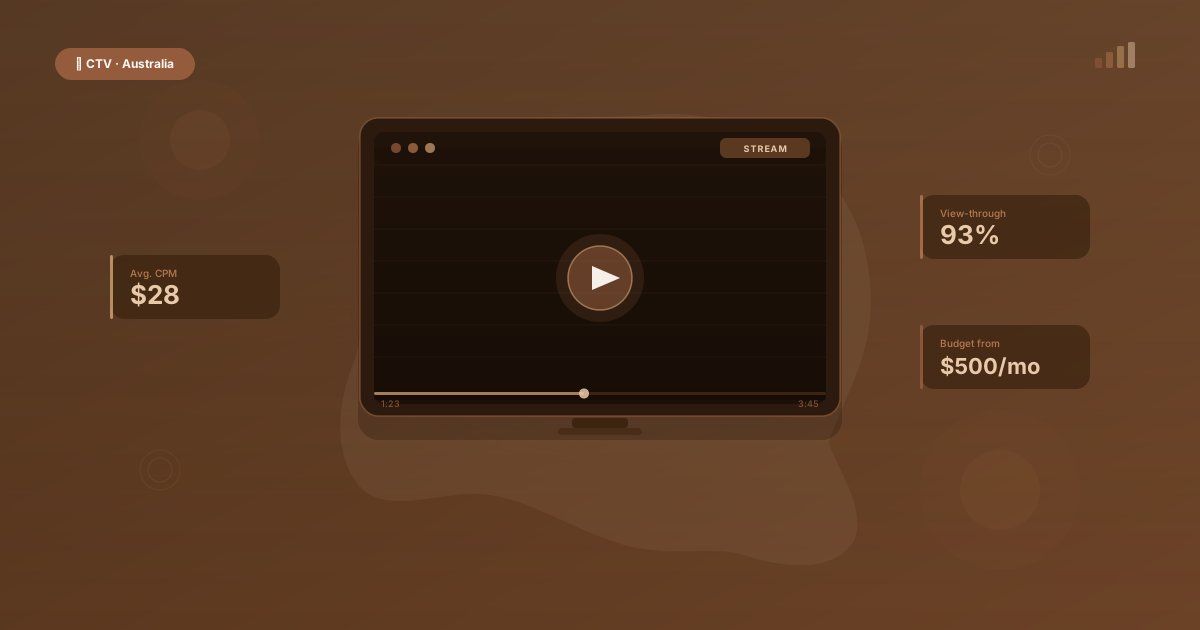
Australia has one of the most dynamic CTV advertising markets in the Asia-Pacific region — and it's uniquely structured to benefit small businesses. Unlike the US market where large national brands dominate streaming inventory, Australia's free-to-air broadcasters have built powerful ad-supported streaming platforms that accept smaller budgets, offer state-level targeting, and deliver premium broadcast-quality audiences. A café in Fitzroy or a hair salon in Bondi can now run TV commercials targeting their exact postcode for less than A$1,500 a month.
Here's what you need to know about advertising on Australian streaming platforms in 2026.
21M↑
Streaming Viewers
Australians watching streaming content regularly
A$22→
Streaming Viewers
Average cost per thousand impressions in AUD
71%↑
Streaming Viewers
Australians reached by broadcaster VOD monthly
2.6hrs↑
Streaming Viewers
Average daily connected TV viewing per adult
Estimates for illustration; actual numbers vary.
The Australian Streaming Landscape in 2026
Australia's CTV ecosystem is dominated by broadcaster-owned VOD (BVOD) platforms — and this is good news for local advertisers. BVOD platforms carry the same ad-load rules as linear TV, meaning ads are non-skippable and reach audiences who are used to commercial breaks.
9Now (Nine Entertainment) is Australia's largest BVOD platform with over 8 million registered users. It streams Nine Network content including NRL, A-Current Affair, and Australian reality programming. CPMs range from A$20–A$35, with premium sports inventory reaching A$50+. 9Now's postcode-level targeting is best-in-class among Australian platforms.
7Plus (Seven Network) reaches 6.5 million registered Australians and streams AFL, Sunrise, and Home and Away alongside catch-up content. CPMs sit at A$18–A$28. 7Plus's audience skews slightly older (35–65) and more suburban — strong for businesses targeting families and established households.
10 Play (Network Ten, owned by Paramount) offers strong entertainment and news content. CPMs are A$15–A$25. 10 Play reaches younger audiences (18–39) better than 7Plus or 9Now, making it relevant for fitness studios and trend-forward salons.
BINGE (Foxtel/News Corp) is Australia's premium SVOD with over 4 million subscribers. Its ad-supported tier, launched in 2024, carries HBO, Foxtel Originals, and international drama. BINGE CPMs are A$28–A$42 — the most expensive in the Australian market — but also the most demographically upscale. High-income households in inner-city Sydney and Melbourne skew heavily to BINGE.
Kayo Sports (also Foxtel) is the dominant sports streaming platform with 1.4 million subscribers. Sports fans are an attractive audience for fitness studios and health-focused businesses. Kayo CPMs range from A$25–A$40.
Stan (Nine Entertainment's SVOD) has limited advertising inventory but is expanding. SBS On Demand is free, ad-supported, and reaches culturally diverse audiences — excellent for businesses in multicultural suburbs of Melbourne, Sydney, or Brisbane.
Amazon Prime Video offers ad-supported viewing in Australia with CPMs around A$18–A$26 and strong purchase-intent data overlays.
State-Level Targeting: A Practical Guide
Australia's state structure maps nearly perfectly to major metro areas, making state-level CTV targeting meaningful for local businesses.
New South Wales (Sydney) is the most competitive and highest-CPM state, particularly for inner-city suburbs. 9Now and BINGE dominate here. A personal trainer in Surry Hills targeting a 5 km radius will face CPMs 15–20% above the national average, but also reach Australia's highest-income consumer base.
Victoria (Melbourne) is the second-largest market and a strong performer for lifestyle categories — cafés, salons, fitness, and pet services all punch above their weight in Melbourne's culture-forward consumer environment. 7Plus performs particularly well in Melbourne's suburban rings.
Queensland (Brisbane/Gold Coast/Sunshine Coast) is experiencing rapid population growth, which means new residents who haven't yet established brand loyalties. CPMs are 10–15% below Sydney rates. 9Now and 7Plus both have strong Queensland reach. The tourism and lifestyle bent of Queensland audiences makes them receptive to café, fitness, and beauty advertising.
Western Australia (Perth) is often underserved by eastern-state advertisers who forget the two-to-three hour time difference. Perth audiences watching CTV in WA prime time (7–10pm AWST) are reached by far fewer advertisers, driving CPMs down to A$14–A$20 on most platforms. For Perth-based small businesses, this is a significant opportunity.
South Australia (Adelaide) offers Australia's lowest CTV CPMs — A$12–A$18 — with a loyal, mid-market audience. Underrated for local business CTV campaigns.
Seasonality: The Reverse Calendar
Australian seasonality is the inverse of the UK and US, which trips up northern-hemisphere-first marketing playbooks. Key planning points:
January–February (peak summer) is Australia's highest foot-traffic period for outdoor-adjacent businesses — cafés with alfresco seating, outdoor fitness studios, beach-adjacent pet groomers. CTV viewership dips during summer evenings but peaks on weekend afternoons when it's too hot to go out.
April–June (Autumn/Early Winter) is the strongest CTV viewing quarter. Audiences settle into indoor entertainment habits. This is the optimal window for fitness studios to run acquisition campaigns before mid-year.
July–September (Winter) mirrors the northern hemisphere's peak CTV season. AFL finals, NRL finals, and international sports drive Kayo and 9Now viewership to annual highs. Hair salons and grooming businesses benefit from the "winter glow-up" mindset.
October–December leads into the summer holiday spending period. Christmas gift campaigns for salons, gym memberships, and pet grooming packages perform strongly in November.
Which Local Businesses Benefit Most
Coffee shops and cafés have a natural CTV advantage in Australia, where café culture is a central social institution. Targeting breakfast and brunch viewing slots (7–9am on 7Plus and 9Now) with a 5 km postcode radius reaches commuters planning their morning stop. A Saturday morning campaign targeting households within 3 km of a café can be highly effective during winter months when people prefer a local café outing over driving further.
Hair salons and beauty businesses should focus on BINGE and 10 Play, which over-index for female 25–44 audiences. The aspirational, entertainment-focused environment of these platforms aligns with the beauty mindset. Running 15-second ads for seasonal treatments (keratin treatments in summer humidity, colour refresh in autumn) drives strong appointment booking intent.
Pet groomers benefit from SBS On Demand's multicultural reach (targeting diverse suburbs) and 7Plus's family-suburban audience. Australia's 69% pet ownership rate means "pet owner" household targeting segments on programmatic DSPs reach enormous local audiences. A pet groomer in Melbourne's eastern suburbs can target dog-owner households specifically within a 6 km radius.
Fitness studios and gyms should plan around Kayo Sports for the fitness-minded audience and 9Now for the January resolution period. February is particularly effective: Australians who made New Year's fitness resolutions in January and then fell off during summer festivities are ripe for a "restart" message in the cooler autumn months.
Targeting Options in the Australian Market
Postcode targeting is available on all major BVOD platforms (9Now, 7Plus, 10 Play) and delivers local precision equivalent to suburb-level geo-fencing. This is the most important targeting lever for small businesses.
Registered user data is uniquely powerful in Australia because BVOD platforms require login to stream. 9Now has 8 million registered accounts with verified age, gender, and postcode. This is declared first-party data — more reliable than cookie-based targeting.
Content category targeting allows placement adjacent to relevant programming. A pet groomer can run ads before animal documentary content on SBS On Demand; a fitness studio can target sports content on Kayo.
Dayparting matters significantly in Australia. Prime viewing is 6–10pm AEST, but afternoon viewing (2–5pm) on weekends has grown substantially. Businesses targeting parents should consider school-hours viewing on weekday afternoons.
ACMA Regulations: The Australian Communications and Media Authority regulates advertising on broadcast and streaming platforms. CTV ads must comply with the Commercial Television Code of Practice on ad load and content standards. For small businesses, this mostly means ensuring your creative meets standard TV production quality minimums — ACMA does not impose additional targeting restrictions beyond GDPR-equivalent privacy rules under the Australian Privacy Act.
Budget Guidance for Australian Small Businesses
Trial campaign: A$600–A$900/month. Runs on 9Now or 7Plus with postcode targeting. Delivers 25,000–40,000 impressions in your local area.
Core campaign: A$1,500–A$3,000/month. Covers one major metro area with frequency capping and creative rotation across two platforms.
Seasonal push: A$3,000–A$6,000 for a 4–6 week burst around peak periods (January fitness, pre-Christmas beauty, winter café season).
The most efficient entry point is 9Now's self-serve platform or working with a programmatic DSP like StackAdapt or Adstream that has Australian inventory integrations. BINGE and Kayo inventory is accessible via Foxtel's advertising arm, which has packages designed for smaller advertisers.
Common Mistakes in the Australian Market
Targeting too broadly by state: "All of NSW" includes rural areas irrelevant to a Sydney business. Always use postcode or suburb-level targeting, not state-level.
Ignoring the time zone complexity: Australia has five time zones. A campaign running on EST daypart settings will miss Perth prime time entirely. Set up separate daypart rules for each state if running nationally.
Using northern hemisphere seasonal timing: Running a "New Year, New You" fitness campaign in January works in Australia too — but a "spring refresh" salon campaign should run in September, not March.
Skipping BVOD in favour of YouTube: YouTube is not CTV. BVOD platforms (9Now, 7Plus) deliver TV-quality, non-skippable environments with premium content adjacency. For brand-building, BVOD significantly outperforms YouTube for small businesses.
Underestimating SBS On Demand: SBS reaches multicultural Australia — a massive, underserved CTV audience in inner-city Melbourne, Sydney, and Brisbane. For businesses in diverse suburbs, SBS CPMs (A$12–A$18) deliver excellent value.
Frequently Asked Questions
What is the minimum spend to run CTV ads in Australia?
Most BVOD platforms accept campaigns from A$500–A$1,000 minimum. Programmatic DSPs like StackAdapt have no fixed minimums above A$500 for Australian CTV inventory.
Do I need a professionally produced TV ad?
Your video must meet broadcast-quality standards (1080p minimum, stereo audio, no pixelation). This doesn't require a production agency — a well-shot smartphone video with professional editing often meets the technical bar. Budget A$500–A$1,500 for a simple 15-second produced ad from a local video production freelancer.
Can I target specific suburbs in Sydney or Melbourne?
Yes. 9Now and 7Plus support postcode-level targeting. You can target individual postcodes (e.g., 3181 for Prahran in Melbourne or 2010 for Surry Hills in Sydney) and exclude postcodes outside your service area.
How do I measure results from CTV for a local business?
Track Google Business Profile views, direct website traffic (look for uplift during campaign flights), phone calls, and booking volumes. Ask new customers how they heard about you. Some programmatic DSPs provide attribution reports correlating CTV impressions with online conversions using IP-to-device matching.
Local marketing strategist with 10+ years at global agencies — OMD, Dentsu, GroupM, and BBDO. Now helping small businesses get the same data-driven edge. Based in Europe, working with clients in the US, UK, Australia, and beyond.