CTV Advertising Indianapolis, IN: Local Guide 2026
July 6, 2026·Nataliia Rumiantsewa· 7 min read All posts
CTV advertising in Indianapolis, IN lets local businesses run video ads on streaming services and target households by ZIP code. The main decision is scope, not whether the channel works. Pick a small geographic area, set a monthly budget you can hold for at least a quarter, and measure brand effects through branded search and direct visits rather than clicks. This guide covers setup, a worked budget with labelled assumptions, and sourced benchmarks for the search and display channels that often run alongside CTV.
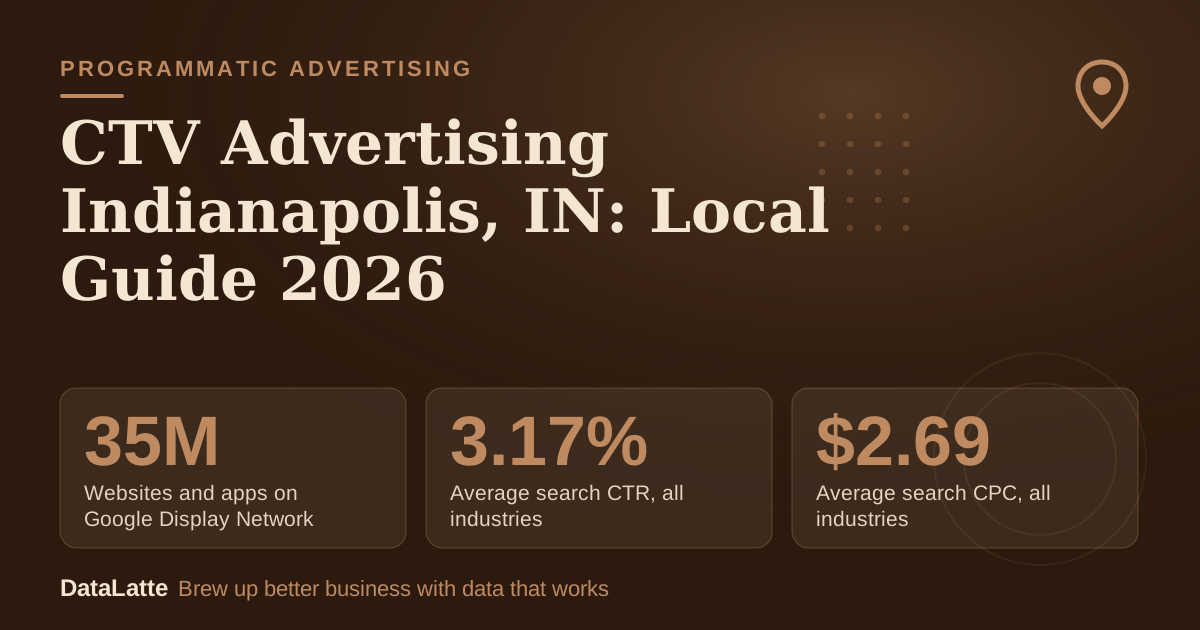
35M→
Websites and apps on Google Display Network
Google support page, primary source
3.17%↑
Average search CTR, all industries
WordStream benchmark, secondary
$2.69→
Average search CPC, all industries
WordStream benchmark, secondary
$0.63→
Average display CPC, all industries
WordStream benchmark, secondary
See Sources at the end of the article. Cards marked Assumption are examples, not results.
How does ZIP-code targeting shape a local CTV campaign?
Most of the value in a local CTV buy comes from geography. Set the target to the ZIP codes where your existing customers already live, or draw a radius that matches your real service area. A studio that draws clients from three suburbs should not pay for impressions across the whole metro.
Hand-picked ZIP codes also let you compare two neighbourhoods inside the same flight. Start with the areas where your best customers already live, then widen only after you see which ones respond.
Demographic filters come second. Age, household income and household composition can narrow the audience, but each filter reduces available inventory and can raise cost. Add them one at a time so you can see which change moved results.
Google's documentation says Display campaigns reach people across 35 million websites and apps, including YouTube and Gmail, so advertisers can extend reach past Search without a separate buying process Google support. Display is not CTV. It runs mostly on websites and apps, not full-screen living-room video. It still raises the same planning question: what does a unit of attention cost in your category?
WordStream's benchmark report puts the all-industry average search cost per click at $2.69 and display cost per click at $0.63 WordStream benchmarks. These are cost-per-click figures, not CTV cost per thousand impressions, so they cannot be compared directly.
Category matters more than the average. The same report lists legal services at $6.75 per search click, more than double the all-industry search average, so check your own category before you set expectations.
What should a local CTV budget look like?
Platform minimums and CPM quotes vary, and the sources for this guide do not publish CTV pricing. The example below therefore uses labelled assumptions. Replace them with real quotes from your platform before committing money.
Assumption inputs:
Monthly budget: $500 (assumption)
Cost per 1,000 impressions (CPM): $20 (assumption)
Average frequency per household per month: 4 impressions (assumption)
Calculation: $500 divided by $20 per 1,000 impressions gives 25,000 impressions per month (assumption-based). At 4 impressions per household, that reaches about 6,250 households in a month (assumption-based). A three-month flight at the same spend yields about 75,000 impressions.
Now test the example against a real quote. If the CPM is $40 instead of $20, the same $500 buys about 12,500 impressions. Either the budget rises or the ZIP footprint shrinks. Decide which before the flight starts.
Which streaming platforms suit a local business?
Several large streaming services sell ad-supported tiers, including Hulu, Peacock, Tubi and Amazon Prime Video. Their audiences differ. Sports-heavy viewing reaches a different household than general entertainment viewing, and a service with purchase-linked data suits a different offer than one without.
Choose by audience fit first. Ask which viewers your customers resemble, then check whether the platform can target those viewers in your ZIP codes. Brand size matters less than targeting accuracy at local scale.
Buying route matters too. Self-serve ad managers suit a first test with a small budget. Demand-side platforms that buy across several streaming sources give more control but usually need a larger commitment. If your customers also shop online, the Amazon ads guide for local businesses covers a parallel channel worth comparing.
How do you set up a CTV campaign step by step?
Work through the steps in order. Each decision narrows the next one, and skipping a step usually means paying for impressions you cannot use.
Step
Decision
Why it matters
1
Define the service area
Sets the ZIP codes or radius
2
Pick the audience filters
One filter at a time keeps tests readable
3
Set the monthly budget
Must hold for at least one quarter
4
Choose a platform route
Self-serve for tests, DSP for scale
5
Write a 15-second spot
Brand first, then the offer and location
6
Set frequency and dayparts
Limits repetition and matches viewing times
7
Log a baseline before launch
Lets you measure lift against it later
Keep the creative simple. A short spot that names the business, shows the service and gives a location or phone number is usually enough for a first flight.
How do you measure a CTV campaign without clicks?
CTV does not produce clicks the way search does. It builds familiarity, which shows up later as searches for your business name, direct visits and customers who mention the ad when asked how they found you.
Track four signals: branded searches for your business name, direct website visits, Google Business Profile views and the answers to a consistent "how did you hear about us?" question. Compare each signal against the baseline you logged before launch, and look at the same weeks in the previous period for seasonal context.
Branded search is also worth watching in paid channels. If you run search ads, the Bing Ads guide for local businesses shows how to read branded traffic across a second search network. Allow a full quarter before judging the result, because brand effects accumulate slowly.
Frequently asked questions
Is CTV advertising worth it for a small local business?
It can be, if the service area is small and the budget can run for at least a quarter. Judge it on brand signals such as branded searches and direct visits, not on clicks, which CTV does not generate in the same way as search.
How much should a first CTV test cost?
The worked example uses $500 per month as an assumption. The real figure depends on the platform's quote, the CPM and the ZIP footprint. Compare the quote with the impressions it buys before you commit.
Do I need to run CTV and Google Ads together?
No, but they work well as a pair. CTV builds awareness in the household and search captures the resulting intent. Run them in the same ZIP codes so you can compare results directly.
What creative should a local CTV ad use?
Use a short spot that establishes the brand early, shows the service or outcome, and ends with a clear location or phone number. Simple messages usually outperform complex stories for local businesses.
Local marketing strategist with 10+ years at global agencies — OMD, Dentsu, GroupM, and BBDO. Now helping small businesses get the same data-driven edge. Based in Europe, working with clients in the US, UK, Australia, and beyond.