Landing Page Conversion for Startups: What to Test
November 14, 2026·Nataliia Rumiantsewa· 9 min read All posts
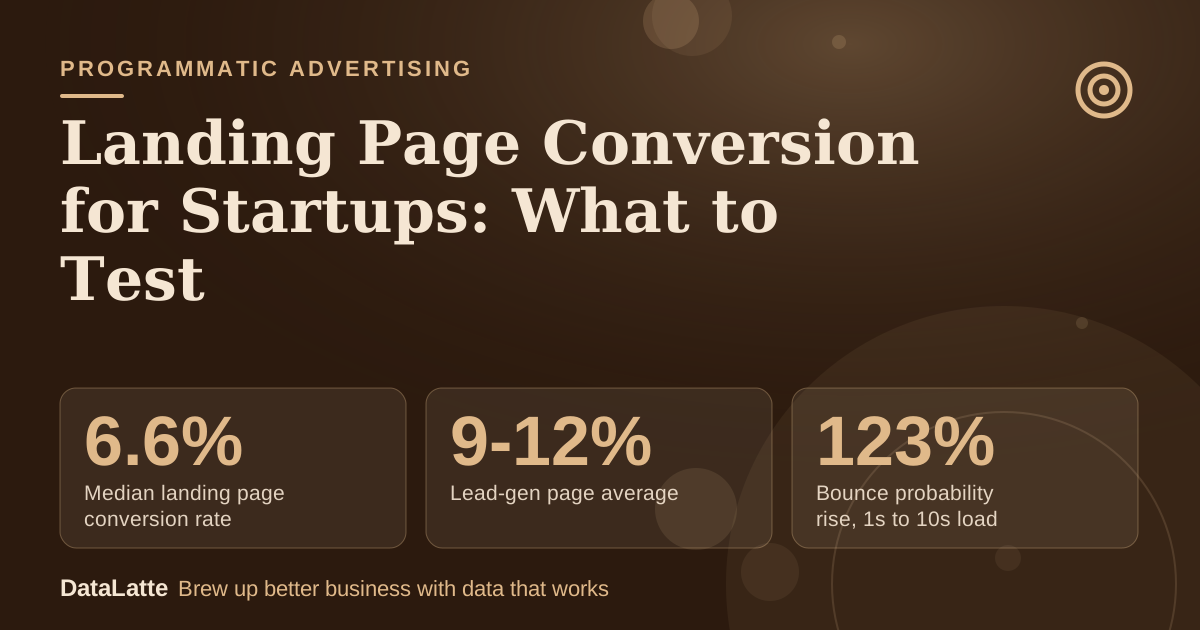
A startup landing page should be tested in this order: tracking first, then form length, proof, page speed, headline, and the call to action. One reported dataset puts the median landing page conversion rate at 6.6%, and lead-generation pages at roughly 9 to 12% (AdWave summary of Unbounce data, secondary). Those are reference points, not promises. The useful number is the startup's own baseline, measured as completed submissions per visitor.
6.6%→
Median landing page conversion rate
Unbounce Q4 2024 via AdWave (secondary)
9-12%→
Lead-gen page average
Benchmark summary via AdWave (secondary)
123%↑
Bounce probability rise, 1s to 10s load
Google mobile analysis via AdWave (secondary)
95%↓
Conversion probability drop, 400 to 6,000 elements
Google mobile analysis via AdWave (secondary)
See Sources at the end of the article. Cards marked Assumption are examples, not results.
What conversion rate should a startup landing page expect?
Conversion rate is the number of conversions divided by the total number of visitors, multiplied by 100 (StackAdapt, secondary). A page with 500 visitors and 25 submissions converts at 5%.
The benchmark data is broad. The Unbounce Q4 2024 dataset covered 41,000 landing pages, 464 million visits, and 57 million conversions, and put the median at 6.6%. Lead-generation pages sat around 9 to 12% on average, and e-commerce product pages around 2 to 5% (AdWave, secondary).
Those figures mix many industries and offers. A salon booking page and a software demo page are not the same thing. Treat the range as a sanity check: a page far below it likely has a fixable problem, while a page inside it still has room to improve against its own history.
Why measure before testing anything?
Traffic is expensive to buy and cheap to waste. A third-party 2024 study cited by StackAdapt found brands spent 13.2% more on digital advertising in 2024 than the year before, yet conversions declined 6.1% year over year (StackAdapt, secondary). More spend does not fix a page that fails to convert.
Tracking decides what a test can prove. A click on a phone number, a connected call, a submitted form, and an attended appointment are different stages, and Google's conversion tools only measure the actions configured for the account (ChiroCandy, secondary).
The simplest start is one metric: completed form submissions, tracked as a conversion event in analytics (AdWave, secondary). Form starts versus completed submissions and device performance can follow once that number is reliable.
Which landing page elements should be tested first?
The order below follows where the sources give the most to work with. Headline and call to action have no sourced benchmark, so they are judged only against the page's own baseline.
Element
What to test
Sourced expectation
Tracking
Completed submissions as a conversion event
Start with one measurement: completed form submissions (secondary)
Form length
Current form versus three or four essential questions
Shorter forms often improve completion; qualification can move to follow-up (secondary)
Proof
Customer photos or reviews placed near the form
Adding user-generated content to pages can increase conversions by up to 74% (secondary, vendor-cited)
Page speed
Load time and number of page elements
Bounce probability rose 123% from one to ten seconds; conversion probability fell 95% from 400 to 6,000 elements (secondary)
Headline
Plain offer statement versus a benefit-led version
No benchmark in the sources; compare against own baseline
Call to action
One action versus several competing actions
No benchmark in the sources; compare against own baseline
Only one row changes per test. The guidance is to change one meaningful element at a time and give it enough time to produce a pattern (AdWave, secondary).
How long should a startup lead form be?
The sources point toward fewer fields at first contact. Lead-gen guidance cited by AdWave says shorter forms often improve completion rates, while multi-step forms and CRM integration can improve qualification by collecting details later (AdWave, secondary).
A starting design is three or four essential questions on the first submission, with deferred details collected on a confirmation page or in a follow-up email (AdWave, secondary).
One caution applies. Baymard Institute found an average of 11.3 fields across 5.1 steps in checkout flows in 2024 and estimated most sites could cut displayed fields by about 20 to 60%. That is checkout data, not lead forms, so it signals direction rather than a target.
The guardrail matters more than the field count. Qualified-lead rate is sales-accepted leads divided by completed submissions, and a field should be removed only when a test shows that rate holds.
Does page speed really affect landing page conversion?
Google's mobile-site performance analysis, as cited by AdWave, found bounce probability increased 123% as load time rose from one second to ten. It also found conversion probability fell 95% as page elements increased from 400 to 6,000 (AdWave, secondary).
Mobile makes this more relevant. One compilation cited by AdWave reports mobile devices at 63.15% of global web traffic (AdWave, secondary). That is a global figure, so a startup should check its own device split before assuming the same ratio.
A speed test is less about the headline and more about removing weight: oversized images, extra widgets, and unused scripts. A practical version is to build a stripped-down copy of the page with fewer elements and compare completed submissions per visitor.
Another claim, that nearly half of visitors never get beyond the primary landing page, comes from third-party landing-page research cited by AdWave. It is a reason to make the first screen carry the offer and the action.
What proof belongs on a startup landing page?
A new business has little history, so proof has to come from early customers. Vendor-cited statistics suggest it is worth testing. Adding user-generated content to website pages can increase conversions by up to 74% (EveryoneSocial), and 79% of consumers report more trust in companies that use it (MedianUG). The Shelf reports UGC drives 29% more web conversions than other content (AdWave, secondary).
All of these are vendor-cited figures, and "up to" is a ceiling, not an expectation.
Permission is the practical trap. A customer tagging a business does not automatically grant broad usage rights for ads, websites, email campaigns, or TV, so written permission should come before a photo goes on the page. A simple request such as "Can you record a 15-second clip about what stood out most?" gives customers something specific to answer.
What does a worked example look like for a fitness studio?
All inputs below are assumptions for a new fitness studio with a free intro class page.
Monthly visitors: 1,000 (assumption)
Current form: seven fields, converting at 4% (assumption)
Variant: four fields, converting at 5% (assumption)
Share of submissions the front desk accepts as real prospects: 60% (assumption)
Accepted prospects who join: 25% (assumption)
First-year revenue per member: $600 (assumption)
Current page: 40 submissions, 24 accepted, 6 members, about $3,600. Variant: 50 submissions, 30 accepted, 7.5 members, about $4,500.
Now the guardrail. If the short form lets in more unqualified leads and acceptance drops to 45% (assumption), the variant yields 22.5 accepted prospects, fewer than the 24 from the original. More submissions would then hide a worse result, which is why the rule is to adopt a variant only when the primary metric improves and quality holds.
Sample size is the second limit. Splitting 1,000 visitors gives 500 per version, so 20 versus 25 submissions is a gap of five. That is thin evidence, so a longer run or a larger change is the better choice.
What does a six-week test calendar look like?
The vendor suggests running a form test for at least a full business cycle, usually a week or more including weekday and weekend traffic, and reserving two to four weeks as a planning window (AdWave, secondary). A six-week plan fits two tests.
Week 1: set up completed submissions as a conversion event, and decide whether phone clicks and booked appointments will be tracked separately.
Week 2: record the baseline (visitors, submissions, form starts, device split) and note the accepted-lead rate from the sales side.
Weeks 3 and 4: run the form test, with one change only, and let it cover weekdays and weekends.
Week 5: read the result against the primary metric and the qualified-lead rate, then adopt or discard the variant.
Week 6: start the second test, such as adding permissioned customer proof near the form, and keep the monthly review going.
Is 6.6% a good conversion rate target for a startup?
It is a reference point, not a target. The 6.6% figure is a median from a Q4 2024 dataset of 41,000 landing pages across many industries (AdWave, secondary). A startup should set its first goal as beating its own measured baseline.
How long should a landing page test run?
Plan for at least a full business cycle, usually a week or more including weekday and weekend traffic. A planning window of two to four weeks is suggested, with the required sample and business cycle deciding whether that is enough (AdWave, secondary).
Should a phone call count as a conversion?
It can, but it is a different stage from a submitted form or an attended appointment. Tools measure only the actions configured, so the choice of what to count shapes every report (ChiroCandy, secondary).
Can customer photos go on a landing page without asking?
No. A customer tagging a business does not automatically grant broad usage rights for ads, websites, email campaigns, or TV, so explicit permission should be collected first (AdWave, secondary).
A landing page test is only as good as the traffic and tracking behind it. For paid search traffic and a review of how the page converts it, request a free audit. If a campaign keeps sending visitors to a page that does not convert, see when to pause an ad campaign.
Local marketing strategist with 10+ years at global agencies — OMD, Dentsu, GroupM, and BBDO. Now helping small businesses get the same data-driven edge. Based in Europe, working with clients in the US, UK, Australia, and beyond.