First 100 Customers on a Startup Budget: 8-Week Plan
November 14, 2026·Nataliia Rumiantsewa· 9 min read All posts
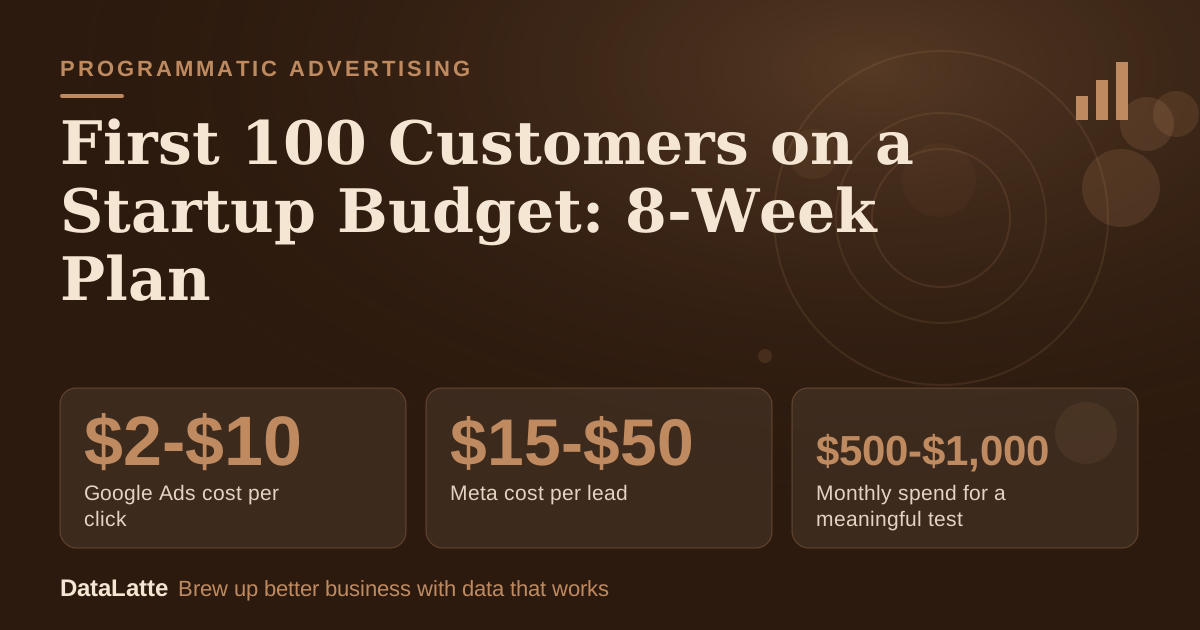
The first 100 customers usually come from a mix of high-intent search, one small paid social test, and free channels such as referrals, local partnerships and email. One vendor guide puts meaningful search or social experiments at around $500-$1,000 a month and advises at least 2-3 months of experimentation before any channel proves reliable (Adwave, secondary). The plan below covers costs, a channel table, an 8-week checklist and a worked example.
$2-$10→
Google Ads cost per click
Most small business categories, Adwave (secondary)
See Sources at the end of the article. Cards marked Assumption are examples, not results.
How much should a startup spend to win its first 100 customers?
Budget tiers from a vendor startup guide give a starting frame. Bootstrap Mode is $0-$1,000 a month, Seed Stage is $1,000-$5,000 a month, and Series A+ is $5,000-$25,000+ a month (Adwave, secondary). A local business opening its doors usually sits in the first or second tier.
Paid channels need enough money to produce a readable result. Another Adwave page says most small businesses need $500 to $2,000 a month per digital channel to see results, and suggests a very early-stage business at $500-$1,000 a month go 100% digital with Google Ads on high-intent keywords (Adwave, secondary).
With only $200 to $500 a month in total, the same page says to concentrate everything on Google Ads.
The startup guide also recommends starting at $10-$50 a day and raising spend only when promising signals appear (Adwave, secondary). Budget planning for a whole local business is covered in the local marketing budget guide.
Which channels fit a startup budget, and how do they compare?
Sourced costs exist for paid search, paid social, connected TV, local profiles and email lead magnets. No cost or conversion figures were found for referrals and partnerships, so the table says so. Speed and effort columns are assumptions, not sourced figures.
Channel
Sourced cost or result
Speed to first customers (assumption)
Effort (assumption)
Google Ads search
$2-$10 per click in most small business categories; $15-$50+ in legal, insurance and HVAC
Days to first clicks
Medium
Meta and Instagram ads
CPM $8-$20; cost per lead $15-$50
Days, but creative needs testing
Medium to high
Retargeting
Under $200 a month at bootstrap stage
Only after traffic exists
Low
Email lead magnet
Single-magnet landing page converted 24.44% vs 8.96% for generic pop-ups
A few weeks
Medium
Local profile and local SEO
$0-$500 a month in tools and time (cleaning-industry estimate)
Connected TV is a stretch for most day-one startups. The cleaning guide positions it for businesses with 12+ months of operating history in a defined area, and the vendor's own suggested range for local awareness is $1,000-$2,500 a month (secondary).
Why does search usually come first?
Search captures people who already want the service. For a startup with no reviews and no brand awareness, that intent is worth more than reach. A vendor budget framework for the earliest stage recommends Google Ads on high-intent keywords as the whole paid plan (Adwave, secondary).
Cost per click ranges from $2 to $10 for most small business categories, and $15 to $50+ in competitive fields such as legal, insurance and HVAC (same source, secondary). Ask a platform or agency for current rates in the exact category and city, because averages hide wide local differences.
Clicks are not customers. Cost per customer equals cost per click divided by the share of clicks that become bookings. One cleaning-industry guide lists Google Ads cost per quote request at $25-$95 for residential cleaning and says most cleaning businesses convert 30-55% of quote requests into first-job bookings (Adwave, secondary).
Those figures are specific to cleaning. They show the two-step math, not a benchmark for a coffee shop or salon. More on turning clicks into leads is in the local lead generation guide.
Where do social ads and retargeting fit?
Social ads suit a startup that sells something visual, such as a groom, a haircut, a latte or a class. They build awareness, though, and rarely convert on the first view. Meta and Instagram ads carry an average CPM of $8 to $20 and a cost per lead of $15 to $50, with no technical monthly minimum (Adwave, secondary).
The cleaning guide notes that first-touch Meta visitors often need 3-7 touches before converting (secondary). That is the case for a small retargeting budget. The startup guide suggests keeping retargeting under $200 a month at bootstrap stage so warm visitors are not lost (Adwave, secondary).
Creative matters more than targeting. A Shopify advertising guide states that the gap between a $20 and an $80 cost per purchase is almost always the ad creative, not the audience, and that user-generated content often outperforms studio-shot content 2-5x (Adwave, secondary). That guide covers online stores, so treat the figures as directional for local services.
Small budgets cannot run the same testing volume as large ones. The same guide recommends 3-5 new creative variants a week and 50-100 conversions before killing a creative. A startup should run fewer variants and judge them over longer windows.
How do email, referrals and local partnerships add customers without ad spend?
Free channels cost time rather than cash, and they compound. An email list is the clearest example. A lead magnet, such as a first-visit checklist or a free consultation guide, gives visitors a reason to leave an address.
Landing page design affects the result. MailerLite data cited by Adwave found a focused single-magnet page converting at 24.44%, against about 8.96% for generic pop-up forms, so visitors were roughly 2.7 times more likely to submit their details (Adwave, secondary). Showit data cited there says problem-specific magnets achieve 30-50% higher opt-in rates than generic "top-10" guides.
After sign-up, a three-email welcome sequence is enough: deliver the resource, help the subscriber use it, then bridge to the next step (same source, secondary).
Local presence is the other low-cost lever. The cleaning guide estimates local SEO and Google Business Profile work at $0-$500 a month in tools and time (secondary). Local partners, such as a neighboring business or a community group, can also supply links and introductions. See the local link building guide.
Referrals and partnerships have no sourced cost or conversion rate, so the worked example below labels them as assumptions.
What does an 8-week plan look like?
The checklist below runs one experiment at a time so results stay readable. Numeric targets in it are assumptions, not benchmarks.
Week 1: choose one offer and one service area; claim and complete the Google Business Profile; set up call, form and booking tracking; write down the maximum acceptable cost per customer.
Week 2: build a single landing page; launch Google Ads on high-intent keywords with a daily cap inside the $10-$50 range; draft a lead magnet.
Week 3: launch the email sign-up and the three-email welcome sequence; start a Meta test with 3-5 creative variants.
Week 4: contact a first batch of local partners (assumption: 10 businesses); review cost per lead and cost per customer by channel.
Week 5: pause the weakest keywords and creatives; add retargeting under $200 a month.
Week 6: add a referral ask at the point of sale or after the first booking; follow up with partners.
Week 7: test one change at a time, such as a new offer headline or landing page form length.
Week 8: compare channels by cost per customer, move budget toward the cheapest one, and decide what to keep testing.
Eight weeks is a first read, not a verdict. The startup guide advises at least 2-3 months of experimentation, and notes that content marketing can take 6-12 months (Adwave, secondary). Low-budget tactics beyond ads are collected in marketing on a shoestring budget.
What does $2,000 a month look like for a pet groomer?
Every input below is an assumption. The $3 click cost and $30 lead cost were chosen inside the sourced ranges of $2-$10 and $15-$50, but they are not predictions for any real market.
Line
Monthly spend (assumption)
Inputs (assumption)
Customers per month (assumption)
Google search
$1,000
$3 per click gives about 333 clicks; 8% of clicks book
27
Meta prospecting
$500
$30 per lead gives about 17 leads; 30% become customers
5
Retargeting
$150
Warm visitors only
4
Email tool and lead magnet
$100
Supports the other lines, no direct count
0
Referral cards and partner perks
$250
Printed cards, small first-visit discount
10
Total
$2,000
46
Cost per customer at steady state, by line:
Google search: $1,000 divided by 27 is about $37.
Meta prospecting: $500 divided by 5 is $100.
Retargeting: $150 divided by 4 is about $38.
Blended: $2,000 divided by 46 is about $43.
Assume month one runs at half pace while campaigns learn, giving about 23 customers. Month two reaches 46, for a running total of 69 at week 8. At 46 a month, the remaining 31 customers arrive around week 11.
If a first groom is $75 (assumption), Google search and retargeting recover their cost on the first visit, while Meta prospecting needs a second visit. That comparison uses revenue, not profit, and ignores service costs. At the week 8 review, the Meta budget would be the first candidate to shrink in this example.
When should spend go up, and when should it stop?
Raise spend only when a channel shows a cost per customer below the ceiling set in week 1. The startup guide recommends increasing budgets only on promising signals, and defines payback period as the time it takes a customer to generate enough revenue to recover acquisition cost (Adwave, secondary).
A channel that misses its ceiling after a fair test needs a decision. Criteria for stopping or pausing are in when to pause an ad campaign.
Targets also need to be realistic. A goal of 100 customers in 30 days on $500 would ignore the sourced ranges above. The realistic sales goals guide explains how to set a goal that matches budget and market.
FAQ
How much does it cost to get the first 100 customers?
No source gives one number, because it depends on category, city and conversion rate. Sourced inputs are $2-$10 per click, $15-$50 per lead on Meta, and $500-$2,000 a month per channel to see results (secondary). In the groomer example, $2,000 a month produced an assumed 46 customers a month, so 100 customers took roughly 11 weeks.
Should a startup start with Google Ads or social ads?
A vendor framework recommends Google Ads on high-intent keywords for a very early-stage business at $500-$1,000 a month. For $200-$500 a month in total, it also says to concentrate on Google Ads (Adwave, secondary). Social ads can follow once search shows what converts.
Is TV advertising realistic for a new business?
Connected TV is advertised from $30 a day on the vendor's platform (secondary). The same vendor's cleaning guide says it is best for businesses with 12+ months of operating history in a defined area. A brand-new local business is usually better served by search and referrals first.
How long before the channels start working?
The startup guide advises at least 2-3 months of experimentation before finding reliable acquisition approaches, and says channels like content marketing can take 6-12 months (secondary). Ask any provider for current rates and timelines for the specific category and location.
A free audit can check which of these channels fits a local startup's budget and market before any money is spent.
Local marketing strategist with 10+ years at global agencies — OMD, Dentsu, GroupM, and BBDO. Now helping small businesses get the same data-driven edge. Based in Europe, working with clients in the US, UK, Australia, and beyond.