November 14, 2026·Nataliia Rumiantsewa· 9 min read All posts
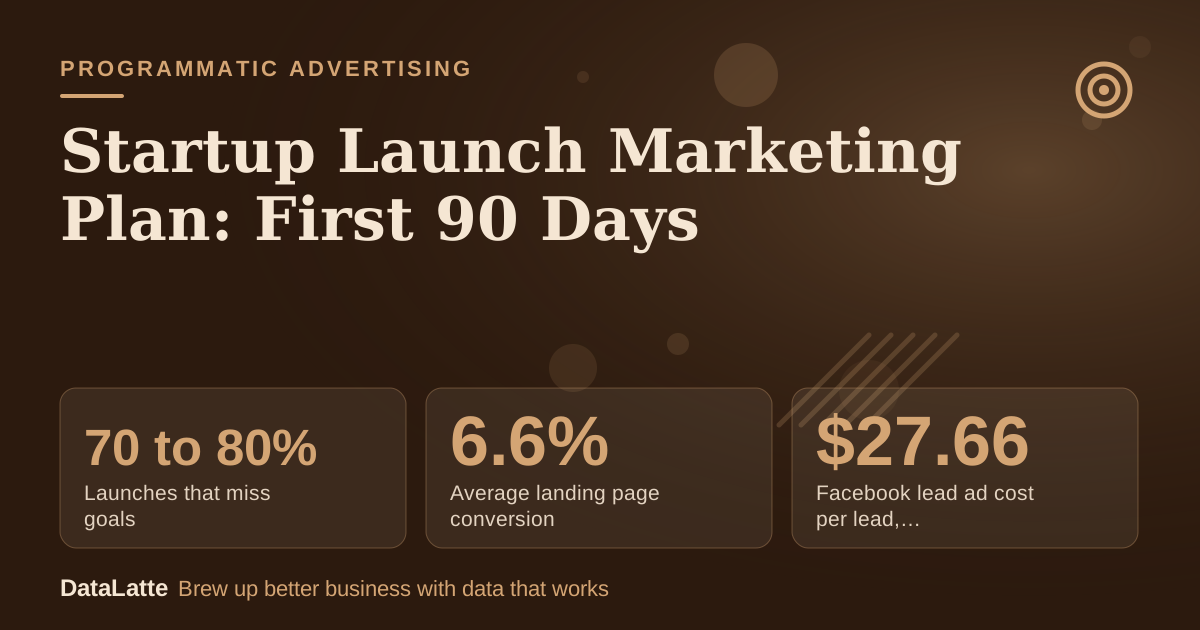
A startup launch marketing plan for the first 90 days has three phases: about five weeks building a waitlist and landing page, one launch week built around a single offer, and roughly seven weeks of measuring and tuning. Product Leadership, cited by Adwave (secondary), says 70 to 80% of launches miss their goals because of vague value propositions or poor planning. The plan below covers a phase table, a weekly checklist, metrics and a worked example.
70 to 80%→
Launches that miss goals
Product Leadership via Adwave (secondary)
6.6%↑
Average landing page conversion
Leadpages via Adwave (secondary)
$27.66↓
Facebook lead ad cost per lead, all industries
AdManage benchmark, Sept 2025 (secondary)
10,000→
Free-plan subscriber limit at Kit
Email pricing guide, 2026 (secondary)
See Sources at the end of the article. Cards marked Assumption are examples, not results.
What does a startup launch marketing plan cover in 90 days?
A 90-day plan splits into 13 weeks. Each phase has a different job, so each needs different tasks and different numbers to watch. Pre-launch work collects people who want the opening. Launch week turns them into first customers. The weeks after opening show which channels deserve more money.
The table below maps the phases. The metrics column lists what to track, not targets, because a coffee shop, a salon, a groomer and a fitness studio will each set different targets.
Phase
Weeks
Core tasks
Metrics to track
Foundation
1 to 2
Write a one-sentence offer, build a one-goal landing page, set up the email tool and tracking
Offer passes the 10 to 15 second hero test, page live
Waitlist build
3 to 5
Short video, personal network outreach, local partners, small paid test
Waitlist signups, landing page conversion rate, cost per signup
Launch week
6
Waitlist email sequence, opening offer, ads on, call and booking tracking
Compare cost per customer with the allowance, pause or scale, write down the process
Cost per customer vs allowance, repeat visits
What should happen before launch, in weeks 1 to 5?
Weeks 1 and 2 are for the offer and the page. A usable clarity test comes from Adwave's landing page guide (secondary). If a visitor can look at the hero for 10 to 15 seconds and accurately describe the offer, the audience and the next action, the page is probably clear enough.
Page structure matters. ZoomInfo's analysis of more than 18,000 landing pages, as reported in that guide, found 13.5% average conversion for pages with a single primary CTA, 11.9% for pages with 2 to 4 links and 10.5% for pages with 5 or more. Leadpages puts the cross-industry average at 6.6%, with top performers at 10% or higher. These are benchmarks, not promises for a local waitlist.
The same guide says more than half of landing page visits now happen on phones. Its form advice: ask for name and email, add phone only if follow-up calls are part of the process, and use a single-column layout with button copy that matches the action instead of "Submit". Copy follows pain, promise, proof, action.
Weeks 3 to 5 are for filling the list. Free channels come first: personal network, neighbors, nearby businesses. The shoestring budget guide covers those tactics.
Which email tool should hold the waitlist?
A waitlist is a list, so the email tool is the first recurring cost. Prices below come from a 2026 email pricing guide (secondary) and can change, so confirm current rates before signing up.
Kit's free plan covers up to 10,000 subscribers. The guide notes Kit rebranded from ConvertKit in 2024 and targets creators.
Mailchimp Essentials is listed at $13/month for 1K contacts, and Standard at $20/month. Its free plan was restricted to 500 contacts in 2022, down from 2,000.
Klaviyo's free tier is 250 contacts. Its email-only plan for 1,001 to 1,500 contacts is $30/month.
ActiveCampaign Starter is listed at $15/month for 500 contacts.
Billing rules differ. Mailchimp counts a contact in two audiences as two contacts. Klaviyo counts subscribed, unsubscribed and suppressed profiles toward its tier. The guide also warns that what starts at $20/month can reach $500 to $2,000/month as a list grows. For a local launch, the cheapest plan that supports a welcome email and one automated sequence is usually enough.
Where do video and paid social fit before opening?
A short video gives the landing page something to show before the doors open. The Adwave launch video guide (secondary) cites research that the optimal launch video runs 1 to 3 minutes, and that the first 10 seconds must carry one core message. It also cites Vidico research that videos on landing pages can raise conversion rates by up to 86%, and simpleshow research that 79% of users aged 18 to 34 watch video on smartphones.
Paid social can work as a small test in weeks 4 and 5. AdManage (secondary) cites Pew Research Center's 2025 study: 71% of U.S. adults use Facebook. Its benchmark table lists average Facebook Lead Ads cost per lead at $27.66 across all industries and $41.26 in Home and Home Improvement (September 2025). The spread shows that industry changes the price, and neither figure is a fitness, salon or coffee benchmark.
One platform note from the same page: as of April 2026, Meta changed access to the Conversion Leads goal for new campaigns without a Conversions API integration. Check what the account can run before planning around it.
What does launch week need?
Launch week works best with one offer, one page and one tracking setup. The waitlist gets the first email. Paid ads and local announcements point to the same landing page, so every signup and booking can be counted in one place.
Tracking deserves attention before the first ad runs. A window-replacement vendor on Home Service Direct (secondary) describes a company that paused a $1,200/month campaign that appeared to produce 3 form leads. Call tracking later showed the campaign also drove 14 phone calls per month. Local businesses that take bookings by phone face the same risk of undercounting.
The Adwave launch guide (secondary) recommends reading a launch in three layers, covered in the metrics section below. For lead sources beyond ads, the local lead generation guide covers the options. For press and community coverage around opening day, see PR on a budget.
What should weeks 7 to 13 focus on?
After opening, the work shifts from collecting attention to removing waste. If search ads are running, the quality of the landing page counts. Google assigns each keyword a Quality Score from 1 to 10 based on ad relevance, landing page experience and expected click-through rate, according to the Home Service Direct vendor guide (secondary). The vendor claims a score of 7 or higher cuts actual cost per click by 30 to 50% compared with a score of 4 to 5. That claim comes from a vendor selling to window companies, so treat it as directional.
Remarketing is the second lever. The same vendor says 82 to 96% of visitors from Google Ads clicks to window company sites leave without converting. It says remarketing clicks cost $0.50 to $3.00 and can reach visitors for 30 to 90 days. Local rates will differ, so ask for current numbers.
The list below assigns one main job per week. Smaller tasks fit around it.
Week 1: write the one-sentence offer and run the 10 to 15 second hero test on a draft.
Week 2: publish the landing page with one goal and a short form, and connect the email tool.
Week 3: send the waitlist link to the personal network and ask nearby businesses to share it.
Week 4: record a 1 to 3 minute video with one core message in the first 10 seconds.
Week 5: run a small paid test and check cost per signup against the plan.
Week 6: send the launch email, open the doors, and watch bookings and calls daily.
Week 7: review the first week of data and fix the biggest drop-off point.
Week 8: send a follow-up email to waitlist members who did not book.
Week 9: review search terms and ad relevance if search ads are running.
Week 10: add remarketing for landing page visitors who left.
Week 11: compare cost per new customer with the allowance.
Week 12: pause what exceeds the allowance and move budget to what beats it.
Week 13: document the process so the next promotion repeats it.
What should be measured during the first 90 days?
The Adwave launch video page (secondary) recommends three layers: attention metrics, intent metrics and outcome metrics. Attention metrics are views, watch behavior and click-through activity. For a local launch, a reasonable mapping puts waitlist signups and trial or appointment requests under intent, and paid first visits, bookings and repeat visits under outcome. That mapping is a suggestion, not part of the source.
Each layer answers a different question. Attention shows whether the message reaches people. Intent shows whether the offer persuades them. Outcome shows whether the business earns more than it spends.
Setting targets before launch prevents hindsight bias. The realistic sales goals guide explains how to set targets from capacity rather than hope. PW Skills, cited by Adwave (secondary), says video-integrated launch strategies hit their targets 65% more often than those without video. The page presents that as a reported statistic, not a guarantee.
What does a 90-day plan look like for a fitness studio?
The example below uses a boutique fitness studio. Every input is an assumption, and the studio's own numbers should replace them. The allowance method follows an illustrative example in the AdManage guide (secondary), which notes that the share of gross profit allowed for acquisition is a scenario choice, not a recommended margin policy.
Inputs (all assumption):
Membership price: $120 per month.
Average stay: 8 months.
Gross margin: 60%.
Share of gross profit allowed for acquisition: 25%.
Free-trial-to-member close rate: 25%.
Paid social budget over 13 weeks: $2,400.
Cost per trial lead: $30.
Gross profit per member is $120 × 8 × 0.60 = $576. At 25%, the allowance is $144 per new member. At a 25% close rate, the ceiling is $36 per trial lead ($144 × 0.25).
At $30 per lead, $2,400 buys 80 leads, which become 20 members. Cost per member is $120, under the $144 allowance. Waitlist signups from free channels are not counted here.
A stress case: if cost per lead rose to $41.26 (the Home Improvement benchmark, used here only as a high example), $2,400 buys about 58 leads and about 14.5 members. Cost per member becomes $165.04, over the allowance. That result points to a pause or a landing page fix at weeks 11 and 12.
To check a launch plan against local numbers, request a free audit.
FAQ
How early should a waitlist start before opening?
The plan above starts the waitlist in week 1 and opens in week 6, giving about five weeks. No source documents an ideal lead time. A longer runway gives more time to test the page, but it also delays the first signups.
Is a free email plan enough for a waitlist?
Often yes at small scale. The 2026 pricing guide (secondary) lists Kit's free plan at up to 10,000 subscribers and Klaviyo's free tier at 250 contacts. Mailchimp's free plan was cut to 500 contacts in 2022. Check current limits before choosing.
Is video required for a launch?
No source says video is required. PW Skills, cited by Adwave (secondary), reports that video-integrated launch strategies hit targets 65% more often. That does not prove video caused the result. A video of 1 to 3 minutes with one message in the first 10 seconds is a reasonable low-cost test.
When should launch ads be paused?
Pause when cost per new customer stays above the allowance after the landing page and tracking are fixed. Check call tracking first, since form counts alone can undercount results.
Local marketing strategist with 10+ years at global agencies — OMD, Dentsu, GroupM, and BBDO. Now helping small businesses get the same data-driven edge. Based in Europe, working with clients in the US, UK, Australia, and beyond.