November 14, 2026·Nataliia Rumiantsewa· 9 min read All posts
SaaS and local business marketing differ in who is being reached, how fast they decide, and what counts as a win. A software startup tries to win buyers anywhere and measures sign-ups and subscription revenue. A coffee shop, salon, groomer or gym tries to win people within a short drive and measures calls, bookings and repeat visits. The funnel concept stays the same. The channels, targeting and math change.
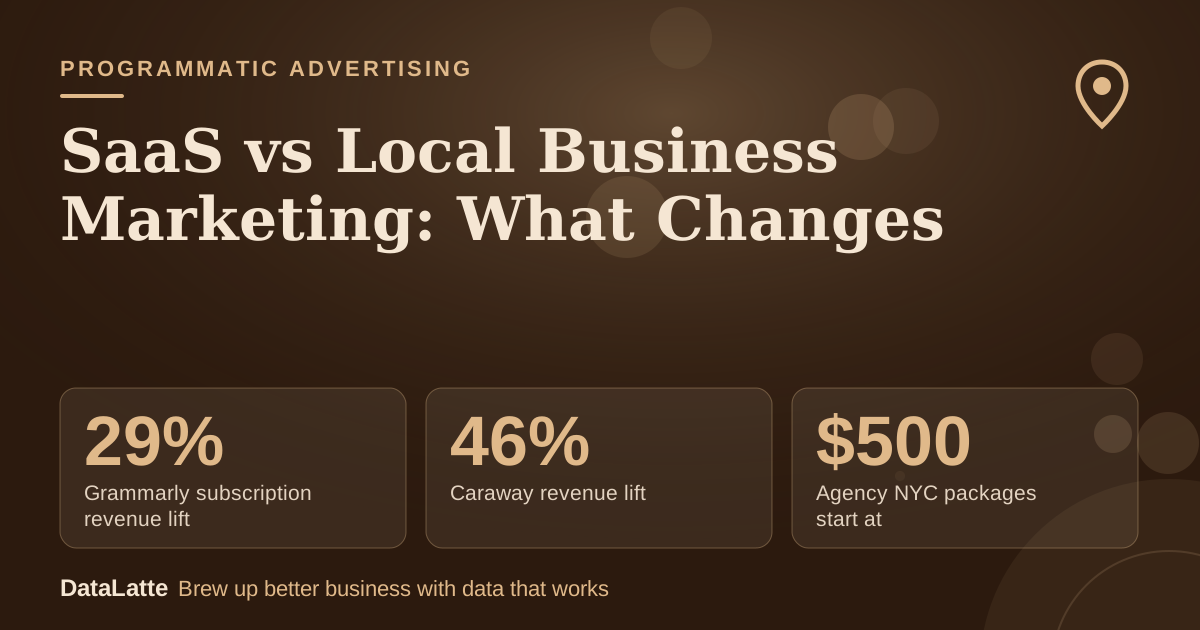
29%↑
Grammarly subscription revenue lift
Google case study, as of March 2025 (secondary)
46%↑
Caraway revenue lift
Google case study, as of March 2025 (secondary)
$500→
Agency NYC packages start at
Thrive agency page, excludes ad spend (secondary)
3→
Main parts of a generic funnel
StackAdapt article, 2020 (secondary)
See Sources at the end of the article. Cards marked Assumption are examples, not results.
How does SaaS marketing differ from local business marketing?
Software companies sell to people who can be anywhere, so reach is the main problem. Local businesses sell to people within a limited area, so relevance and proximity are the main problem. Everything else follows from that split: keywords, ad targeting, creative, landing pages and the numbers reviewed each week.
Vendor-published results show the contrast. Google's own case study page reports that Grammarly's subscription revenue rose 29% and its ROAS rose 23% after using AI-powered search (secondary; Google-published and not independently verified). Those outcomes are measured entirely online, inside a checkout or subscription flow.
A salon's outcome often happens by phone, through a booking tool or at the front desk. Measuring that takes more setup, and the plan has to account for it from the start.
What does the comparison look like side by side?
The table below is a planning framework. It summarizes typical differences as a starting point for decisions, not measured industry data. Only the sales-cycle row draws on a cited source.
Dimension
Local business
SaaS or online startup
Audience
People within a drive or short commute of one or a few locations
Buyers across a country or the world, often defined by job role or use case
Search intent
"Near me" and service-plus-city searches, often ready to book
Problem and comparison searches, often early research
Main channels
Google Business Profile, local search ads, reviews, local links, referrals
Content, paid search and social, email nurture, free trials, partnerships
Sales cycle
Usually short for a haircut or a coffee; longer for memberships
Usually longer when the buyer is a business with several decision-makers (secondary)
Core metrics
Calls, bookings, cost per new client, repeat visit rate
Small monthly media spend tied to capacity and margin per visit
Larger spend that scales with recurring revenue per customer
Retention
Rebooking, memberships, referrals
Renewals, upgrades, churn reduction
Who is the audience and what intent do they show?
A local audience is defined by geography first. The question is who lives, works or travels within range of the door, and what they search for when a need appears. A pet groomer does not need awareness among dog owners in another state.
Intent shows up differently too. Someone searching for a service in their own city is often close to buying. Someone searching for a category of software may be months from a decision.
That is why local campaigns can start at the bottom of the funnel, where buyers are ready, while many software campaigns need to build trust first. The local lead generation guide covers how to capture that ready-to-book demand.
The same article states that the B2B sales cycle is usually longer than B2C because of a multi-step buying process involving multiple decision-makers, and that B2B purchases are typically higher-ticket (secondary). Many SaaS products are sold to businesses, so that pattern often applies. A solo shopper booking a manicure has no committee to convince.
For a local business, the funnel compresses. A person can discover a shop, check reviews and book in one sitting. A fitness studio selling memberships has a somewhat longer path, with a trial class in the middle.
StackAdapt advises weighing sales cycle length and the number of decision-makers when choosing where and how to reach an audience (secondary). For most local owners, that points to fewer touchpoints and faster follow-up.
Which metrics matter for each model?
SaaS teams track revenue metrics tied directly to the digital product. The Google case studies mentioned earlier use revenue and ROAS. Caraway, a cookware brand, is reported with a 46% revenue increase at 31% better ROAS using Performance Max (secondary; Google-published, not independently verified). Online sales can be attributed in the same system that shows the click.
Local businesses need a bridge from the click to the till. Practical measures include tracked calls, booking form submissions, coupon or offer codes, and a simple "how did you hear about us" question at checkout. The headline figure to watch is cost per new client, not cost per click.
Top-of-funnel metrics also need context. StackAdapt names CTR as the key native-ad goal for awareness and website visits, and time on site as the engagement metric for mid-funnel (secondary). Those are useful signals for a software brand building awareness. For a local shop, a high CTR that produces no bookings is not a win.
Agency pages show how loosely results can be framed. Thrive's page shows figures such as +500% impressions and +190% engagement without a stated client or time period (secondary). Numbers like that cannot be compared with a business's own bookings.
How do budgets compare?
Software companies can justify larger budgets when each customer pays recurring revenue. Local businesses usually work from a smaller monthly figure tied to chair time, class capacity or table turnover. The question is how many new clients the schedule can absorb, not how much the market can bear.
Fees and media are separate line items. Thrive's page says its packages for New York City businesses start at $500, and its proposal form notes that the monthly budget does not include ad spend (secondary). Anyone comparing agency quotes should ask what is included and what is paid to the ad platform on top.
Realistic targets also matter. The realistic sales goals guide shows how to set revenue goals the schedule can actually deliver.
Which channels fit a local business?
Start with channels that match intent. Local search ads and a complete Google Business Profile put a business in front of people already looking. Reviews, local links and community mentions build trust within the area. The local link building guide and the PR on a budget guide cover the earned side.
Paid social and display help when a business wants to reach nearby people who are not searching yet. Google notes that Lookalike audiences are a feature exclusive to Demand Gen (secondary). That kind of audience expansion is more useful once a customer list is large enough to learn from, so it usually comes after the basics.
Several campaigns can sit in one Google Ads account, according to Google's account creation notice. A salon can therefore run separate campaigns for color, cuts and bridal services without opening a new account.
Retargeting has a local twist. StackAdapt suggests an exclusion audience of users who have already converted so spend is not wasted on them (secondary). A groomer can apply the same idea by excluding existing clients from new-customer offers.
All inputs below are assumptions for illustration. They are not benchmarks and will differ by city and service.
Monthly ad budget: $1,000 (assumption)
Cost per click: $4 (assumption)
Share of clicks that become booking requests: 5% (assumption)
Share of requests that show up: 60% (assumption)
Average first-visit ticket: $90 (assumption)
Share of new clients who book a second visit: 40% (assumption)
The calculation runs as follows. $1,000 divided by $4 gives 250 clicks. At 5%, that is 12.5 booking requests. At 60% attendance, that is 7.5 new clients. First-visit revenue is 7.5 times $90, or $675.
Cost per new client is $1,000 divided by 7.5, or about $133. The first visit alone does not cover that cost. At 40% rebooking, 3 of the 7.5 clients return for one more $90 visit, adding $270, so total revenue is $945, still just under the $1,000 spend.
Break-even needs roughly 1.5 visits per new client at $90 ($133 divided by $90). A SaaS company reads the same math through subscription months. A salon reads it through visits, so rebooking and memberships are part of the ad plan.
What is a six-week plan for choosing local channels?
Run the plan in order, because each step produces something the next one needs.
Week 1: Write the ideal customer profile using the 5 W's, list services by margin, and pick one goal such as new clients per month.
Week 2: Set up call tracking, a booking link with tracking, and an offer code so every lead can be traced to a source.
Week 3: Launch one search campaign for the highest-margin service, using city and neighborhood terms.
Week 4: Review search terms and booking requests, remove irrelevant queries, and check cost per new client against the break-even figure.
Week 5: Add a second service campaign or a retargeting audience, with existing clients excluded.
Week 6: Compare cost per new client with the rebooking rate, then decide whether to scale, adjust or pause.
A written process makes this repeatable. The repeatable sales process guide shows how to turn leads from these channels into booked appointments consistently.
FAQ
Can a local business copy SaaS marketing tactics?
Some tactics transfer, such as email follow-up and clear tracking. Others do not fit, like long content-driven nurture for a purchase that takes one visit. Start with tactics that match short local decisions, then test additions one at a time.
Why do agency case study numbers look so large?
Percentage gains depend on the starting point and are often shown without client names or time periods. Thrive's page, for example, lists +500% impressions with no stated client or period (secondary). Treat such figures as marketing claims and judge results by calls, bookings and cost per new client.
Is the funnel different for local businesses?
The stages are the same: awareness, engagement, consideration and conversion (secondary). For most local services, they happen faster and often in one session, so conversion-ready channels such as local search usually come first.
Do I need an agency to run these channels?
Not necessarily. A small budget can start with one search campaign and tracked calls. An agency may help once the plan is working and time is the constraint. Ask what the monthly fee covers and whether ad spend is billed separately.
For a review of which channel mix fits a specific location and budget, request a free audit.
Local marketing strategist with 10+ years at global agencies — OMD, Dentsu, GroupM, and BBDO. Now helping small businesses get the same data-driven edge. Based in Europe, working with clients in the US, UK, Australia, and beyond.