November 14, 2026·Nataliia Rumiantsewa· 8 min All posts
Customer acquisition cost (CAC) is total sales and marketing spend in a period divided by the number of new customers won in that period, per Adwave's CAC guide (secondary). Payback period is CAC divided by monthly profit per customer. LTV:CAC compares what a customer is worth with what it cost to win them. Common targets are 3:1 for LTV:CAC and payback under 12 months. A coffee shop example below runs all three on one set of inputs.
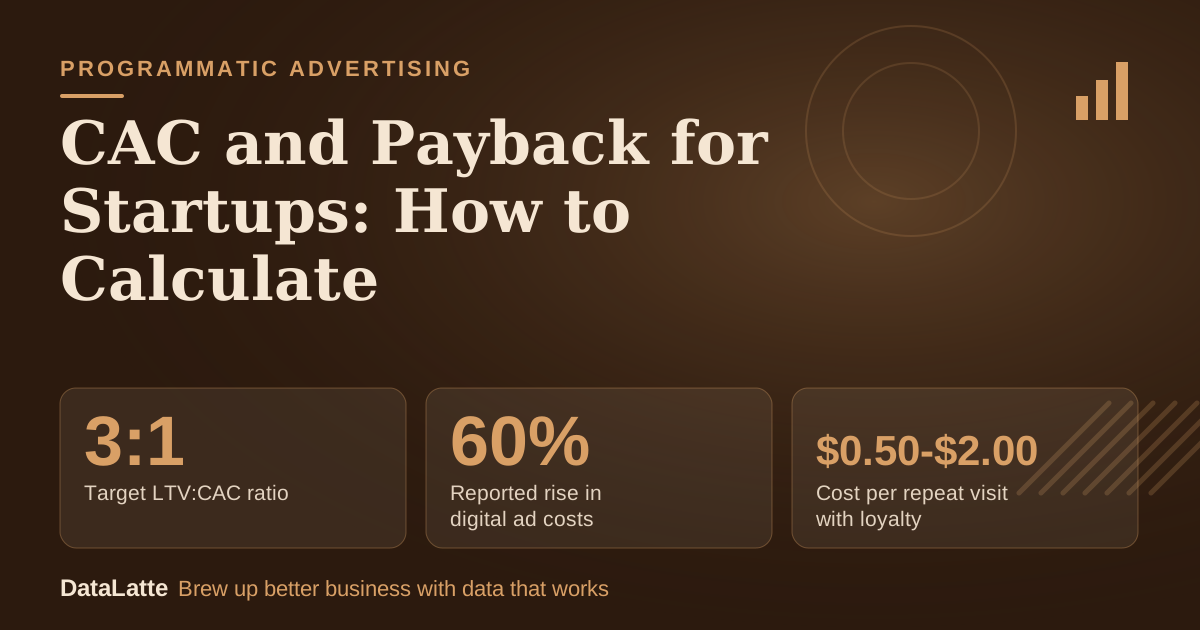
3:1→
Target LTV:CAC ratio
Adwave CAC guide (secondary)
60%↑
Reported rise in digital ad costs
Adwave, original source not named (secondary)
$0.50-$2.00↓
Cost per repeat visit with loyalty
Adwave coffee shop guide (secondary)
Under 12 mo→
Target CAC payback
Adwave CAC guide (secondary)
See Sources at the end of the article. Cards marked Assumption are examples, not results.
What does customer acquisition cost include?
The go-to formula is total sales and marketing spend divided by the number of new customers, according to Adwave (secondary). A GroomSoft article for pet groomers (secondary) gives the same logic with marketing spend only. Its illustration: $500 on social ads that brings 10 new clients yields a CAC of $50. That figure is an example, not real data.
Adwave also shows a blended case from home services. Marketing of $30,000 plus $10,000 in sales costs across 160 new customers gives $250 per customer. The case is illustrative. Only new customers belong in the denominator, because repeat visits from existing customers do not reflect acquisition.
For a local business, a workable rule is to count everything paid to win first visits: ad spend, the cost of giveaways, freelancer fees and software. Owner time can be included or excluded. Either choice works as long as it stays fixed for the whole test. Cost per lead sits one step earlier in the funnel, covered in the local lead generation guide.
Which formulas matter for CAC, payback and LTV?
Six calculations cover most decisions. The table pairs each with the example the source gives, so the arithmetic can be checked.
Adwave calls 3:1 the target for most businesses, and a ratio below 1:1 means money is lost on every new customer. Its LTV example multiplies spend, not profit. Using gross profit per customer is the safer version, and the worked example below does that.
How does a coffee shop work through CAC, payback and LTV:CAC?
Every input below is an assumption for a single-location cafe. Ranges come from Adwave's coffee shop guide (secondary), which suggests $300-$1,500 per month on Meta for an active cafe campaign and $0-$500 per month for Google Business Profile help.
Input
Value (assumption)
Meta ad spend, one month
$600
Cost of free first drinks redeemed
$100
Google Business Profile help
$100
New first-time customers
80
Share who become loyal (10+ visits in 90 days)
30%
Average ticket
$5
Visits per loyal customer per month
6
Gross margin
70%
Months a loyal customer stays
12
Total acquisition spend is $800. CAC per new customer is $800 ÷ 80 = $10. Loyal customers number 80 × 30% = 24, so cost per loyal customer is $800 ÷ 24 = $33.33. Monthly gross profit per loyal customer is 6 × $5 × 70% = $21.
Payback is $33.33 ÷ $21 = about 1.6 months. LTV is $21 × 12 = $252, so LTV:CAC is $252 ÷ $33.33 = about 7.6:1. Profit from the 56 one-time visitors is left out, which keeps the estimate conservative.
A stress test shows how fragile this is. If only 10% turn loyal (assumption, below Adwave's 20-40% range), loyal customers drop to 8. Cost per loyal customer rises to $100, payback stretches to about 4.8 months, and LTV:CAC falls to 2.5:1, under the 3:1 target. The ad spend did not change, but the ratio did.
Adwave also notes that most owners cap spend assuming a $5-$15 CAC from first-visit revenue alone. That ignores what a habitual customer is worth: the guide puts a $5 one-time latte at $5 of revenue and a customer visiting 250 days a year at $1,250. Setting revenue targets around these numbers is covered in the realistic sales goals guide.
What CAC benchmarks can a small business trust?
Sources document few benchmarks for local service businesses, so ranges should be treated as rough guides. For cafes, Adwave (secondary) states cost per first visit from Meta typically runs $5-$15 in dense urban markets and $10-$25 in suburban areas. It adds that a first-visit-to-loyal rate of 20-40% puts cost per loyal customer at $25-$80. The worked example above sits inside both ranges.
Adwave's CAC guide (secondary) cites unattributed recent data putting e-commerce CAC around $70 to $78 and B2B SaaS as high as $702. Neither describes a salon, groomer or gym, and the original sources are not named.
The same guide says digital ad costs have reportedly risen 60% in a few years. Its source is also not named. No source here documents what ad prices will do next, so current rates should be requested from each platform before a budget is set.
No source documents CAC ranges for salons, pet groomers or fitness studios. For those businesses, the benchmark is the shop's own history: calculate CAC monthly, then compare it with profit per customer and the 3:1 and 12-month targets. GroomSoft's projections for groomers, such as 2-5 new clients per month from Google Ads at a 5% click-through and 10% conversion rate, are explicitly hypothetical.
How does channel mix change CAC?
A blended number averages channels with very different economics. Adwave's example shows a $7,500 TV campaign, tracked through a unique phone number and URL, producing 40 customers. That is $187.50 per customer, lower than the same company's $250 blended CAC. The source is a TV advertising vendor, so the result is an illustration of method, not a promise of results.
The lesson is attribution. Without a tracking number, offer code or "how did you hear about us" question, channel CAC cannot be separated from the blend. The multi-channel advertising guide covers how to run several channels without losing track of each.
Timing also distorts channel comparisons. Adwave's startup guide (secondary) says content marketing can take 6-12 months to show significant results. Adwave's cafe guide says Google Business Profile results compound over 3-9 months, with a well-optimized listing in a competitive metro producing 500-2,500+ profile views per month and 10-30% turning into walk-ins or direction requests.
Retention changes the picture too. The cafe guide puts cost per repeat visit from loyalty programs at $0.50-$2.00, and a retention guide (secondary) cites a third party saying new customers can cost 5 to 25 times more than retaining existing ones.
How much budget does a CAC test need?
Adwave's startup guide (secondary) recommends starting paid ads at $10-50 per day and raising spend only when promising signals appear. It says meaningful search or social experiments start around $500-$1,000 per month. Its tiers run from Bootstrap ($0-$1,000 per month) to Seed ($1,000-$5,000) and Series A+ ($5,000-$25,000+). Retargeting under $200 per month fits the bootstrap stage.
Those tiers are written for startups generally, not for local shops. A neighborhood business can borrow the idea: begin with one small test, measure CAC, then scale. How to split a limited budget across channels is covered in the local marketing budget guide, and the shoestring budget guide covers tactics for owners with very little to spend.
The same guide advises at least 2-3 months of experimentation before reliable acquisition approaches emerge. A single month of data, as in the worked example, is a starting estimate, not a verdict. Customer counts that small can swing a ratio widely.
What does a 12-week CAC tracking calendar look like?
This calendar combines the sourced timing guidance: the 2-3 month experimentation window, a 60-day loyalty pilot, and monthly KPI reviews. The dates in the table are suggestions for pacing, not requirements from the sources.
Week
Task
Output
1
List every acquisition cost and write down what counts toward CAC
One written CAC rule
2
Add tracking: a unique phone number or URL, an offer code, or a checkout question per channel
Customers tagged by channel
3-4
Launch one paid test at $10-50 per day and start a 60-day loyalty pilot
Weekly new-customer count
4
First monthly review of blended CAC
Baseline CAC
5-6
Add photos and review requests to the Google Business Profile
Profile activity logged
7-8
Add real profit per customer to the sheet and calculate payback
Payback in months
8
Second monthly review; compare channel CAC
Channel table
9-10
Track repeat visits for customers won in weeks 3-4
Early retention rate
11
Calculate LTV and LTV:CAC from observed behavior
Ratio against 3:1
12
Decide whether to scale, hold or pause each channel
The retention guide recommends tracking four loyalty numbers weekly: enrollment rate, reward redemption rate, repeat purchase rate, and average spend of members versus non-members.
Which pitfalls distort CAC?
Counting only ad spend. Giveaways, software and freelancers also belong. Adwave estimates a coffee shop loyalty platform at $50-$300 per month plus $200-$1,000 in incentives, and content help at $150-$500 per month.
Mixing new and returning customers in the denominator, which makes CAC look better than it is.
Using revenue where profit belongs. A $5 sale does not pay back a $5 cost once ingredients and labor are counted.
Judging slow channels too early. Content and local search take months, so early CAC overstates their long-run cost.
Trusting the blend. One strong channel can hide a weak one.
Treating projections as results. Hypothetical conversion rates, such as those in GroomSoft's examples, should be replaced with measured ones.
Quoting benchmarks without a named origin. The e-commerce and SaaS figures above come from unattributed data.
GroomSoft suggests reviewing metrics monthly or quarterly, which fits a calendar like the one above.
FAQ
What is a good CAC for a small local business?
No universal figure exists in the sources. For cafes, Adwave (secondary) cites $5-$15 per first visit in dense urban markets, $10-$25 in suburban areas and $25-$80 per loyal customer. For other trades, the better test is whether LTV is about three times CAC.
How long should CAC payback take?
Adwave (secondary) calls under 12 months a great target for most businesses. Payback is the time a customer takes to generate enough revenue, or ideally profit, to recover acquisition cost.
Should loyalty and retention spending count in CAC?
Keeping it separate is cleaner. Loyalty spending targets repeat visits, which Adwave puts at $0.50-$2.00 each for cafes. Mixing it into CAC blurs which spending wins new customers.
How many months of data are needed before trusting CAC?
Adwave advises at least 2-3 months of experimentation before approaches look reliable. Monthly reviews during that window show whether CAC is stable or just noisy.
A free audit can show where a business's current acquisition spend stands against these formulas.
Local marketing strategist with 10+ years at global agencies — OMD, Dentsu, GroupM, and BBDO. Now helping small businesses get the same data-driven edge. Based in Europe, working with clients in the US, UK, Australia, and beyond.