November 13, 2026·Nataliia Rumiantsewa· 8 min read All posts
AVOD is free or lower-cost streaming paid for by ads. SVOD is subscription streaming that was traditionally ad-free. TVOD is pay-per-title rental or purchase. For a local business, ads run in AVOD and FAST channels and in the ad-supported tiers of SVOD services. TVOD has no ad inventory at all. The practical trade-offs are ad load, price per thousand impressions, and how precisely a campaign can target a ZIP code or DMA.
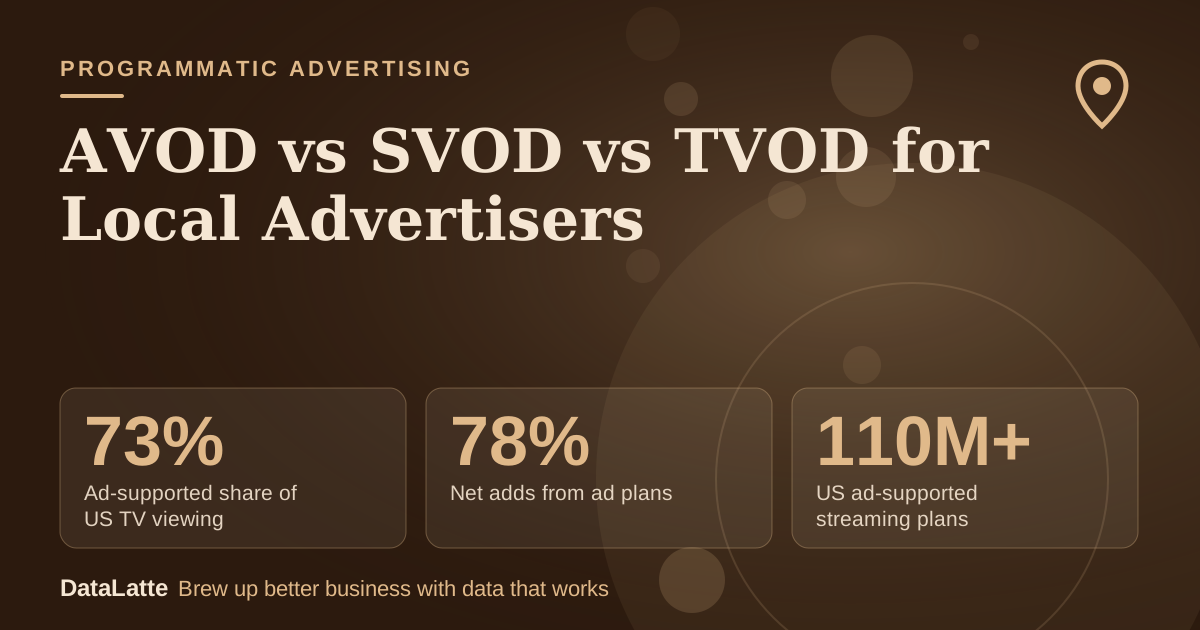
73%→
Ad-supported share of US TV viewing
Nielsen Q1 2026, via StackAdapt (secondary)
78%↑
Net adds from ad plans
Antenna, nine quarters to Q1 2026, via Adwave (secondary)
110M+↑
US ad-supported streaming plans
Antenna Q2 2026, excludes Prime Video, via Adwave (secondary)
$10-$12→
FAST CPM per 1,000 impressions
Digiday, via StackAdapt (secondary)
See Sources at the end of the article. Cards marked Assumption are examples, not results.
What do AVOD, SVOD and TVOD actually mean?
AVOD (advertising video on demand) shows ads in exchange for free or lower-cost content. Tubi, Pluto TV and Peacock's free tier are the examples given in Adwave's FAQ (secondary). SVOD (subscription video on demand) charges monthly fees for ad-free content, with Netflix premium and Disney+ without ads as examples.
TVOD is transactional. StackAdapt (secondary) describes viewers paying title by title, either as a short-term rental or a permanent digital purchase, instead of a recurring subscription.
FAST (free ad-supported streaming TV) sits inside AVOD. It offers linear and on-demand programming, is completely ad-supported, and viewers do not pay, according to StackAdapt's FAST guide (secondary). Pluto TV is the standard example.
The labels have blurred. Adwave notes that Netflix, Disney+ and other traditionally ad-free services have launched ad-supported tiers, and its viewing-share page (secondary) labels Hulu a hybrid model. A single brand can therefore sell both an ad-free product and an ad-supported one. For the full picture of how streaming terms relate, see CTV vs OTT advertising explained.
Where do ads actually run in each model?
Ads run wherever the viewer is not paying the full price. Free services monetize through ads alone, cheaper subscription tiers monetize through a mix, and pay-per-title services do not sell ad inventory. The table maps each model to what a small advertiser can buy. The last column is an assessment, not a sourced figure.
Model
Viewer pays
Ads
Documented reach signal
Fit for a small local advertiser (assessment)
AVOD and FAST
Nothing, or a lower price
Yes, all inventory is ad-supported
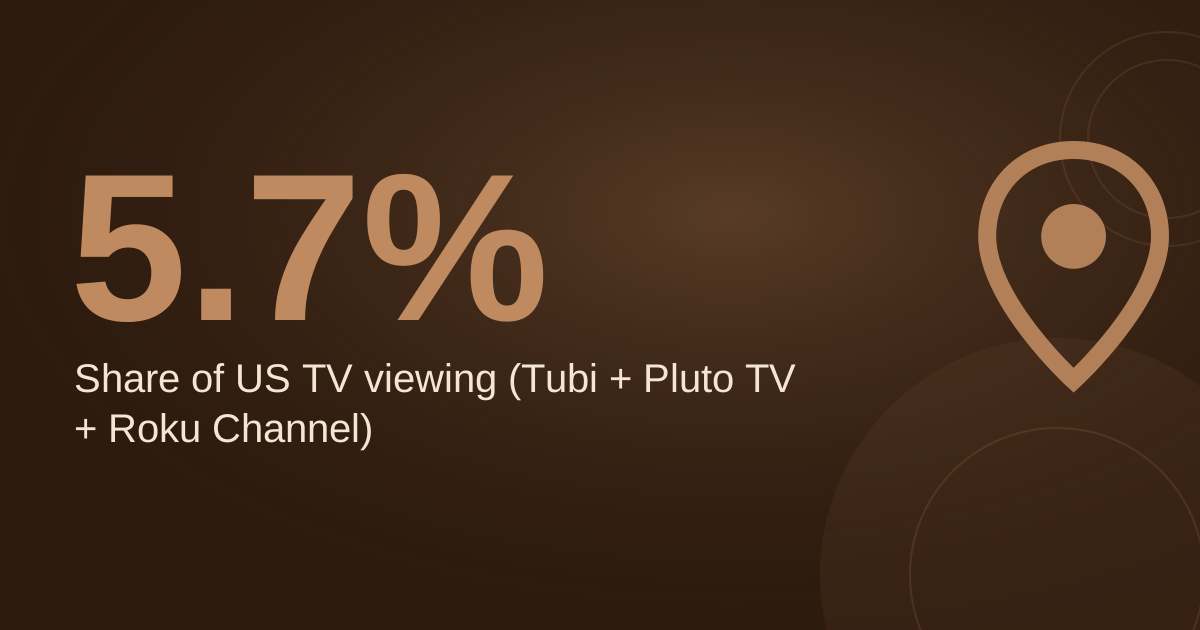
FAST was 5.7% of US TV viewing in May 2025; Roku Channel 2.8%, Tubi 2.2%+, Pluto TV about 1.0%
Strongest fit: lower CPM range, wide choice of channels
SVOD, ad-free tier
Full monthly fee
None
Paid SVOD held about 19% of US viewing share
Nothing to buy
SVOD, ad-supported tier
Cheaper monthly fee
Yes
More than 110M US ad-supported plans, excluding Prime Video
Large audience, but higher CPMs; ask about local targeting
TVOD
Per title
None
Q1 2026 US digital purchase spending $521M, down 18.7%; rental $443M, down 6.6%
Nothing to buy
Viewing shares come from Nielsen Gauge figures cited by Adwave (secondary). The TVOD spending figures come from a 2026 DEG report cited by StackAdapt (secondary), which states that TVOD carries essentially no ad inventory.
Why do SVOD ad tiers matter to local advertisers?
Ad tiers are now a main entry point into subscription streaming. Antenna's Adds & Ads report found that ad plans drove 78% of net subscriber additions (50.4M of 64.8M) at premium SVOD services offering an ad plan, over the nine quarters to Q1 2026. Ad plans also took 59% of gross additions in Q1 2026 and held 48% of subscriptions by March 2026, per Adwave's growth analysis (secondary).
Price explains much of it. As of September 2026, Netflix's ad plan cost $8.99 a month against $19.99 for its Standard ad-free plan, according to Fortune as cited on that page. A Deloitte survey cited by Adwave (secondary) found 60% of respondents would probably cancel a favorite service if its price rose by $5 a month.
Ad-tier viewers are not a throwaway audience. Antenna data shows 37% of subscribers who joined an ad plan were still subscribed after 12 months, against 39% of ad-free joiners.
What the sources do not document is whether a small buyer can purchase ZIP-level targeting on a specific brand's ad tier. That varies by platform and should be asked directly. Amazon Prime Video ads for small business covers one such platform.
What do the forecasts say about where budgets are heading?
Forecasts point toward more TV advertising money moving to streaming, but forecasts are not guarantees. EMARKETER expects CTV ad spend to surpass linear TV for the first time by 2028, per StackAdapt (secondary). The same page cites eMarketer projecting that connected TV will represent 49.7% of TV advertising by 2027.
On the upfront side, eMarketer's Q2 2026 forecast projects US CTV upfront spending of $17.73 billion, above primetime linear TV upfronts of $16.98 billion, in 2026 for the first time, per Adwave (secondary).
Viewing already leans ad-supported. In Q1 2026, 73% of total US TV viewing was ad-supported, and streaming made up 46.6% of that, according to Nielsen as cited by StackAdapt. Adults ages 18 to 49 spend 63.8% of their TV time with ad-supported TV.
None of the sources say what happens to ad prices as supply grows. Treat any claim that rates will rise or fall as unproven, and ask each platform for current rates before committing a budget.
How do ad load and pricing differ across models?
Fewer ads per hour changes what a single spot is worth. Traditional cable averages 15 to 18 minutes of ads per hour, a third-party figure cited by StackAdapt (secondary). The same page puts premium AVOD at roughly four to eight minutes per hour and FAST at approximately eight to 12 (both vendor estimates).
Pricing runs the other way. Digiday reports FAST CPMs between $10 and $12 per 1,000 impressions, compared with upwards of $40 for top-tier publishers like Netflix, per StackAdapt's FAST guide (secondary). CPM is total spend divided by impressions, times 1,000, per Paramount's glossary (secondary).
Format rules are consistent across models. CTV ads are non-skippable, typically 15 or 30 seconds, and full-screen, and Paramount recommends a hook in the first 3 to 5 seconds. The CTV creative specs guide covers file requirements.
What does a small budget buy? A fitness studio example
This worked example is built for a fitness studio. Every input is an assumption, with the CPM chosen from inside the Digiday FAST range. Real local rates need a quote.
Inputs (assumption): $1,200 monthly budget, $11 CPM, 30,000 households in the chosen ZIP codes, average frequency of 6 per household over the month, 20 trial sign-ups, 30% of trials becoming members, $90 monthly membership.
Impressions: $1,200 ÷ $11 × 1,000 = about 109,091.
Households reached: 109,091 ÷ 6 = about 18,182, roughly 61% of the 30,000 target.
Cost per trial: $1,200 ÷ 20 = $60.
New members: 20 × 30% = 6, giving $540 of first-month revenue.
ROAS on month one: $540 ÷ $1,200 = 0.45, using Paramount's formula of revenue divided by ad spend.
Payback: $1,200 ÷ $540 = about 2.2 months, so the campaign pays for itself if those six members stay roughly that long (assumption).
Now swap in a premium-priced ad tier at a $40 CPM (assumption, based on the "upwards of $40" figure). The same $1,200 buys 30,000 impressions, enough for 5,000 households at frequency 6, or about 17% of the target. The premium tier is not wrong, but it fits a narrower job. More fitness-specific detail is in CTV ads for fitness studios.
What should a local advertiser do in the first six weeks?
A short, measured test beats a long commitment. This schedule is a recommended workflow, not a sourced benchmark.
Week 1: Set one goal, such as trial sign-ups. Pick geography. Paramount lists country, state, DMA, ZIP code and radius around an address as geo-targeting options, plus household filters such as age and income.
Week 2: Ask each platform which inventory is AVOD, FAST or an SVOD ad tier, the ad load, current CPM, and the smallest targeting unit.
Week 3: Finish one 15 or 30 second ad with the hook in the first 3 to 5 seconds. Set a frequency cap; Paramount's example is no more than 3 impressions per household per day.
Week 5: Check CPM, video completion rate (completed views divided by impressions) and cost per trial against the plan.
Week 6: Keep, cut or move budget. Compare cost per trial with the break-even math above.
One self-serve example from the sources: Adwave's pricing page states daily budgets start at $30 as of October 2026, per its growth analysis (secondary). Whether a small test makes sense at all is covered in is CTV worth it on a small budget.
FAQ
Can a local business advertise on TVOD?
No. TVOD carries essentially no ad inventory because viewers pay directly for each title, so viewing is ad-free, according to StackAdapt (secondary).
Is Netflix AVOD or SVOD?
It is SVOD with an ad-supported option. As of September 2026, Netflix's ad plan cost $8.99 a month against $19.99 for its Standard ad-free plan, per Fortune as cited by Adwave (secondary).
What is the difference between AVOD and FAST?
FAST is a subset of AVOD. It offers linear and on-demand programming, is completely ad-supported, and viewers do not pay. StackAdapt's FAST guide (secondary) names Tubi, the Roku Channel and Pluto TV as popular platforms.
Which model is cheapest per impression?
Among the sourced figures, FAST is lower. Digiday reports $10 to $12 per 1,000 impressions for FAST against upwards of $40 for top-tier publishers like Netflix. These are reported ranges, so ask for current local rates.
Do ad tiers reach enough people to matter?
Antenna's Q2 2026 report counts more than 110 million US ad-supported streaming plans, excluding Amazon Prime Video, per Adwave (secondary).
Local marketing strategist with 10+ years at global agencies — OMD, Dentsu, GroupM, and BBDO. Now helping small businesses get the same data-driven edge. Based in Europe, working with clients in the US, UK, Australia, and beyond.