Behavioral vs Contextual Targeting for Local Business
November 13, 2026·Nataliia Rumiantsewa· 8 min read All posts
Behavioral targeting shows ads to people based on their past browsing. Contextual targeting shows ads based on the content someone is viewing right now. For a small local advertiser, contextual targeting combined with a tight geographic radius is usually the simpler starting point, because it needs no user-level tracking. Behavioral targeting is worth testing as a second arm once a budget allows a fair comparison. The sections below cover the differences, privacy trends and a six-week test.
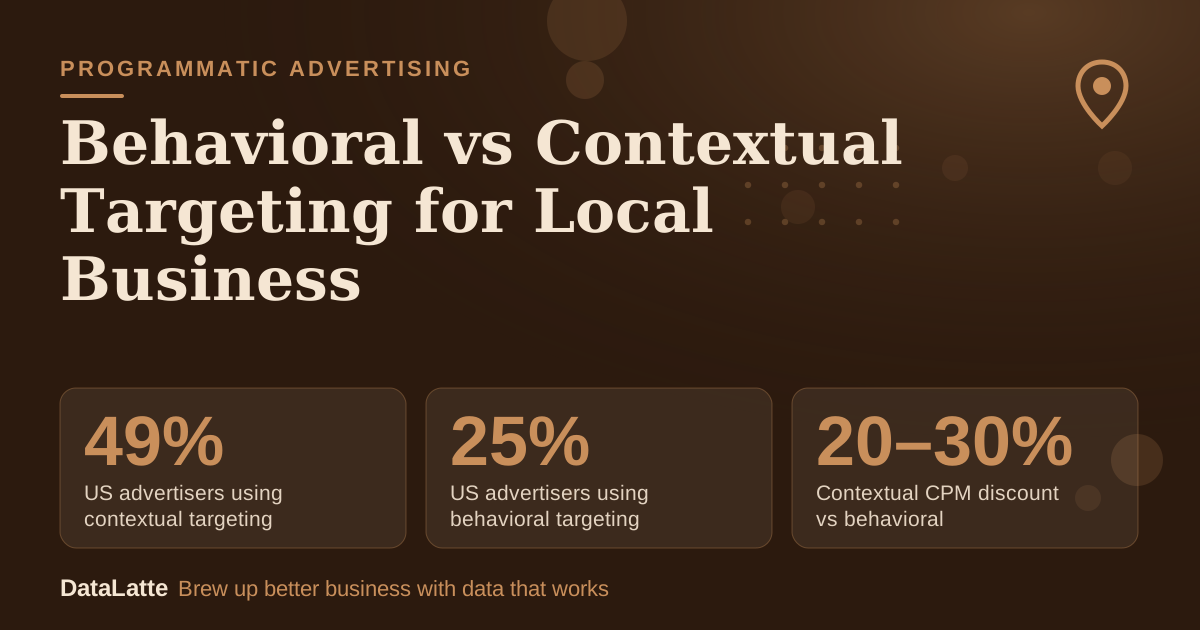
49%↑
US advertisers using contextual targeting
Adwave citing US advertiser research (secondary)
25%→
US advertisers using behavioral targeting
Adwave citing US advertiser research (secondary)
20–30%↓
Contextual CPM discount vs behavioral
2025 third-party synthesis via Adwave (secondary)
74%→
Consumers preferring ads that match content
Surveys cited by Adwave (secondary)
See Sources at the end of the article. Cards marked Assumption are examples, not results.
What is the difference between behavioral and contextual targeting?
Behavioral targeting, which StackAdapt also calls audience or demographic targeting, serves ads based on a person's web-browsing behavior collected through a tracking pixel or cookie (StackAdapt, secondary). It relies on historical data about browsing patterns. The goal is relevance to the person, wherever that person happens to be online.
Contextual targeting flips the logic. It focuses on the content of the page someone is browsing, reading or watching at the current moment. The same StackAdapt article describes algorithms that place ads using keywords, website content and other metadata instead of user behavior.
Mechanically, contextual advertising works through a crawler that records information on each web page. The ad platform then matches that information against the campaign's context (StackAdapt, secondary). StackAdapt adds that AI lets a contextual campaign catch variations of a primary term, called semantic keywords, so ads can appear in related articles.
A coffee shop, for example, might target pages about weekend brunch spots. A behavioral setup would instead follow people who recently read about cafes, whatever page they are on today.
Which targeting method do US advertisers use most?
One piece of US advertiser research, cited by Adwave (secondary), put contextual targeting at 49% usage. That made it the most widely used method, ahead of demographic targeting at 46%, geo-location at 44% and behavioral targeting at 25%. The same page reports that 28% of respondents use contextual targeting all the time.
Two cautions apply. The figures come from a vendor page quoting research, not from a primary study the page links in full. And usage says nothing about results, since popular methods are not automatically better ones.
For a local business, the geo-location figure matters most. Geography is the one filter every neighborhood business already needs. Awarity (secondary) notes that programmatic advertising can include both behavioral and contextual tactics, while Google Display Network targeting mainly uses interests and keywords inside Google's own ecosystem. Programmatic can also reach broader inventory across multiple ad exchanges. Platform choice therefore shapes which of the two methods is even available. The CTV platform comparison covers that decision.
How do privacy changes affect each method?
Behavioral targeting has historically depended on cookies. StackAdapt (secondary) wrote in 2021 that cookies have made tracking in-browser behavior a valuable targeting tool since the 1990s. The same article stated that some browsers were phasing out third-party cookie tracking, which would restrict behavioral advertising in the coming years.
A 2022 StackAdapt article (secondary) adds that browsers such as Apple Safari let users block all cookies. A 2025 Marcom article about Europe (secondary) says third-party cookies are "nearly extinct" and that brands must rely on first-party data and privacy-safe audience targeting. It also says laws such as GDPR continue to shape how advertisers collect and use data. That article covers Europe, so its legal point does not translate directly to US rules.
Contextual targeting sits on the other side of this trend. StackAdapt states that cookieless, contextual advertising is not constrained by privacy legislation because it does not collect or use information about users. That is a vendor claim. How any platform handles data still deserves a direct question before launch.
Timelines for cookie changes differ by source and date, so the exact pace is not documented here.
Does contextual targeting perform as well as behavioral?
A 2025 third-party synthesis, reported through Adwave (secondary), gives three comparison points. Contextual ads delivered 73% of the performance of behavioral targeting for brand awareness. Brand safety incidents were 48% lower for contextual ads. Contextual CPMs were 20% to 30% lower than behavioral CPMs.
Read together, the numbers suggest a trade: somewhat less measured lift per impression, but a cheaper impression and fewer brand-safety problems. Whether that trade favors a given shop depends on the actual CPM gap in the market where it advertises.
Adwave also cites surveys showing 74% of consumers prefer ads that match the content they are viewing, and 46% of mobile shoppers are likely to purchase when an ad is relevant to the content (secondary). Those are survey attitudes, not campaign results.
StackAdapt concedes that it is still impossible to predict human behavior 100% of the time, even with growing volumes of data. Its own recommendation is to use both methods together. That advice comes from a vendor that sells both, so a local test is a better judge than any general claim.
Which targeting method suits a small local advertiser?
Small advertisers face three practical limits: modest budgets, small audiences and thin measurement. Each limit pushes the decision one way or the other.
Factor
Behavioral
Contextual
What it reads
Past browsing, via pixel or cookie (StackAdapt, secondary)
Content of the current page, via keywords and metadata (StackAdapt, secondary)
Cookie dependence
High, and browsers are restricting cookies
Described by StackAdapt as not requiring cookies
Privacy exposure
Uses user-level data
Described as not collecting user information (vendor claim)
Reported CPM
Higher
20% to 30% lower in a 2025 synthesis (secondary)
Reported performance
Baseline
73% of behavioral for brand awareness (secondary)
US advertiser usage
25% (secondary)
49% (secondary)
Local fit
Needs enough matching users inside a small radius
Works from page topics, then narrowed by location
Main risk
Shrinking data supply
Ad appears on a page that is relevant but not purchase-ready
The table points toward contextual as the default for a first campaign, mainly because cost and privacy risk are lower. Behavioral earns a place when the goal is conversion and the budget can fund a second arm. The small-budget CTV worth-it guide explains how to size that budget.
What does a worked test look like for a pet groomer?
The example below uses assumptions throughout. None of the figures is a benchmark or a real client result.
Assumptions: a pet groomer with a 10-mile service area, a total test budget of $900 split evenly at $450 per arm, a behavioral CPM of $20, and a contextual CPM 25% lower at $15 (the midpoint of the reported 20% to 30% range). Assume 0.2% of impressions lead to a tracked site visit in both arms, 5% of visits book a groom, and an average first groom is worth $65.
Metric
Behavioral arm
Contextual arm
Spend (assumption)
$450
$450
CPM (assumption)
$20
$15
Impressions
22,500
30,000
Site visits at 0.2% (assumption)
45
60
Cost per visit
$10.00
$7.50
Bookings at 5% (assumption)
2.25
3.00
First-groom revenue at $65
about $146
$195
Cost per booking
$200
$150
The arithmetic favors contextual here only because the assumptions say it should: equal visit rates and a cheaper CPM. The more useful lesson is the sample size. A gap of under one booking cannot separate a real difference from chance.
A real test should therefore judge cost per tracked visit first and treat booking counts as a directional signal. It should also count repeat visits, since a groomer's value lies in repeat customers rather than the first appointment.
How should the six-week test run?
The test needs one rule: change only the targeting method. Creative, landing page, geography, schedule and budget stay identical across both arms. GreenBananaSEO (secondary) lists demographic, behavioral, interest-based and contextual targeting as four ways to reach CTV audiences, and also presents a three-reason case for A/B testing as continuous improvement.
Week
Task
Week 1
Set one goal (bookings, calls or visits). Set up conversion tracking, ideally using the steps in the GA4 guide for small business. Build one landing page and one creative.
Week 2
Launch both arms with the same radius and daily budget. Confirm impressions are delivering and the tracking fires.
Week 3
Check placements in the contextual arm and exclude pages that do not fit the brand. Do not change budgets yet.
Week 4
Review impressions, click-through rate and conversions. GreenBananaSEO notes analytics tools provide real-time metrics of this kind (secondary). Check reach, meaning unique viewers exposed.
Week 5
Hold settings steady. Record any outside events, such as a promotion or a holiday, that could distort results.
Week 6
Compare cost per visit and cost per booking. Move budget toward the stronger arm, or run a third arm that combines both.
For video or TV inventory, the CTV cost and CPM guide helps set realistic CPM expectations before launch. Adwave (secondary) states its campaigns start at $30 a day, with automatic pacing that never exceeds the set budget, and positions local TV pricing at an estimated $15 to $35 CPM. Current rates should always be confirmed with the platform.
Can a local business combine both methods?
Combining the methods is the vendor-recommended route. StackAdapt's short answer is that both should be used. For a local advertiser, the sequence matters more than the label: start with contextual plus geography, then add behavioral only after measuring a baseline.
A fitness studio shows how this works. Contextual placements could sit beside content about workouts or healthy habits within a few miles of the studio, while a later behavioral arm tests people who have shown interest in fitness. The CTV ads for fitness studios article covers that category in more depth.
First-party data adds a third option. Marcom (secondary) argues that brands need to rely on first-party data and privacy-safe targeting as cookies fade. For a salon or coffee shop, that means email lists and booking records, not purchased audiences. Terminology differs between connected TV and streaming, which this CTV vs OTT explainer clarifies.
FAQ
Is contextual targeting better than behavioral targeting for a small business?
Not universally. Contextual targeting has a lower reported CPM (20% to 30% lower in a 2025 synthesis, secondary) and does not depend on cookies. Behavioral targeting reached 73% of... in reverse: contextual delivered 73% of behavioral performance for brand awareness in the same synthesis. A local test with equal budgets settles the question for a specific market.
Does contextual targeting work without cookies?
StackAdapt (secondary) states that contextual advertising provides a high-performing solution that does not require cookies. That is a vendor claim with no figures attached. Cookie-free does not mean location-free, so geographic limits still need to be set separately.
How big a budget does a two-arm test need?
No source gives a required minimum. The worked example above used $900 in total as an assumption, and it still produced too few bookings to be conclusive. Cost per tracked visit is a more reliable early read than booking counts at that scale.
What does behavioral targeting need to work well?
It needs enough matching users in the target area and a data source such as a pixel or cookie. In a small radius, the matching audience may be thin, which is one reason a contextual arm is a sensible baseline.
A free review of current targeting, location settings and conversion tracking is the quickest way to decide which arm to test first. Request a free audit to get started.
Free for local businesses
Want this applied to your business?
I'll review your Google presence, local SEO, and ad accounts — and send you a specific action plan within 48 hours. No pitch, no pressure.
Local marketing strategist with 10+ years at global agencies — OMD, Dentsu, GroupM, and BBDO. Now helping small businesses get the same data-driven edge. Based in Europe, working with clients in the US, UK, Australia, and beyond.